The conflict in Syria is forging new forms of territorial control, and a political economy that is not unlike the patronage system that was previously fostered by the ruling Ba’ath party.
This paper presents the findings from a case study research comparing the impact on social cohesion of segregated and mixed schooling systems of Lebanese and Syrian refugee students.
This report provides an analytical summary of the conflict context in the Bekaa region of Lebanon, with a focus on the relationships between the Syrian de facto refugees and the Lebanese host communities in the Baalbeck-Hermel area. It is based on a socio-political qualitative assessment and a conflict analysis that are primarily based on experiences and perspectives of key informants,2 as well as Lebanese and Syrian residents of the Bekaa. Unless otherwise noted, information in this report is based on these interviews. The report is intended as a quick reading of the field at a set point in...
This paper focuses on the outcomes of a nationwide survey on the Lebanese public’s perceptions of the security implications of the Syrian refugee presence.
The objective of the Civil Society Review is to bring civil society practitioners, experts, activists, and researchers together to develop knowledge, as well as to innovate new tools and practices so as to strengthen Lebanon’s civil society and its voice. The Civil Society Review produces evidence-based research and analysis and disseminates findings and recommendations to promote civic engagement, shape policies, and stimulate debate within civil society spheres in Lebanon.
This paper is inspired by examples of domestic workers organizing themselves in different parts of the world through social and solidarity economy enterprises and organizations which have become more evident since the advent of the ILO Domestic Workers Convention 2011, (No.189
Launched on 12 December 2014, the Core Humanitarian Standard on Quality and Accountability (CHS) describes the essential elements of principled, accountable and quality humanitarian action.
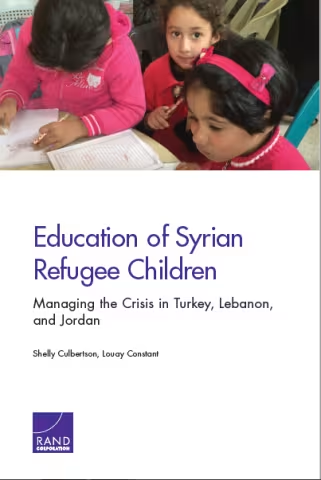
This scoping study is intended to contribute to the ongoing policy discussions among governments, donors, and United Nations agencies about the education of Syrian refugees in Lebanon, Turkey, and Jordan (the three countries with the largest populations of Syrian refugees),
This study aims to shed light on the industry that profits from the recruitment of women from South Asian countries into domestic work employment in the Middle East, with a particular focus on Bangladesh, Jordan and Lebanon.
This study sought to characterize the physical and emotional conditions, dietary habits, coping practices, and living conditions of this elderly population arriving in Lebano
Considerable analysis has been undertaken to date on the challenges and impacts on and of Syrian refugees in Lebanon – including by Oxfam – but the bulk of this analysis is seen through the lens of the wider Syria crisis and often fails to take into consideration Lebanon itsel
In Lebanon, the question of hosting and ensuring protection for Syrian refugees in light of the government stance against the erection of camps has created many deliberations concerning different proposed and implemented shelter options and solutions. UN-Habitat, in partnership with the American University of Beirut’s (AUB) Issam Fares Institute for Public Policy and International Affairs (IFI), initiated a research study in July 2014 to address solutions for hosting and ensuring protection for refugees specifically on the subject of erecting camps to address the Syrian crisis. The study...
The “Profiling vulnerability of Palestine refugees from Syria living in Lebanon” report is a multi-sectorial analysis of the vulnerability experienced by the Palestine Refugees from Syria [PRS] according to the following sectors: economic; education; food-security; health; protection; non-food items; shelter and water, sanitation and hygiene. It provides information on the living conditions of PRS to inform decision-making on programmatic activities. The survey is based on the VASyR [Vulnerability Assessment of Syrian Refugees in Lebanon] and adapted for UNRWA’s specific context. Data was...
In May 2015, the Lebanese authorities instructed UNHCR to temporarily suspend registration of Syrian refugees, including individuals already in the country and new arrivals.
This booklet comprises of the presentations and papers that were presented and discussed during the seminar that was held in Beirut in October 2015, titled “Regional Seminar on Child
Since 2011, Lebanon has seen a huge influx of refugees fleeing the violence in Syria and currently hosts the biggest number of Syrian refugees in the world.