تجاوز إلى المحتوى الرئيسي

موارد

Dossier
Displaying 1 - 20 of 27
National
Publishing Date
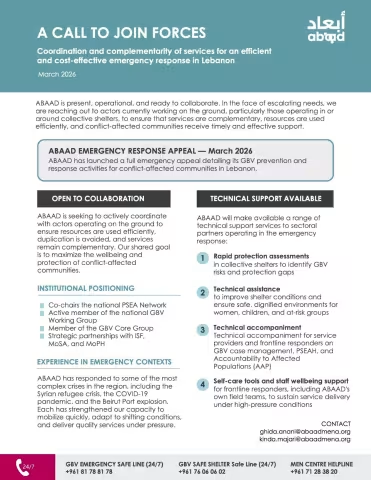
A Call to Join Forces: Coordination and complementarity of services for an efficient and cost-effective emergency response in Lebanon In the face of escalating needs in Lebanon due to the regional armed conflict, ABAAD is reaching out to actors currently working on the ground, particularly those operating in or around collective shelters, to ensure that services are complementary, resources are used efficiently, and conflict-affected communities receive timely and effective support.
National
Publishing Date
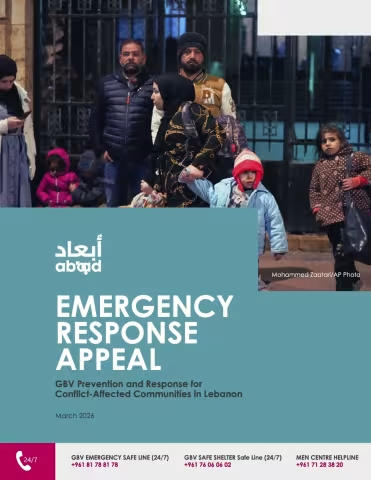
Lebanon is facing the direct consequences of a regional armed conflict that escalated sharply on February 28, 2026. As the conflict spread, strikes on Lebanon resumed and intensified, triggering mass displacement across the country. Civilian casualties are rising, social safety nets are breaking down, and communities are being uprooted in a country where nearly half the population was already living in poverty before this escalation began. ABAAD is launching this emergency appeal to mobilize the resources required to sustain and scale life-saving GBV prevention and response services, ensuring...
National
Publishing Date
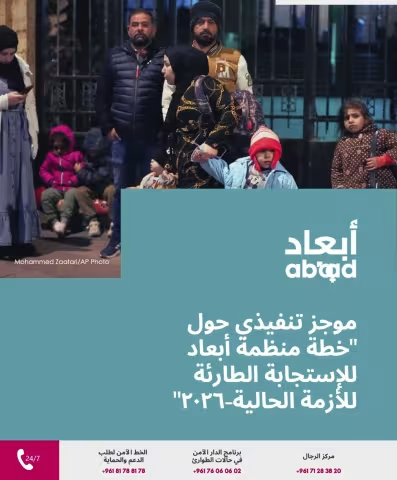
يواجه لبنان تصعيدًا خطيرًا في النزاع الإقليمي منذ 28 شباط 2026، ما أدى إلى تجدّد الضربات واتّساع موجات النزوح وارتفاع أعداد الضحايا، في ظل أوضاع اقتصادية ومعيشيّة هشّة. وفي ظل الاكتظاظ وتراجع الموارد، تتزايد مخاطر العنف القائم على قسمة الأدوار الاجتماعية، فيما تتقلص خدمات الحماية، ما يترك العديد من الناجيات والناجين من دون دعم كافٍ. لذلك، تُطلق أبعاد خطة استجابة طارئة لضمان استمرار وتوسيع خدمات الوقاية والاستجابة، بما يضمن وصول الأسر المتضررة، وخصوصًا النساء والفتيات والفئات الأكثر عرضة للمخاطر، إلى خدمات حماية ودعم آمنة وسريعة ومنقذة للحياة
International
Publishing Date
Have a read of our CubeX Company Profile to find out more about the services we provide and our past projects!
National
Publishing Date
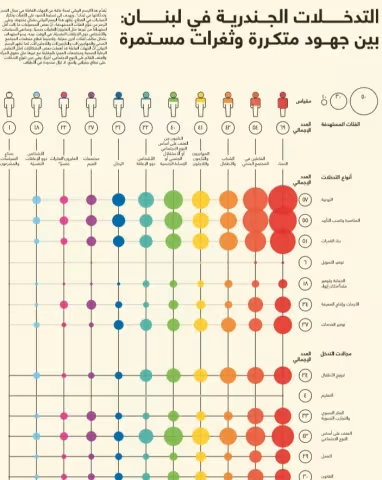
This infographic provides an overview of gender actors and interventions in Lebanon*, and aims to highlight gaps and duplications in the sector. .يُقدِّم هذا الرسم البياني لمحةً عامّة عن الجهات الفاعلة في مجال الجندر وتدخّلاتها في لبنان*. ويهدف إلى تسليط الضوء على الثغرات وتكرار المبادرات في القطاع
National
Publishing Date
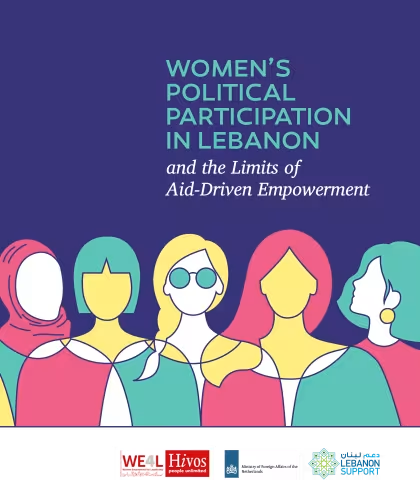
This report attempts to answer current gaps in the literature analysing WPE and WPP donor-funded initiatives in Lebanon, and asks the following question: what explains the current gap between donor-funded WPE and WPP initiatives, and the continued low rates of women’s political participation and overall low political empowerment in Lebanon?
National
Publishing Date
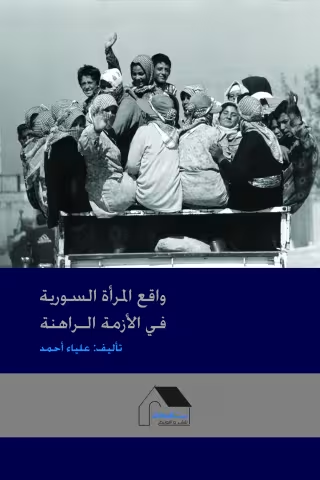
هل تغيّرت، أو تخلخلت، الصورة النمطية للمرأة في الواقع الراهن في سورية؟ هذا هو السؤال المؤسس لهذه الدراسة التي تسعى فيها الباحثة لرصد تحولات المكانة الاجتماعية للمرأة من خلال متابعتها لمدى المشاركة النسوية في الحياة العامة، في سورية. تركز الباحثة على فترة الأزمة الحالية متسائلة «هل يمكن أن يشكل انخراط المرأة السورية في الأزمة، موالاةً أو معارضة، معبراً إلى إنجاز بقية حقوقها... أم يزيد من معاناتها؟
National
Publishing Date

In the absence of a clear national plan for Integrated Waste Management (IWM), and due to various political and governmental issues, Lebanon has had to face a serious waste crisis in 2015.  The paper scrutinizes events leading up to the 17th of July 2015, and the impact of its aftermath on Lebanon’s environment, infrastructure, health and landscape. Parallels are drawn throughout the paper to a similar crisis faced by residents of Campania, Italy.


This paper thoroughly analyzes Lebanon’s “waste profile” and benchmarks it against a spectrum of countries to further understand global trends in...

National
Publishing Date

Research Report | April 2015
In this paper, we analyze the susceptibility of agricultural outputs to future climate change in Lebanon, and the extent to which it propagates to the economic system as a whole. We use a methodological framework in which physical and economic models are integrated for assessing the higher-order economic impacts of projected climate changes. By using this integrated modeling approach, we are able to quantify the broader economic impacts in the country by considering not only the temporal dimension but also the regional disaggregation of the results. Our estimates...

National
Publishing Date

Working Paper | March 2015
Sustainable Transportation and Mega Sporting Events in Arab Countries: the Case of Qatar by Robert Wittkuhn and Danyel Reiche
​Qatar has successfully developed into a hub for mega sporting events; the most prestigious of them will be the FIFA World Cup in 2022. Qatar promotes it as the “first completely carbon-neutral” and “most compact” World Cup. Such statements emphasize a very small impact of transport on the event’s carbon footprint; but they also raise questions about the understanding and applicability of carbon neutrality. As motive for hosting mega events...

National
Publishing Date

Working Paper | February 2015
Commuters’ Behavior towards Upgraded Bus Services in Greater Beirut: Role of Itinerary and Implications for Greenhouse Gas Emissions, Social Welfare and Transport Policy by Ali Chalak, Hani Al-Naghi, Alexandra Irani, and Maya Abou-Zeid
Climate change is one of the most critical environmental challenges facing the world today. The transportation sector alone contributes to 22% of carbon emissions, of which 80% are contributed by road transportation. In this paper, we investigate the potential greenhouse gas (GHG) emissions reduction and social welfare gains...

National
Publishing Date

Working Paper | February 2015
Economic Impacts of Adopting a Sustainable Transport System in Beirut by Mazen Omran, Johnny Ojeil, and Youssef Fawaz
​The work carried out in this paper demonstrates the economic benefit of a sustainable transport system. It compared a scenario with and without such system, and calculated loss time as a result of being held up in congestion during key peak hours mainly due to relying entirely on the private car. The work demonstrates that in addition to reducing congestion levels a sustainable transport system will generate benefits related to travel time...

National
Publishing Date

Working Paper | February 2015
Getting to Campus: Sustainable Public Transportation and Relocating the American University in Cairo by Richard Tutwiler, Hagar Eldidi, Yumna Kassim, and Andrew Petrovich
​Cairo is one of the most congested cities in the world, and public transportation is one of its greatest challenges. Government strategies to alleviate congestion have stressed horizontal expansion into the surrounding desert areas and the construction of more and ever larger motorways. This paper uses the experience of the American University in Cairo, which physically relocated in 2008 from...

National
Publishing Date

Working Paper | February 2015
Harnessing Motorists' Potential Demand for Hybrid-Electric Vehicles in Lebanon: Policy Options, CO2 Emissions Reduction and Welfare Gains by Alexandra Irani and Ali Chalak
Public concern over deteriorating air quality and the associated local and global impacts has grown significantly in the past decade. Air quality degradation is linked first and foremost to the transportation sector in the Arab region with about 90% of total emissions of carbon monoxide resulting from transportation activities. In Lebanon’s capital, Beirut, current levels of ozone and smog...

National
Publishing Date

Working Paper | February 2015
Sustainable Transportation in the Arab World: International Benchmarking on Sustainable Transport Policies and their Impacts by Issam Kaysi and Farid Chaaban
​The world’s transport sector still suffers from unsustainable trends that lead to increased levels of greenhouse gas (GHG) emissions. There have been efforts, in the Arab world, as well as the rest of the world, to tackle the issue. Work done in the US and Europe exceeds that of the Arab world, and their efforts have been successful, and have thus succeeded in reducing GHG emissions. In the Arab world, most...

National
Publishing Date

Policy Brief | August 2014
Commuters’ Behavior towards Upgraded Bus Services in Greater Beirut: Role of Itinerary and Implications for Greenhouse Gas Emissions, Social Welfare and Transport Policy by Ali Chalak, Hani Al-Naghi,Alexandra Irani, and Maya Abou-Zeid
​Potential greenhouse gas (GHG) emissions reduction and social welfare gains can be achieved from upgrading the bus service in the Greater Beirut Area through a bundle of realistic bus service improvements in the short term. Such improvements will need to be comprehensive in scope and include both improvements in bus level of service...

National
Publishing Date

Policy Brief | August 2014
Economic Impacts of Adopting a Sustainable Transport System in Beirut by Mazen Omran, Johnny Ojeil, and Youssef Fawaz
​The current congestion levels in the Beirut Central District (BCD) are not acceptable. These levels are expected to get worse with further development proposed in the BCD and New Waterfront District. Beirut will not be able to economically compete with other cities as it is lacking a comprehensive multi-modal transport system. One way to improve this situation is by introducing a more sustainable transportation system. In addition to reducing...

National
Publishing Date

Policy Brief | August 2014
Jeanne d’Arc Street; A Model Pedestrian-Friendly Street for all of Beirut by Cynthia Myntti and
Mounir Mabsout
Walking, it has been said, is the ultimate form of sustainable public transportation. Beirut, however, is one of the most pedestrian unfriendly cities in the world. Many streets do not even have sidewalks, and where they exist, they are often broken, or obstructed, or hazardous when wet. In 2010, two units at AUB, the Neighborhood Initiative and the Center for Civic Engagement and Community Service, joined forces to design Beirut’s first barrier-free walkway...