تجاوز إلى المحتوى الرئيسي

موارد

Displaying 1 - 20 of 22
National
Publishing Date
The National Report on Freedom of Religion & Belief was launched by the National Working Group on FoRB in Lebanon, which Peace of Art is part of. This report is the proud work of the National Working Group on Freedom of Religion and Belief (FoRB) in Lebanon.
National
Publishing Date
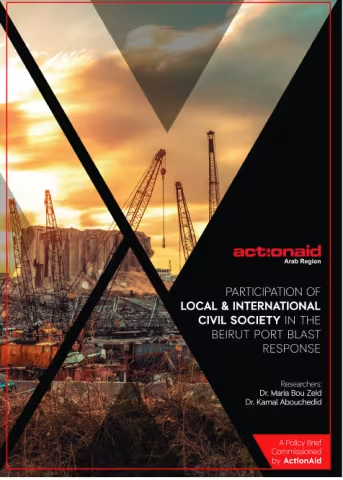
CONCLUSION AND RECOMMENDATIONS This policy brief examined the complex trajectories and mechanisms of the intervention deployed in the aftermath of the explosion raising questions of fairness and equality to the forefront of the humanitarian regime in Lebanon. Based on results yielded from fieldwork, we recommend the following: Launching a consortium of CSOs, fourth sector civil society, and government representatives in order to set out a coordination scheme among humanitarian players for future crises. CSOs, fourth sector organizations in collaboration with the Ministry of Social Affairs are...
National
Publishing Date
في إطار النظام السياسي اللبناني الذي يقوم على المحاصصة الطائفية والعائلية السياسية والزبائنية المتمثلة في نظام الزعامة، والذي يعزز من الأبوية القائمة على القرابية، تسعى هذه الدراسة إلى فهم وتحليل مشاركة النساء في مواقع قيادية وقاعدية في أربعة كيانات في لبنان تتضمن حزب سياسي، نقابة، منظمة مجتمع مدني وحركة اجتماعية. تفحص الدراسة الهياكل والبنى المؤسسية لتلك الكيانات ومواقفها من قضايا النساء، والديناميات التي تعتمدها للتفاعل مع محيطها، وذلك من خلال تحليل وثائقها الرسمية، خطابها العام، ممارساتها، وأخيراً تجارب النساء المنتميات لها وما عايشنه من تحديات ضمن هذا الإطار. بالإضافة إلى هذه التقرير،...
National
Publishing Date
Lebanon may witness a remarkable rise in the number of women serving in Parliament come May 2018 due to initiatives from women’s groups, “civil society” activists, and the substantial number of female candidates – 113 at the start of the election period. However, as this briefing paper shows, Lebanese women continue to face numerous challenges in entering government. The new electoral law passed in June 2017 does not provide women with equal opportunity to be elected, and it is yet to be seen whether it will increase female representation in Parliament. Nevertheless, the historic number of...
National
Publishing Date

Working Paper | February 2014
The Dilemma of Human Rights In Lebanese Electoral Laws by Elie Al-Hindy
This study concludes with a number of recommendations with respect to the issues that need to be introduced to the debate and that can strengthen advocacy efforts by the different stakeholders involved. Reflecting on all of the above, and in light of the current political realities in Lebanon, including present sectarian demographics and political structure, the study concludes that the standards imposed on the new electoral law is impossible to meet, as no law, which this study has reviewed...

National
Publishing Date
While women’s issues and rights have been at the forefront of public and civil society debate, academic, and activist publications, women’s inequalities and the discrimination women face in Lebanon have been notably undermined, whether as citizens, refugees, or migrants. However, if the publicising of the “issue of women in Lebanon” has prompted the production of more “gender-related” information and knowledge, it has oftentimes adopted the rhetoric of denunciation and victimisation. Hence, there is a scarcity of in-depth and sectoral studies on the logics of exclusion and discrimination in...
National
Publishing Date

Working Paper | April 2015
Social Justice and the Arab Uprisings by Amaney A. Jamal and Michael Robbins
As the Arab Spring proceeded, massive changes swept across the region. Long-standing stability gave rise to ongoing chaos in some countries, most notably Syria and Libya, but also to a significant extent in Tunisia and Egypt. Meanwhile, Islamist parties won free and fair elections in Egypt and Tunisia and were allowed to come to power. These and other changes greatly altered the political landscape across the region. The importance of these changes cannot be overstated. Yet, amidst talk of a...

National
Publishing Date

Working Paper | October 2014
Operation Protective Edge & Legal Remedies by Noura Erakat, Bianca Isaias, and Salmah Rizvi
This briefing paper provides a non-exhaustive survey of the legal fora in which Palestinians have sought, or can seek, legal redress. These include international courts, in particular the International Court of Justice (ICJ), the International Criminal Court (ICC), and special tribunals; national courts under universal jurisdiction as well as the Alien Tort Statute (ATS) in US federal courts; and human rights bodies and mechanisms like the Human Rights Council, and human...

National
Publishing Date

Research Report | May 2014
Relative Deprivation and Politics in the Arab Uprisings by Asya el-Meehy
This study seeks to assess the relative weights of economic and political grievances across the uprisings in Bahrain, Egypt, and Tunisia. Highlighting the unique shared role of middle class youth, it contends that these constituencies have suffered from relative deprivation, despite deliberate efforts by authoritarian regimes to shield them through new targeted social protection initiatives. Nonetheless, economic grievances were not always the primary driving dynamic of protests and the...

National
Publishing Date
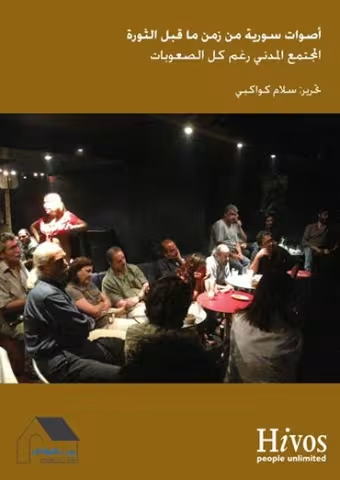
أصوات سورية من زمن ما قبل الثورة – المجتمع المدني رغم كل الصعوبات يتضمن هذا الكتاب، مجموعة من الدراسات، وهي مقتطفات أدبية مدنيّة، بأقلام بعض ناشطي المجتمع المدني، يتحدثون فيها عن تجاربهم وآفاق عملهم المدني، ومعضلاته وإنجازاته. ولا شكّ في أنّ تجارب السوريين الماضية في بناء مجتمع مدني قائمٍ على مواطنيّة فاعلة وتشاركيّة، والإنجازات التي تحققت رغم كل العقبات، قبل ولادة الثورة، سوف تُساعد على تحديد آفاق الجهود المستقبليّة الرامية إلى إعادة الإعمار والمصالحة والتنمية.
National
Publishing Date

Working Paper | September 2013
A Changing Regional Order: The Arab Uprisings, the West and the BRICS by Christina Lassen
The Arab uprisings have thrown the regional order of the Middle East into disarray and are challenging traditional actors and alliances. Notably, regional actors, both governments and the region’s people, are driving developments to a much larger extent than before. This paper will explore how the European Union (EU) 1 and the United States, in the following referred to as “the West”, reacted to the Arab uprisings and whether the West has managed to play an active role and...

National
Publishing Date

تقرير بحثي | آب 2013
حين كان الزمن الفلسطيني -. اللبناني جميلاً
 مقاربة منهجية تاريخية تأصيلية للعلاقات الفلسطينية– اللبنانية والحقوق المشروعة لفلسطينيي لبنان من إعداد حسين ابو النمل

National
Publishing Date

Research Report | June 2013
Arab States and UN Human Rights Mechanisms by Fateh Azzam
The revolts that have rocked the Arab region in 2011 have focused on demands for dignity, social and economic justice, and political freedoms. As the protests unfolded and spread from one country to another, their chants gained remarkable consistency in their rejection of unaccountable leadership and exclusionary economic and development policies that had failed for decades. The revolts were a wake-up call to all those concerned with politics and development in the region, that development can no longer be...

National
Publishing Date

Working Paper | March 2013
Lebanon: The Legacy of Sectarian Consociationalism and the Transition to a Fully-Fledged Democracy by Samir Makdisi and Youssef El-Khalil
Since independence in 1943 Lebanon’s political system has been based on a power sharing arrangement among its religious communities. Referred to as a consociational democracy, it was embedded in an unwritten national pact by the leaders of the independence movement which specified the division of parliamentary seats among the Christian and Muslim communities on the basis of a six to five ratio in favor of the Christian community.3...

National
Publishing Date

Background Paper | March 2013
“Nabiha 5”: A Kuwaiti Youth Movement for Political Reform by F. Gregory Gause III
Among Arab states Kuwait is a leader in terms of political freedoms and the importance of its civil society organizations. Thus it should not be surprising that one of the few successful Arab youth movements advocating political reform should have arisen in the country. The success of the “Nabiha 5” movement (Kuwaiti colloquial Arabic for “we want it to be five”) in bringing about the change in the Kuwaiti electoral system from a 25 district to a 5 district configuration certainly...

National
Publishing Date

The Foundation & UNHABITAT analyzed the row results of  the Municipal Observatory (MO) which is a tool that aims at evaluating the performance of the Lebanese municipalities through four different aspects:

  1. Administration & Management;
  2. Financial Resources;
  3. Governance; and
  4. Municipal Development & Services

The questionnaire contains a total of 84 questions distributed across 6 sections. Those questionnaires were filled by the “Municipal Guides”, a group of municipal employees established within the context of the UN-Habitat Decentralization Project implemented in partnership with the...

National
Publishing Date

Working Paper | December 2012
Production of Norms and Securitization in Development Policies: From Human Security to Security Sector Reform by Penelope Larzilliere 
Several regional products have been very successful as region-based products, such as Saudi Dates, Jordanian Thyme, Syrian Barazi, Egyptian Foul Mdamas, and Lebanese Chick Pea paste (Homos Tahini). These trends of regionbased, Geographic indicator (GI) and governmental labeled products are considered to be an added value to agroindustrial sector, and are highly efficient tactics to increase small and medium-sized enterprises (SME’s...