تجاوز إلى المحتوى الرئيسي

موارد

Displaying 1 - 9 of 9
National
Publishing Date

Working Paper | April 2015
Social Justice and the Arab Uprisings by Amaney A. Jamal and Michael Robbins
As the Arab Spring proceeded, massive changes swept across the region. Long-standing stability gave rise to ongoing chaos in some countries, most notably Syria and Libya, but also to a significant extent in Tunisia and Egypt. Meanwhile, Islamist parties won free and fair elections in Egypt and Tunisia and were allowed to come to power. These and other changes greatly altered the political landscape across the region. The importance of these changes cannot be overstated. Yet, amidst talk of a...

National
Publishing Date

Research Report | May 2014
Relative Deprivation and Politics in the Arab Uprisings by Asya el-Meehy
This study seeks to assess the relative weights of economic and political grievances across the uprisings in Bahrain, Egypt, and Tunisia. Highlighting the unique shared role of middle class youth, it contends that these constituencies have suffered from relative deprivation, despite deliberate efforts by authoritarian regimes to shield them through new targeted social protection initiatives. Nonetheless, economic grievances were not always the primary driving dynamic of protests and the...

National
Publishing Date
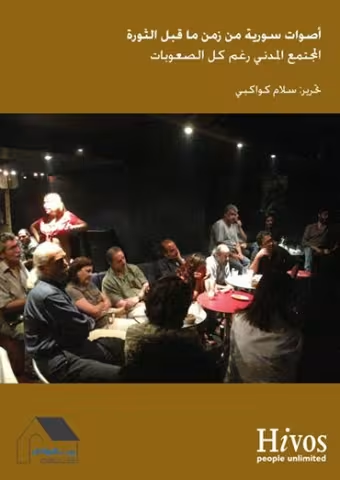
أصوات سورية من زمن ما قبل الثورة – المجتمع المدني رغم كل الصعوبات يتضمن هذا الكتاب، مجموعة من الدراسات، وهي مقتطفات أدبية مدنيّة، بأقلام بعض ناشطي المجتمع المدني، يتحدثون فيها عن تجاربهم وآفاق عملهم المدني، ومعضلاته وإنجازاته. ولا شكّ في أنّ تجارب السوريين الماضية في بناء مجتمع مدني قائمٍ على مواطنيّة فاعلة وتشاركيّة، والإنجازات التي تحققت رغم كل العقبات، قبل ولادة الثورة، سوف تُساعد على تحديد آفاق الجهود المستقبليّة الرامية إلى إعادة الإعمار والمصالحة والتنمية.
National
Publishing Date

Working Paper | September 2013
A Changing Regional Order: The Arab Uprisings, the West and the BRICS by Christina Lassen
The Arab uprisings have thrown the regional order of the Middle East into disarray and are challenging traditional actors and alliances. Notably, regional actors, both governments and the region’s people, are driving developments to a much larger extent than before. This paper will explore how the European Union (EU) 1 and the United States, in the following referred to as “the West”, reacted to the Arab uprisings and whether the West has managed to play an active role and...

National
Publishing Date

Working Paper | March 2013
Lebanon: The Legacy of Sectarian Consociationalism and the Transition to a Fully-Fledged Democracy by Samir Makdisi and Youssef El-Khalil
Since independence in 1943 Lebanon’s political system has been based on a power sharing arrangement among its religious communities. Referred to as a consociational democracy, it was embedded in an unwritten national pact by the leaders of the independence movement which specified the division of parliamentary seats among the Christian and Muslim communities on the basis of a six to five ratio in favor of the Christian community.3...

National
Publishing Date

Background Paper | March 2013
“Nabiha 5”: A Kuwaiti Youth Movement for Political Reform by F. Gregory Gause III
Among Arab states Kuwait is a leader in terms of political freedoms and the importance of its civil society organizations. Thus it should not be surprising that one of the few successful Arab youth movements advocating political reform should have arisen in the country. The success of the “Nabiha 5” movement (Kuwaiti colloquial Arabic for “we want it to be five”) in bringing about the change in the Kuwaiti electoral system from a 25 district to a 5 district configuration certainly...

National
Publishing Date

The Foundation & UNHABITAT analyzed the row results of  the Municipal Observatory (MO) which is a tool that aims at evaluating the performance of the Lebanese municipalities through four different aspects:

  1. Administration & Management;
  2. Financial Resources;
  3. Governance; and
  4. Municipal Development & Services

The questionnaire contains a total of 84 questions distributed across 6 sections. Those questionnaires were filled by the “Municipal Guides”, a group of municipal employees established within the context of the UN-Habitat Decentralization Project implemented in partnership with the...

National
Publishing Date

Study | December 2011
Restoring Dignity: The Raison D’etre of the Youth Movements in the Arab Citizen Revolt? by Rima Afifi, Ziyad Mahfoud, Rami Khouri, Sara Bittar, and Ahmad Younis
Dignity (in Arabic: Al Karama) is a slogan that has been chanted regularly during the Arab Citizen Revolt1 and a concept that continues to be a central theme as events unfold. In this paper, we explore the concept of dignity, identify a conceptual framework for thinking about dignity, and connect dignity to youth and the current situation. We then use data from the Gallup World Poll of Arab youth to assess the fit...