This study explores the role of community-based organizations in preparing for and responding to crisis in Lebanon. While there has been considerable work conducted on preparedness, responsiveness and recovery to crisis in Lebanon, there has been little work so far that focuses on measuring and assessing the capacities, expertise, strengths and weaknesses of local CBOS in preparing and responding to crises. Managers and decisions makers from nine different organizations were interviewed on the overall expertise gained in past conflicts since the civil war as well as their current level of...
This report presents qualitative data collected by ICTJ on how individuals in Greater Beirut talk about the Lebanon wars and the need for truth, justice, and an end to violence in their country.
This report compiles information on hundreds of incidents of serious human rights violations that occurred in Lebanon from 1975 to 2008, including mass killings, enforced disappearances, assassinations, forced displacement, and the shelling of civilian areas.
The “Review of the Public Procurement Legal Framework in Lebanon” introduces the Sustainable Public Procurement (SPP) in Lebanon and elaborates on the legal of the country’s procurement and sustainability laws that may offer a legal possibility for the adoption of SPP principl
This report is a summary of the presentations given during the regional workshop on free trade agreements in the Arab region. The meeting was part of the two-year project on the “socio-economic impact of trade liberalization policies on the Arab region”.
In late 2011, WILPF began to develop a programme to enhance the collective capacities of women’s rights organisations to respond to the unprecedented political events in the Middle East and North Africa (MENA).
The fourth National Human Development Report, “Toward a Citizen’s State”, addresses citizenship in Lebanon through three principle perspectives: citizenship and sectarian state, socio-economic citizenship and citizenship and culture and education.
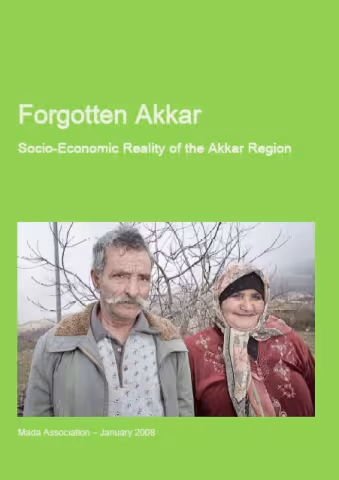
This study focuses on presenting the socio-economic reality of Akkar. It begins with a situational analysis, including an assessment measuring the impact of the July 2006 and Nahr al-Bared wars on the livelihoods of the people of Akkar.
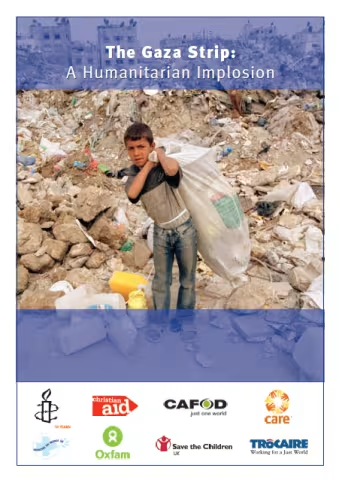
The situation for 1.5 million Palestinians in the Gaza Strip is worse now than it has ever been since the start of the Israeli military occupation in 1967.
Lebanon in Figures 2008 gathers number of social and economic indicators: About Lebanon, Population, Education, Employment, Tourism, Consumer Price Index, National Accounts...
The Israeli July 2006 war exposed the Lebanese population to disastrous conditions. It has profoundly affected residents’ livelihoods through bringing down access to services, infrastructure and natural resources. Responding to these emerging problems poses further challenges for the Lebanese government and society. In this respect, different emergency measures have been undertaken to address the arising needs, starting with assessing physical, economic and social damages.
As a contribution to identifying short and medium term intervention needs, the World Bank initiated undertaking a Post...
تهدف "دراسة الأحوال المعيشية للأسر للعام 2007 " إلى توفير قاعدة غنية من البيانات الإحصائية في المواضيع أدناه، وذلك بهدف التعرّف على الأوضاع المعيشية للأسر في العام 2007 ومدى تأثير عدوان تموز 2006عليها: • الخصائص الاجتماعية للأسر ولأفرادها • الخصائص الديموغرافية والتربوية لأفرا
Why would a reference book addressing non-governmental organizations (NGOs) of different sizes, interests, and functions begin with a discussion on development?
A simple answer to this very relevant question is that development is the ultimate aim and objective that underlies the work of each and every NGO, association, trade union, and civil society institution. In other words, development is a common ground for all these organizations, as well as the long-term goal that enables them to broaden their range of activities, to cooperate with others, and to expand their scope from the local to...
The National Survey of Household Living Conditions (The Multipurpose survey) provides a statistical database vital for the setting forth of national policies in various sectors.