This study, supported by UNFPA, assessed the reproductive health and gender-based violence among displaced Syrian women in Lebanon between July and September 2012.
The human rights situation in the Syrian Arab Republic has deteriorated significantly since November 2011, causing further suffering to the Syrian people. Widespread violence and increasingly aggravated socio-economic conditions have left many communities in a perilous state.
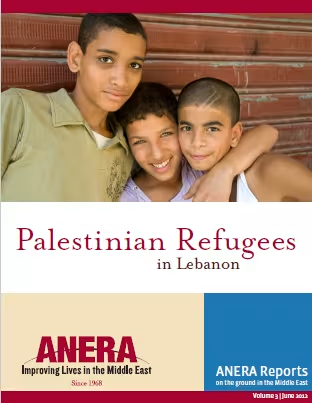
The list of challenges Palestinian refugee families living in Lebanon face is long and overwhelming. They live in overcrowded camps and have to deal with discrimination, isolation and social exclusion.
Oxfam GB commissioned the pilot study discussed in this report in order to understand further the context that shapes men’s gender roles and affects their behaviours, practices, and attitudes towards gender equality, with an explicit focus on VAW.
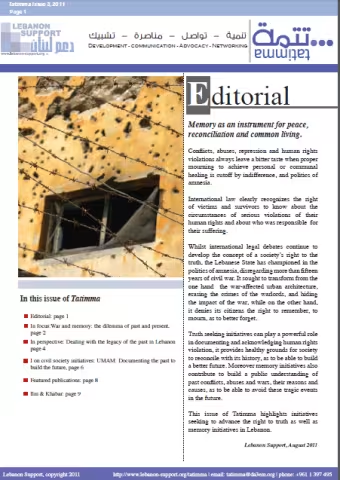
Conflicts, abuses, repression, and human rights violations always leave a bitter taste when proper mourning to achieve personal or communal healing is cutoff by indifference, and politics of amnesia.
Accountability has many meanings. Traditionally, it was understood as the was in which those who authorised others to act on their behalf made sure that authority was being used as agreed.
This report was presented at the International Labour Conference, 99th Session, 2010. It was intended to facilitate the discussion of domestic work at the Conference and consists of ten chapters, each of which covers issues pertaining to the topic of domestic work.
The Manual on the Internal Management of the Non Governmental Organizations (NGOs) in Lebanon aims at providing a practical tool to develop and build the capacities of the NGOs in Lebanon.
The report assesses the progress made in the achievement of the Millennium Development Goals (MDGs) based on new national data which was formulated after the first MDGR that was published in 2003.
This paper examines the impact of a rise in the Value Added Tax (VAT) on poverty and inequality in Lebanon. It develops an empirical model based on consumer demand theory and uses only household survey data on expenditures and spatial price indexes.
The Israeli July 2006 war exposed the Lebanese population to disastrous conditions. It has profoundly affected residents’ livelihoods through bringing down access to services, infrastructure and natural resources. Responding to these emerging problems poses further challenges for the Lebanese government and society. In this respect, different emergency measures have been undertaken to address the arising needs, starting with assessing physical, economic and social damages.
As a contribution to identifying short and medium term intervention needs, the World Bank initiated undertaking a Post...
This national survey provides a vital statistical database on the demographic and the educational status in Lebanon; the residential fact and the economic activity of the individuals; the health insurance, the migration, the family’s income and the aid received during the war
Pcode is an abbreviated term for 'Place Code'. P-codes are similar to zip codes and postal codes and are part of a data management system that provides unique reference codes to over a thousand locations in the Darfur region.
Most theorists maintain that social exclusion is a process, not only the condition reflecting the outcome of that process. Yet few, if any, people ever reach the ultimate end of the imagined trajectory.
As a consequence of the armed struggle between the Islamist group Fatah al-Islam and the Lebanese Army in and around the Nahr El-Bared Palestinian refugee camp north of Tripoli the past 3 weeks, the vast majority of its population has fled their homes and is now dispersed to
The Universal Declaration of Human Rights, proclaimed by the United Nations General Assembly on 10 December 1948, grants to everyone the right to seek, receive and impart information and ideas through any media and regardless of borders (Article 19).
Why would a reference book addressing non-governmental organizations (NGOs) of different sizes, interests, and functions begin with a discussion on development?
A simple answer to this very relevant question is that development is the ultimate aim and objective that underlies the work of each and every NGO, association, trade union, and civil society institution. In other words, development is a common ground for all these organizations, as well as the long-term goal that enables them to broaden their range of activities, to cooperate with others, and to expand their scope from the local to...