This project aims to (1) bring statistical transparency to youth’s opinions, attitudes, feelings, and perceptions about social, cultural, political, and familial freedom of speech barriers within our society, and find what activities facilitate youth’s freedom of speech; (2) create discussion and widespread accountability by engaging the online and offline community, institutional stakeholders, and youth though an advocacy Call to Action based on our research findings, and (3) provide evidence that creative civic spaces are an integral part of our community and change negative attitudes...
We Rise through Art is a handbook produced under the project with the same title in response to Beirut's explosion, highlighting activities and tools that can be adopted by trainers, coaches and facilitators with pre-adolescents and children under arts, sports and recreation.
We Play for Peace is a handbook produced under the project with the same title highlighting activities and tools that can be adopted by trainers, coaches and facilitators with pre-adolescents and children under arts, sports and recreation.
“More than 60% of Syrian refugees households comprise a person with disabilities and 1/5 Syrian refugees has a disability in Lebanon and Jordan”, shows a large study conducted by Humanity & Inclusion (HI) and iMMAP.
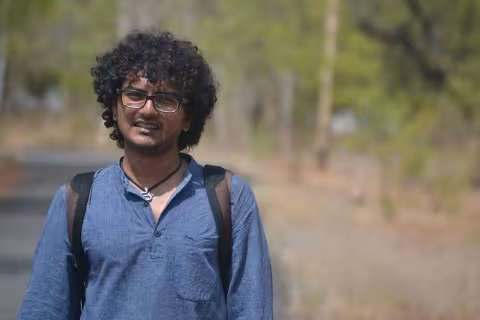
MOSAIC had the pleasure and privilege to speak with activist Gopi Shankar Madurai moments after the Supreme Court in India decriminalized Section 377 of the Penal Code.
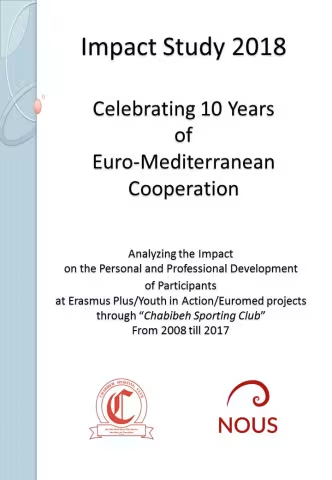
Analyzing the Impact on the Personal and Professional Development
of Young Participants at Erasmus Plus/Youth in Action/Euromed projects through “Chabibeh Sporting Club” From 2008 till 2017
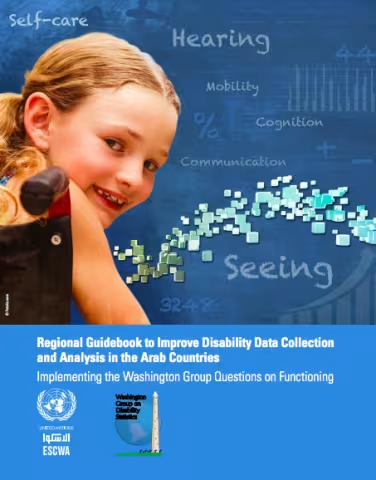
This regional Guidebook explores the different approaches in design, implementation and analysis of disability data collection in the Arab countries, in view of improving the standardization and implementation of the Washington Group Short Set on Functioning and related indica
This report presents findings from a survey conducted from 3-11 July, 2017 with three distinct refugee groups in Lebanon: Syrian refugees; Palestine refugees from Syria; and Palestine refugees from Lebanon.
The Gender Dictionary, published by Lebanon Support, is a practical bilingual tool, based on multidisciplinary research and consultations with local gender actors (academics, experts, activists, practitioners).
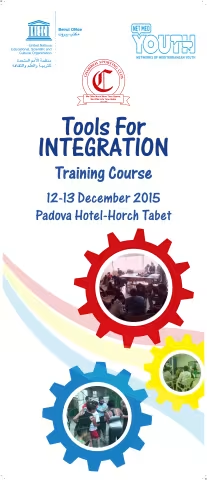
In December 2015, Chabibeh Sporting Club organized the
TOOLS FOR INTEGRATION project, funded by UNESCO, which was divided into 2 phases:
A 2 days training course (12-13 Dec 2015) that gathered 24 youth workers and leaders from different Leba-nese regions. Over these 2 days the topics of social cohesion and integration were discussed and participants reflected on traditional games they played when they were kids in order to develop together new tools and games under the themes of integration and cohesion
A 1 day camp (21 December 2015) for Lebanese, Syrian and Palestinian youth during which...
GVC and YAB have implemented a pilot initiative in 6 public schools in order to provide directors, teachers, special educators and social workers with technical tools and expertise to encourage the inclusion of children with special needs. Almost 60 children have been included in regular classes all along the implementation (2012-2015). At the same time, the project involved parents and communities where the 6 schools are located to raise culture of diversity and respect and to enhance participation of children with special needs at all levels of social and cultural life.
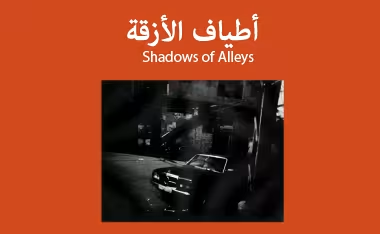
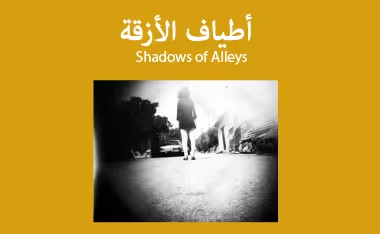
About the bookletThis booklet is one of a serie of 3 booklets enclosing a collection of 180 photos, captured by young Palestinian girls and boys in Burj Chemali Camp, South Lebanon. Through using the ‘Pinhole Camera’ technique, these girls and boys captured some challenging sides of the lives of Palestinian youth through aspects of discrimination, violence and gender-based violence affecting their communities. Throughout these photos, the 3 booklets tell 3 personal stories narrated by the participants that implicate deep personal sufferings caused by community-imposed norms, traditions and...
About the bookletThis booklet is one of a serie of 3 booklets enclosing a collection of 180 photos, captured by young Palestinian girls and boys in Burj Chemali Camp, South Lebanon. Through using the ‘Pinhole Camera’ technique, these girls and boys captured some challenging sides of the lives of Palestinian youth through aspects of discrimination, violence and gender-based violence affecting their communities. Throughout these photos, the 3 booklets tell 3 personal stories narrated by the participants that implicate deep personal sufferings caused by community-imposed norms, traditions and...
About the Zero Project: For a World without Barriers
The Zero Project was initiated by the Essl Foundation in 2010. It has been run in partnership with the World Future Council (WFC) since 2011 and the European Foundation Centre (EFC) since 2013. The mission of the Zero Project is to work for a world without barriers, according to the principles and Articles of the UN CRPD.
This "Thirty Questions Guide" is the first guide that addresses the various stages of work and employment based on the principles of the CRPD and its relevant detailed provisions.