مذكرات للباحثين و صناع القرار#2 | كانون الثاني 2009
بإمكان القطاع العام أن يخفف من العوامل التي تسبب هجرة الشبابجاد شعبان
يفضل الشباب، ذكوراً وإناثاً، مغادرة لبنان بشكل مؤقت أو نهائي للعمل خارجاً ّ ، مما يقلص من الثروة البشرية والمجتمعية للبلد. وبما أن العوامل الخارجية التي تجذب الشباب للهجرة لا يمكن تغييرها، فإن الحمل يبقى على ّ كاهل المؤسسات الرسمية لتحد من العوامل الداخلية التي تدفع بالشباب للهجرة.
ويضيق الهرم السكاني في لبنان عند فئة الشباب من عمر 20-35، بحسب الباحث والخبير الاقتصادي جاد شعبان، المهتم أيضا بقضايا الشباب فيالعالم العربي.
كما أن معظم من يهاجرون من الشباب إلى أميركا...
This paper was produced by ANND and Christian Aid and contains five main sections: “Executive Summary: a crisis of multiple dimensions; the threat of explosive vulnerabilities and increasing insecurities”, “Vulnerability to poverty: the key challenges faced by the Arab region”
Following the Nahr EL Bared War, LPDC launched in 2008 a workshop mapping the recovery and development initiatives in the camp's area. They followed up in 2009 with another workshop reviewing the development projects that took place in the NBC area.
The fourth National Human Development Report, “Toward a Citizen’s State”, addresses citizenship in Lebanon through three principle perspectives: citizenship and sectarian state, socio-economic citizenship and citizenship and culture and education.
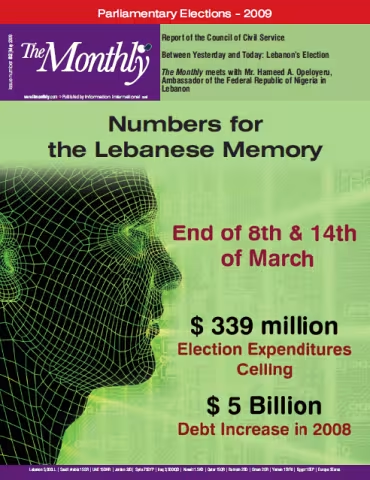
Parliamentary elections of 2009 and the year 2008 in review. The evenings of tuesday and Wednesday, April 7/8 marked the last day to register as a candidate for the Lebanese Parliamentary Elections scheduled on Sunday June 7, 2009.
This paper examines the impact of a rise in the Value Added Tax (VAT) on poverty and inequality in Lebanon. It develops an empirical model based on consumer demand theory and uses only household survey data on expenditures and spatial price indexes.
Research and Policy Memo #2 | January 2009
Public Sector Can Reduce Push Factors that Drive Youth Emigration Jad Chaaban
Young men and women prefer to leave Lebanon either temporarily or permanently to work abroad, leading to a decline in the country’s human capital and welfare. While the factors that attract youth abroad cannot be altered, the onus rests on public institutions in Lebanon to reduce the internal “push” factors that drive youth away.
“The Lebanese population’s age pyramid shows a shrinking trend in the 20-35 age categories,” said Jad Chaaban, a leading economist and researcher...
The aim of the “Socio-Economic Assessment in Nahr el-Bared surrounding areas” report is to provide an assessment of the pre and post conflict conditions of households located in the vicinity of Nahr el Bared camp for a variety of livelihood aspects including: housing, health,
This brochure highlights UNDP’s contribution in the Early Recovery process of the Palestinian and Lebanese populations who were affected by the Nahr El Bared crisis.
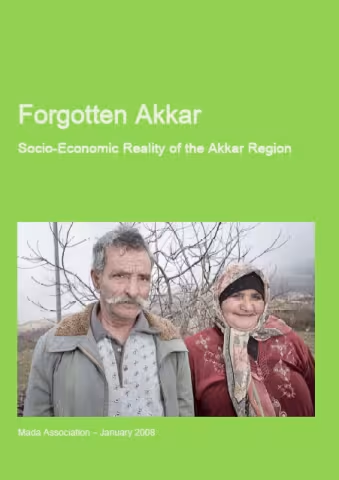
This study focuses on presenting the socio-economic reality of Akkar. It begins with a situational analysis, including an assessment measuring the impact of the July 2006 and Nahr al-Bared wars on the livelihoods of the people of Akkar.
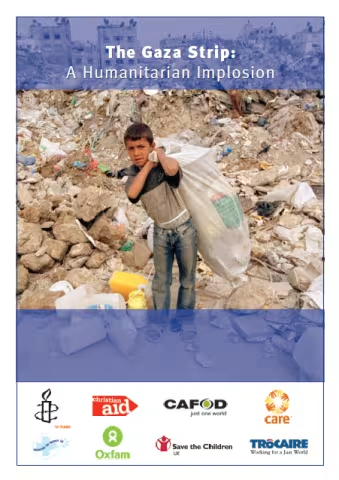
The situation for 1.5 million Palestinians in the Gaza Strip is worse now than it has ever been since the start of the Israeli military occupation in 1967.
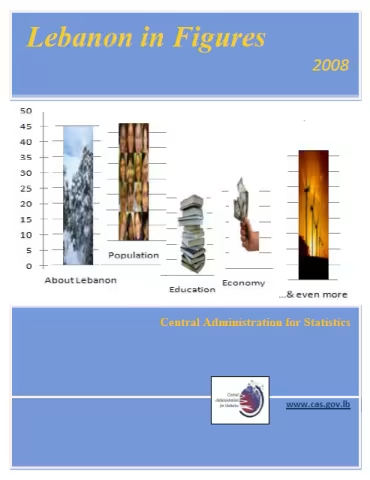
Lebanon in Figures 2008 gathers number of social and economic indicators: About Lebanon, Population, Education, Employment, Tourism, Consumer Price Index, National Accounts...
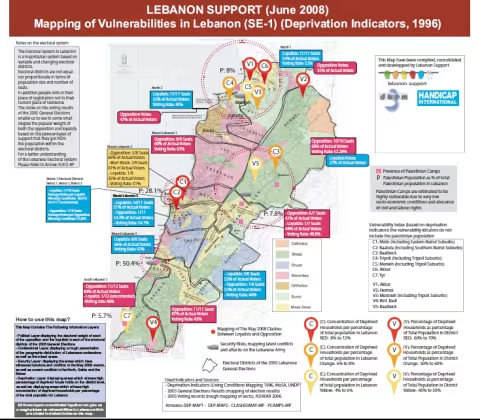
This Map Contains The Following Information Layers: - Political Layer displaying the electoral weight of each of the opposition and the loyalists in each of the electoral districts of the 2005 General Elections - Confessional Layer, displaying a rough presentation of the geogr
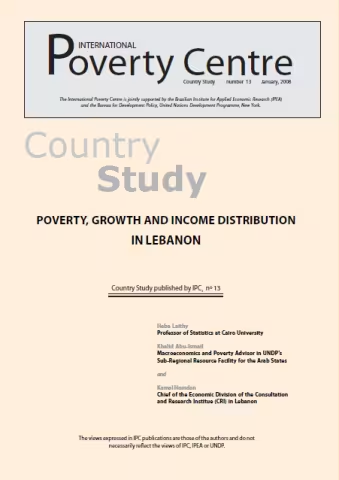
This Country Study is based on a full national report that is the first to draw a profile of poverty in Lebanon based on money-metric poverty measurements of household expenditures.
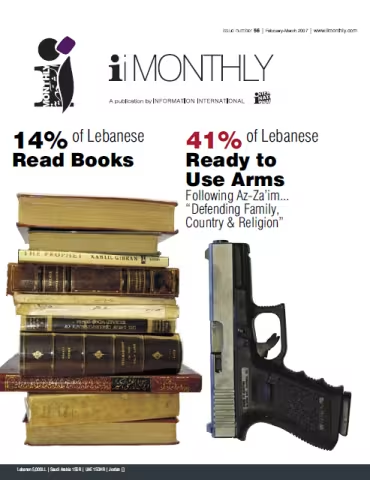
Events and experiences over the past years have confirmed that Lebanon is not a "country" in the legal and political context of the term but an "agreement" between 18 confessions to live on one land and find an appropriate framework (the state) to deal with their differences.