This resource published within Lebanon Support's Humanitarian Knowledge Base, in partnership with the Swiss Agency for Development and Cooperation (SDC)
The 2015 Global Humanitarian Assistance (GHA) Report highlights that in 2013, 147 countries received humanitarian assistance, with countries from the Arab region, particularly those affected by the Syrian crisis, being the highest beneficiaries of aid.
Local actors experience conflicts first hand. Therefore, they have an intimate understanding of what conflict dynamics need to be addressed in order to build sustainable peace.
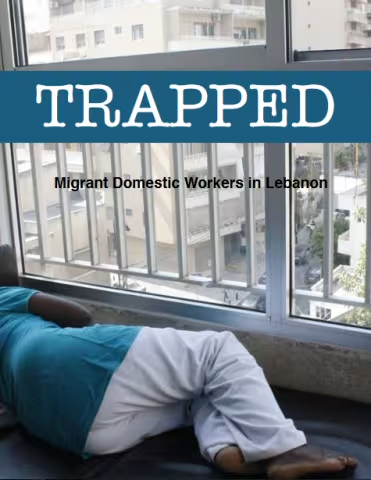
Over 250,000 migrant women are employed by private households in Lebanon to carry out household tasks such as cleaning, cooking, and caring for children and the elderly.
In October 2014, Lebanon’s Council of Ministers adopted a comprehensive policy on Syrian displacement, one explicit goal of which is to decrease the number of Syrians in Lebanon by reducing access to territory and encouraging return to Syria.
This report presents a brief analysis of the social stability context in the Qazas of Nabatieh and Bint Jbeil in the Nabatieh governorate, a sparsely populated religiously and politically homogenous area which hosts a small number of Syrian refugees.
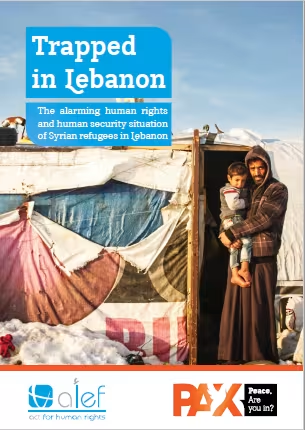
This report analyses the human rights and human security situation of refugees from Syria and their impact on the Lebanese society. Since the beginning of the conflict
The right to freedom of movement forms one of the cornerstones of the international human rights regime and the Lebanese legal system. It is a right that everyone ought to enjoy regardless of race, national origin, residence status, religion or any other criteria.
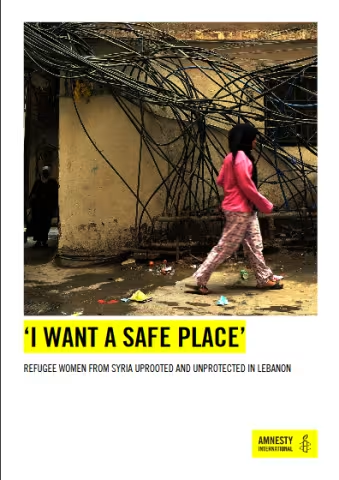
Syrian refugee women and Palestinian refugee women from Syria face risks of serious human rights violations and abuses in Lebanon, including gender-based violence and exploitation. Those who are heads of their households are at particular risk.
This is a survey with Lebanese women 75% and Syrian refugees women 25% aiming at detecting the status of human rights in general and women rights in particular in the local southern community as well as refugees' community. The study also aims at detecting the economical status related to these women and the possibility or the access to jobs or small businesses financing and the level of economical dependency on males which relates positively or negatively on their knowledge of rights and consequently access to it.
Digital Citizen is a biweekly review of news, policy, and research on human rights and technology in the Arab World.
It is a collaborative reporting effort by Global Voices Advocacy, Access, EFF, and Social Media Exchange.
Get the latest edition of Digital Citizen on the web.
ينتمي مفهوم المجتمع المدني إلى تلك المجموعة من المفاهيم التي كلما زاد حضورها في حياة الناس زاد عليهم غموضها، ما يحوّلها إلى أيقونة يحتشد الناس انتصارا لها وينبرون للدفاع عنها، خاصة في بلدان الاستبداد حيث يُحاصر المجتمع المدني ويُضَيّق عليه الخناق حتى يكاد يختنق ويتلاشى. والواقع أن لمفهوم المجتمع المدني دلالات متغيرة بتغيّر الأوضاع التي تمر بها الدولة والمجتمع. كذا هو الحال في منتقطنا حيث تختلف دلالة المجتمع المدني إبان بداية أحداث العنف اختلافا جذريا عما كانت عليه قبلها وكذلك عما آلت إليه الأوضاع اليوم. لكن يبقى وجود مجتمع مدني حر وفاعل شرطا أساسيا لتحقيق الديمقراطية المنشودة، ولا يبدو هذا...
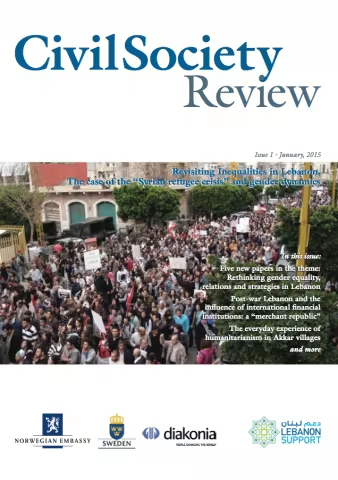
The objective of the Civil Society Review is to bring civil society practitioners, experts, activists, and researchers together to develop knowledge, as well as to innovate new tools and practices so as to strengthen Lebanon’s civil society and its voice. The Civil Society Review produces evidence-based research and analysis and disseminates findings and recommendations to promote civic engagement, shape policies, and stimulate debate within civil society spheres in Lebanon.
Launched on 12 December 2014, the Core Humanitarian Standard on Quality and Accountability (CHS) describes the essential elements of principled, accountable and quality humanitarian action.
This study aims to shed light on the industry that profits from the recruitment of women from South Asian countries into domestic work employment in the Middle East, with a particular focus on Bangladesh, Jordan and Lebanon.
In May 2015, the Lebanese authorities instructed UNHCR to temporarily suspend registration of Syrian refugees, including individuals already in the country and new arrivals.