تجاوز إلى المحتوى الرئيسي

موارد

Intervention Sectors
Resource Type
Displaying 1 - 20 of 73
National
Publishing Date
هل تغيّرت، أو تخلخلت، الصورة النمطية للمرأة في الواقع الراهن في سورية؟ هذا هو السؤال المؤسس لهذه الدراسة التي تسعى فيها الباحثة لرصد تحولات المكانة الاجتماعية للمرأة من خلال متابعتها لمدى المشاركة النسوية في الحياة العامة، في سورية. تركز الباحثة على فترة الأزمة الحالية متسائلة «هل يمكن أن يشكل انخراط المرأة السورية في الأزمة، موالاةً أو معارضة، معبراً إلى إنجاز بقية حقوقها... أم يزيد من معاناتها؟
National
Publishing Date
يهدف هذا البحث العمليّ المنحى إلى إعلام الممارِسين وصانعي القرار بشأن وضع الحماية الاجتماعيّة واحتياجاتها والثغرات الموجودة فيها، وذلك بالنسبة إلى العاملين في قطاع المجتمع المدنيّ. يقدّم هذا البحث توصيات مستهدَفة تهدف إلى تعزيز وصول العاملين في قطاع المجتمع المدنيّ إلى الحماية الاجتماعيّة، كما تستهدف الدولة، جماعة المانحين والمنظّمات غير الحكوميّة الدّولية، والمنظّمات غير الحكوميّة المحليّة.
National
Publishing Date
This action-oriented research aims to inform practitioners and decision makers on social protection status, needs and gaps of workers in the civil society sector. It formulates targeted recommendations that aim at enhancing access to civil society workers to social protection, and that target the Lebanese state, the donor community and international NGOs, and local NGOs.
National
Publishing Date
The 2019 CPDE Monitoring Report’s Key Messages and Recommendations aim to inform and augment dialogue in the Global Partnership for Effective Development Cooperation (henceforth the Global Partnership). CPDE is committed to dialogue on outstanding development effectiveness challenges, including ‘unfinished business’ for many key commitments and indicators agreed in Paris (2005) and Busan (2011). The Report focuses on the centrality of democratic country ownership by examining in more depth issues of inclusion in development policy and practices, in the context of a human rights-based approach...
National
Publishing Date

Working Paper | February 2014
The Dilemma of Human Rights In Lebanese Electoral Laws by Elie Al-Hindy
This study concludes with a number of recommendations with respect to the issues that need to be introduced to the debate and that can strengthen advocacy efforts by the different stakeholders involved. Reflecting on all of the above, and in light of the current political realities in Lebanon, including present sectarian demographics and political structure, the study concludes that the standards imposed on the new electoral law is impossible to meet, as no law, which this study has reviewed...

National
Publishing Date
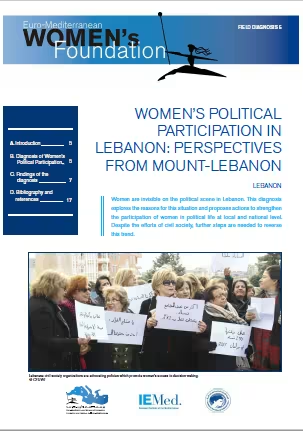
Although Lebanon is sometimes considered as the only democratic country in the Arab region with a free political environment and electoral system, the situation of women has not been strengthened enough for them to have a role on an equal footing with men. Lebanese women form a majority of 53% and they are actively participating in all aspects of Lebanese society. They enjoy equal constitutional rights with men and have the right to vote, hold public office, elect and be elected in municipal councils. Yet, this diagnosis, elaborated by the Committee for the Follow-Up on Women’s Issues (CFUWI)...
National
Publishing Date
Local actors experience conflicts first hand. Therefore, they have an intimate understanding of what conflict dynamics need to be addressed in order to build sustainable peace.
National
Publishing Date
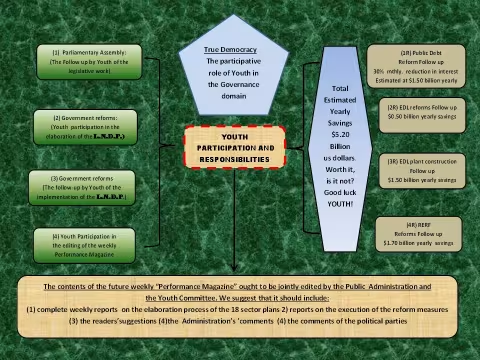
LET THE KIDS DO IT A lot has been said and printed about the role that is expected to be performed by YOUTH in the governance process, and here I am thinking generally of University undergraduates.  However, I do not recall reading any serious and studied proposals on the subject. It is as though, some of our esteemed dinosaur leaders consider the idea so “farfetched “that, for them, it is not really worth considering. They ask: “Do you seriously think that “kids” can tell us what to do or not do? The answers would be: First, these “kids”, as you call them, can come up with some fresh ideas...
National
Publishing Date

Working Paper | April 2015
Social Justice and the Arab Uprisings by Amaney A. Jamal and Michael Robbins
As the Arab Spring proceeded, massive changes swept across the region. Long-standing stability gave rise to ongoing chaos in some countries, most notably Syria and Libya, but also to a significant extent in Tunisia and Egypt. Meanwhile, Islamist parties won free and fair elections in Egypt and Tunisia and were allowed to come to power. These and other changes greatly altered the political landscape across the region. The importance of these changes cannot be overstated. Yet, amidst talk of a...

National
Publishing Date
The objective of the Civil Society Review is to bring civil society practitioners, experts, activists, and researchers together to develop knowledge, as well as to innovate new tools and practices so as to strengthen Lebanon’s civil society and its voice. The Civil Society Review produces evidence-based research and analysis and disseminates findings and recommendations to promote civic engagement, shape policies, and stimulate debate within civil society spheres in Lebanon.
National
Publishing Date
The humanitarian aid system is growing and expanding, and so surely its capacity to meet these challenges should also be growing. Yet despite the enormous resources, in the more complex, less high-profile and difficult contexts, MSF teams in the field have seen that humanitarian responses to displacement emergencies have not occurred in a timely and effective way. This is especially the case in conflict areas. These observations have prompted MSF to conduct this review, to better understand how the humanitarian system is responding to acute displacement emergencies. The review is based on...
National
Publishing Date
Integrity’s research highlights that women’s networks and organisations in Syria are active across a range of service delivery sectors. In many cases these groups are either responding to gaps in services provided by other NGOs, civil society organisations (CSO), or other service delivery actors, or they are providing understanding and access to the specific needs of women and children beneficiaries that other groups cannot. Women’s groups interviewed by Integrity are most active (62 per cent) in the education, skills training, and livelihoods sectors. These areas both help meet immediate...
National
Publishing Date

Policy Memo | June 2014
Social Cohesion and Intergroup Relations: Syrian Refugees and Lebanese Nationals in the Bekaa and Akkar by Charles Harb and Reem Saab
The growing influx of Syrian refugees to Lebanon has strained its socio-economic fabric, piling pressure on employment opportunities, housing, trade, and infrastructure capacities (basic services). Tensions between Syrian refugees and their Lebanese host communities have led to intercommunity clashes, and it thus becomes imperative to identify the indicators of social instability and ways to reduce them. A research project initiated by...

National
Publishing Date

Research Report | May 2014
Relative Deprivation and Politics in the Arab Uprisings by Asya el-Meehy
This study seeks to assess the relative weights of economic and political grievances across the uprisings in Bahrain, Egypt, and Tunisia. Highlighting the unique shared role of middle class youth, it contends that these constituencies have suffered from relative deprivation, despite deliberate efforts by authoritarian regimes to shield them through new targeted social protection initiatives. Nonetheless, economic grievances were not always the primary driving dynamic of protests and the...