Findings in the "Analysis on Stunting Among Syrian Refugee Children" showed that risk factors perceived to be contributing to stunting levels among Syrian refugee children included those at the individual and household level with poor maternal nutrition, household food insecurity and inadequate complementary feeding practices as the factors perceived to be contributing the most to stunting among Syrian children. On the other hand, at the institutional and community level, market food prices, poverty, income, employment and livelihoods were the factors perceived to be contributing the most to...
Swiss Solidar undertook a multi-sectoral needs assessment in August 2013 to assess the humanitarian needs of Syrian refugees residing in Nabatieh and Jezzine Districts in Southern Lebanon.1 Prior to undertaking its field assessment, Solidar undertook a detailed documentation r
Since March 2011 and the continuously escalating crisis in Syria, Lebanon (along with Jordan, Iraq and Turkey) has been a refuge area for Syrian families fleeing the instability and violence in their country.
The human rights situation in the Syrian Arab Republic has deteriorated significantly since November 2011, causing further suffering to the Syrian people. Widespread violence and increasingly aggravated socio-economic conditions have left many communities in a perilous state.
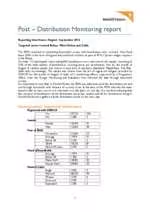
The PDM consisted of conducting household surveys with beneficiaries who received Non-Food Items (NFIs in the form of hygiene kits) and food vouchers as part of WVL's Syrian refugee response in the Bekaa.
The report assesses the progress made in the achievement of the Millennium Development Goals (MDGs) based on new national data which was formulated after the first MDGR that was published in 2003.