يهدف هذا البحث العمليّ المنحى إلى إعلام الممارِسين وصانعي القرار بشأن وضع الحماية الاجتماعيّة واحتياجاتها والثغرات الموجودة فيها، وذلك بالنسبة إلى العاملين في قطاع المجتمع المدنيّ. يقدّم هذا البحث توصيات مستهدَفة تهدف إلى تعزيز وصول العاملين في قطاع المجتمع المدنيّ إلى الحماية الاجتماعيّة، كما تستهدف الدولة، جماعة المانحين والمنظّمات غير الحكوميّة الدّولية، والمنظّمات غير الحكوميّة المحليّة.
This action-oriented research aims to inform practitioners and decision makers on social protection status, needs and gaps of workers in the civil society sector. It formulates targeted recommendations that aim at enhancing access to civil society workers to social protection, and that target the Lebanese state, the donor community and international NGOs, and local NGOs.
This report presents the findings of the labour market study in Bar Elias and the Bekaa, focusing on the labour activities, initiatives, and aspirations of current B&Z beneficiaries and Syrian refugee youth and women heads of household respondents that could potentially be
The Arab region lacks sustainable natural resource management, mostly in the areas of energy efficiency and its overwhelming reliance on fossil fuels for virtually all its energy needs.
This report introduces the conflict context in the Central Bekaa region. The area is of geostrategic importance as it contains the main border crossing to Syria and the Damascus highway, the international route from Beirut to Damascus.
Based on the findings of participatory protection research that Oxfam undertook with refugees in Lebanon between late 2016 and early 2017, this paper explores refugees’ own definitions and conceptions of safety, and highlights refugee perspectives on how the international comm
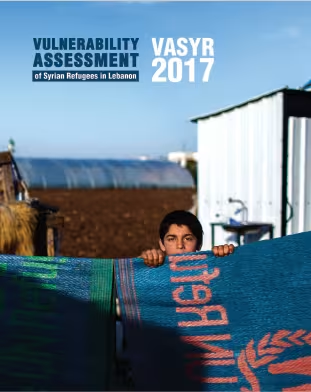
The 2017 Vulnerability Assessment of Syrian Refugees in Lebanon (VASyR) is the fifth annual survey assessing the situation of a representative sample of registered Syrian refugee households to identify situational changes and trends.
This report examines both the historical development and current situation of Syrians working in Lebanon through the analysis of policies established and implemented by the Lebanese government. While the report is not an assessment of these policies, it nevertheless reflects on its impact on Syrians’ working conditions and livelihoods. In this vein, this report notably focuses on emerging dynamics of increased informality, exploitation, and dependence.
It is part of a series of reports to be published in 2016, the 1st of which being "Formal Informality, Brokering Mechanisms, and Illegality...
The purpose of this policy brief is to inform policy formulation on local level security provision and refugee protection, and to propose modalities for upgrading the sys- tems of the Lebanese security institutions in a way that strengthens protection of the Lebanese communities and the Syrian refugees they host. Based on eld research conducted between February and May 2016 in three locations across Lebanon, this brief analyses the challenges to protecting local communities and refugees in a hybrid system, in which formal and informal security actors coexist and implement a mix of security...
This report aims to analyse how formal and informal security providers implement their respective social order agendas through a security “assemblage”. It also aims to inform the debate on refugee protection and security provision in urban settings, in the context of Lebanon’s hybrid security system. The accounts collected illustrate how state security institutions tacitly accept – or even rely on – informal security actors, managing at times to achieve their political and strategic goals through decentralised and/or illegal forms of control. In this vein, local municipalities imposed curfews...