تجاوز إلى المحتوى الرئيسي

موارد

Intervention Sectors
Displaying 21 - 40 of 112
National
Publishing Date
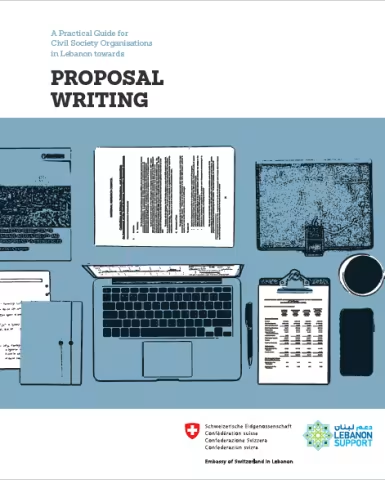
يقدّم هذا الدليل أدوات تسهّل عملية صياغة مقترحات المشاريع والحصول على التمويل، من خلال توضيح ما يتم الاستناد إليه في أغلب المنظمات المانحة، مع الأخذ في الاعتبار الفوارق البسيطة بين مانح وآخر. يتألف هذا الدليل من قسمين لكلٍ منهما أهميته الخاصة. في القسم الأول، يتم التركيز على مفهوم المنح المالية، وكيفية تحديد حاجتنا للتمويل، وكيفية اختيار الشريك الممول لهذا المشروع أو ذاك، وكيفية استهداف الشريك وإقناعه بالفكرة المطروحة. أما القسم الثاني، فيستعرض المراحل الضرورية لبناء مقترح مشروع متكامل، والمحاور الأساسية التي يجب العمل عليها وآلية صياغة الأفكار والأهداف والنتائج المتوقعة، وصولاً إلى صياغة...
National
Publishing Date
This guide provides you with the tools needed to facilitate the proposal writing process and securing funds, by explaining the criteria upon which most donors base their decisions to provide funding, while taking into account the subtle differences between one donor and another. In the first section, we focus on defining the concept of funding grants, in addition to how to identify our funding needs, how to select funding partners for a said project, and how to target partners and persuade them of the proposed idea. In the second section, we present the phases needed to formulate a...
National
Publishing Date
تُعتبَر تكنولوجيا المعلومات والاتّصالات ضروريةً لمساعدة المنظّمات والمجموعات القاعدية على التواصل والتخطيط للبرامج والمبادرات وتنظيمها وتنفيذها ورصدها وتطويرها بشكلٍ أفضل. يسعى هذا الدليل إلى تلبية الاحتياجات الأوّلية لمختلف منظّمات المجتمع المدني الصغيرة والمتوسّطة الحجم، من أجل استخدام التكنولوجيا في مهامها اليومية على نحو أفضل. يتوجّه الدليل إلى أعضاء فِرَق العمل على اختلاف أدوارهم في المنظّمة، ويفترض أنَّهم يتمتّعون بمعرفة أساسية بديهية حول الوسائل والتقنيات الرقمية. يتناول هذا الدليل كيفية استخدام برامج مايكروسوفت أوفيس (MS Office)، وجوجل سويت، والرصد والتقييم باستخدام نماذج جوجل أو...
National
Publishing Date
We Play for Peace is a handbook produced under the project with the same title highlighting activities and tools that can be adopted by trainers, coaches and facilitators with pre-adolescents and children under arts, sports and recreation.
International
Publishing Date
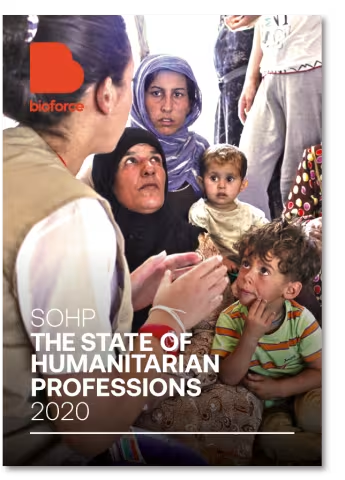
The State of Humanitarian Professions 2020 (SOHP) is the result of a year-long consultation with more than 1,500 humanitarian professionals. For the first time, this study gathers and analyses key figures on 24 humanitarian professions, as well as on recruitment practices and professional development in the sector. In addition, the SOHP study demonstrates the need to coordinate on the challenges of professionalising humanitarian teams, with 19 recommendations to be discovered in the final report.
National
Publishing Date
The toolbox is intended as an open learning resource for youth workers that are engaged in community work with young refugees, asylum seekers and young people with migration background. Specifically: project managers, community leaders, educators, facilitators, social workers, intercultural mediators that are interested to improve their ability in the social inclusion of excluded groups. The toolbox could also be used in formal settings such as schools, colleges and universities addressing development challenges as well as for project managers and experts engaged in the design and...
National
Publishing Date
This document is the outcome of a workshop done during the Erasmus Plus training "Influence Youth". The workshop was about the topic of teamwork, specifically the challenges faced when working with a team of volunteers and how to overcome it. The participants of the workshop talked about their challenges and possible interventions were shared also by participants based on their experience working in this field. The document includes the information shared by the participants in this workshop.
National
Publishing Date
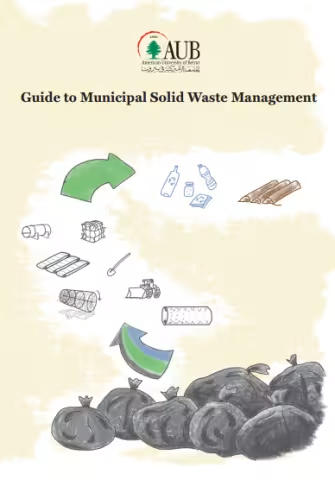
The American University of Beirut Solid Waste Management Task Force has published a manual entitled Guide to Municipal Solid Waste Management. The manual gives an overview of the waste management situation in the country (past, current, and potential solutions) along with some helpful tips on how to transition to more sustainable practices.
National
Publishing Date

In the absence of a clear national plan for Integrated Waste Management (IWM), and due to various political and governmental issues, Lebanon has had to face a serious waste crisis in 2015.  The paper scrutinizes events leading up to the 17th of July 2015, and the impact of its aftermath on Lebanon’s environment, infrastructure, health and landscape. Parallels are drawn throughout the paper to a similar crisis faced by residents of Campania, Italy.


This paper thoroughly analyzes Lebanon’s “waste profile” and benchmarks it against a spectrum of countries to further understand global trends in...

National
Publishing Date

Research Report | April 2015
In this paper, we analyze the susceptibility of agricultural outputs to future climate change in Lebanon, and the extent to which it propagates to the economic system as a whole. We use a methodological framework in which physical and economic models are integrated for assessing the higher-order economic impacts of projected climate changes. By using this integrated modeling approach, we are able to quantify the broader economic impacts in the country by considering not only the temporal dimension but also the regional disaggregation of the results. Our estimates...

National
Publishing Date

Working Paper | March 2015
Sustainable Transportation and Mega Sporting Events in Arab Countries: the Case of Qatar by Robert Wittkuhn and Danyel Reiche
​Qatar has successfully developed into a hub for mega sporting events; the most prestigious of them will be the FIFA World Cup in 2022. Qatar promotes it as the “first completely carbon-neutral” and “most compact” World Cup. Such statements emphasize a very small impact of transport on the event’s carbon footprint; but they also raise questions about the understanding and applicability of carbon neutrality. As motive for hosting mega events...

National
Publishing Date

Working Paper | February 2015
Commuters’ Behavior towards Upgraded Bus Services in Greater Beirut: Role of Itinerary and Implications for Greenhouse Gas Emissions, Social Welfare and Transport Policy by Ali Chalak, Hani Al-Naghi, Alexandra Irani, and Maya Abou-Zeid
Climate change is one of the most critical environmental challenges facing the world today. The transportation sector alone contributes to 22% of carbon emissions, of which 80% are contributed by road transportation. In this paper, we investigate the potential greenhouse gas (GHG) emissions reduction and social welfare gains...

National
Publishing Date

Working Paper | February 2015
Economic Impacts of Adopting a Sustainable Transport System in Beirut by Mazen Omran, Johnny Ojeil, and Youssef Fawaz
​The work carried out in this paper demonstrates the economic benefit of a sustainable transport system. It compared a scenario with and without such system, and calculated loss time as a result of being held up in congestion during key peak hours mainly due to relying entirely on the private car. The work demonstrates that in addition to reducing congestion levels a sustainable transport system will generate benefits related to travel time...

National
Publishing Date

Working Paper | February 2015
Getting to Campus: Sustainable Public Transportation and Relocating the American University in Cairo by Richard Tutwiler, Hagar Eldidi, Yumna Kassim, and Andrew Petrovich
​Cairo is one of the most congested cities in the world, and public transportation is one of its greatest challenges. Government strategies to alleviate congestion have stressed horizontal expansion into the surrounding desert areas and the construction of more and ever larger motorways. This paper uses the experience of the American University in Cairo, which physically relocated in 2008 from...

National
Publishing Date

Working Paper | February 2015
Harnessing Motorists' Potential Demand for Hybrid-Electric Vehicles in Lebanon: Policy Options, CO2 Emissions Reduction and Welfare Gains by Alexandra Irani and Ali Chalak
Public concern over deteriorating air quality and the associated local and global impacts has grown significantly in the past decade. Air quality degradation is linked first and foremost to the transportation sector in the Arab region with about 90% of total emissions of carbon monoxide resulting from transportation activities. In Lebanon’s capital, Beirut, current levels of ozone and smog...