The average number of assisted families during the a/m period is 46% of the overall number of families reportedly arrived to DRC North Lebanon operational area (Akkar region).
The average number of assisted families during the a/m period is 35% of the overall number of families reportedly arrived to DRC Bekaa operational area.
This operational guidance note is anchored on the principles of universal health care for all persons of concern fleeing the ongoing conflict in Syria and in need of international protection in Lebanon.
Since March 2011 and the continuously escalating crisis in Syria, Lebanon (along with Jordan, Iraq and Turkey) has been a refuge area for Syrian families fleeing the instability and violence in their country.
The “Review of the Public Procurement Legal Framework in Lebanon” introduces the Sustainable Public Procurement (SPP) in Lebanon and elaborates on the legal of the country’s procurement and sustainability laws that may offer a legal possibility for the adoption of SPP principl
Disability & Vulnerability Focal Point (DVFP) have been developed based on the observation that one of the greatest difficulties following a crisis is not only to identify and to access to vulnerable people including people with disabilities, but also to accompany them wit
This book tackles key Issues of concern within the aid discussion. It outlines issues of particular importance for civil society in the Arab region and highlights the difference of prospectives between government representatives and CSOs.
The human rights situation in the Syrian Arab Republic has deteriorated significantly since November 2011, causing further suffering to the Syrian people. Widespread violence and increasingly aggravated socio-economic conditions have left many communities in a perilous state.
As of the end of April 2012, the number of Syrian families displaced in the Bekaa has increased to 2,800 households. Families registered with local partners receive kits of dry food, but they have requested more variety and choice in food items.
28 refugee households were surveyed, which represented a total of 501 refugees, 48% male and 52% female, which is approximately 11% of the Syrian refugee population in North Bekaa.
The National Report for the United Nations Conference on Sustainable Development (Rio + 20) presents the current situation as is and highlights the achievements and failures, strengths and weaknesses, opportunities and risks.
The PDM consisted of conducting household surveys with beneficiaries who received Non-Food Items (NFIs in the form of hygiene kits) and food vouchers as part of WVL's Syrian refugee response in the Bekaa.
The Strategic Planning is based on the findings of fieldwork carried out in several villages in Dinnieh, which aimed at identifying the major characteristics of the region in different fields.
UNHCR, coordinating the operations in the North along side with the HRC (High Relief Commission) and DRC as its main implementing partner, requested from DRC to conduct a first rapid assessment in the Bekaa with the following objectives: a) To identify existing areas of displa
The State and Trends of the Lebanese Environment report provides an overview of the current condition of natural resources and environmental management in the country. Furthermore, it gives an analysis of past and future developments across multiple different sectors.
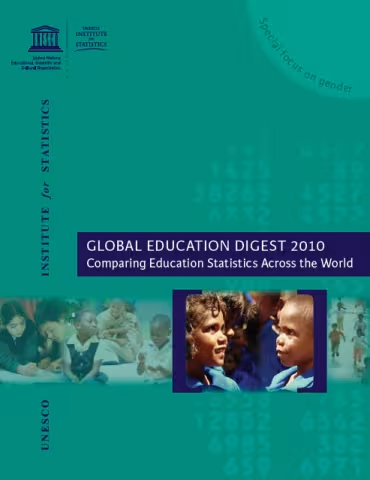
This edition of the Global Education Digest (GED) explores the changing patterns in gender and schooling throughout the formal education system – from primary to tertiary education levels.
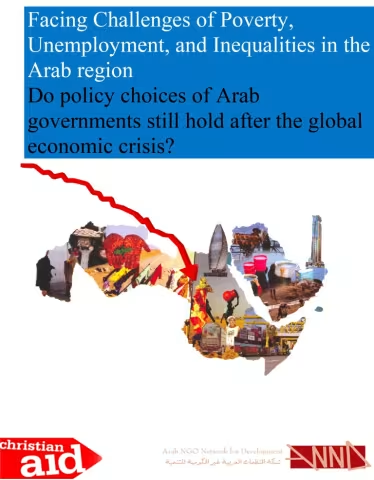
This paper was produced by ANND and Christian Aid and contains five main sections: “Executive Summary: a crisis of multiple dimensions; the threat of explosive vulnerabilities and increasing insecurities”, “Vulnerability to poverty: the key challenges faced by the Arab region”
The report assesses the progress made in the achievement of the Millennium Development Goals (MDGs) based on new national data which was formulated after the first MDGR that was published in 2003.
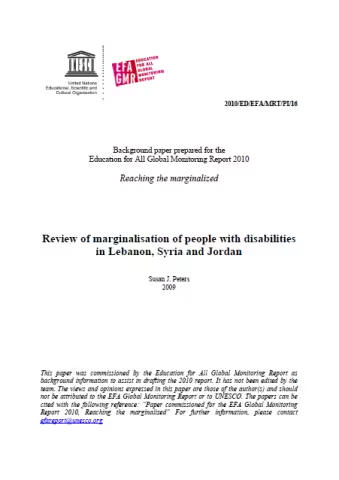
Review of marginalisation of people with disabilities in Lebanon, Syria and Jordan. Using a social exclusion conceptual framework, this paper identifies several causes of marginalization of people with disabilities in the context of the MENA region.