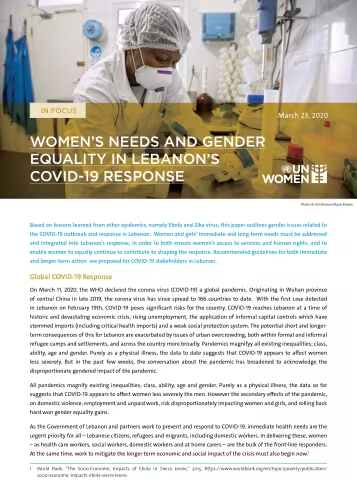
On March 11, 2020, the WHO declared the corona virus (COVID-19) a global pandemic. Originating in Wuhan province
of central China in late 2019, the corona virus has since spread to 166 countries to date.
This report attempts to answer current gaps in the literature analysing WPE and WPP donor-funded initiatives in Lebanon, and asks the following question: what explains the current gap between donor-funded WPE and WPP initiatives, and the continued low rates of women’s political participation and overall low political empowerment in Lebanon?
في إطار النظام السياسي اللبناني الذي يقوم على المحاصصة الطائفية والعائلية السياسية والزبائنية المتمثلة في نظام الزعامة، والذي يعزز من الأبوية القائمة على القرابية، تسعى هذه الدراسة إلى فهم وتحليل مشاركة النساء في مواقع قيادية وقاعدية في أربعة كيانات في لبنان تتضمن حزب سياسي، نقابة، منظمة مجتمع مدني وحركة اجتماعية. تفحص الدراسة الهياكل والبنى المؤسسية لتلك الكيانات ومواقفها من قضايا النساء، والديناميات التي تعتمدها للتفاعل مع محيطها، وذلك من خلال تحليل وثائقها الرسمية، خطابها العام، ممارساتها، وأخيراً تجارب النساء المنتميات لها وما عايشنه من تحديات ضمن هذا الإطار.
بالإضافة إلى هذه التقرير،...
This report aims to provide statistical and analytical tools for the recovery community working in North Lebanon, specifically those working with the Nahr el-Bared displaced and returnee population. The information will allow for better assessment of current needs and gaps, which will eventually support the development of appropriate strategies of intervention on both the short and long term.
Lebanon may witness a remarkable rise in the number of women serving in Parliament come May 2018 due to initiatives from women’s groups, “civil society” activists, and the substantial number of female candidates – 113 at the start of the election period. However, as this briefing paper shows, Lebanese women continue to face numerous challenges in entering government. The new electoral law passed in June 2017 does not provide women with equal opportunity to be elected, and it is yet to be seen whether it will increase female representation in Parliament. Nevertheless, the historic number of...
The July war 2006, lasted 34 days, and led to the displacement of 915,762 (almost 25% of the Lebanese population) persons, relocating into public and private schools all over the country. With the coming into force of the cease fire in August 14th 2006, there was a rapid return of the displaced to the south.
The Arab region lacks sustainable natural resource management, mostly in the areas of energy efficiency and its overwhelming reliance on fossil fuels for virtually all its energy needs.
“We Can Never Go Back to How Things were Before”* is a qualitative study carried out as a partner study to the International Men and Gender Equality Survey – Middle East and North Africa (IMAGES MENA).
Lebanon provides a refuge for many women and teenagers driven away from neighbouring countries by wars and conflicts, as well as some who have come from other countries seeking better economic conditions.
Only a handful of studies in Lebanon have shed light on the changing gendered dynamics within the refugee families by comparing gender roles, expectations, and practices before and after displacement (as result of armed conflict).
Today, women in Lebanon are fighting for equal access to opportunities and rights without prejudice against their gender, their expectations and their careers.
This study maps the current state of gender justice in the Arab region, documenting barriers as well as opportunities. Its primary research aim is to determine how to develop an environment, at the legal, policy, and social levels that is conducive to gender justice.
Although Lebanon is sometimes considered as the only democratic country in the Arab region with a free political environment and electoral system, the situation of women has not been strengthened enough for them to have a role on an equal footing with men. Lebanese women form a majority of 53% and they are actively participating in all aspects of Lebanese society. They enjoy equal constitutional rights with men and have the right to vote, hold public office, elect and be elected in municipal councils. Yet, this diagnosis, elaborated by the Committee for the Follow-Up on Women’s Issues (CFUWI)...
While women’s issues and rights have been at the forefront of public and civil society debate, academic, and activist publications, women’s inequalities and the discrimination women face in Lebanon have been notably undermined, whether as citizens, refugees, or migrants. However, if the publicising of the “issue of women in Lebanon” has prompted the production of more “gender-related” information and knowledge, it has oftentimes adopted the rhetoric of denunciation and victimisation. Hence, there is a scarcity of in-depth and sectoral studies on the logics of exclusion and discrimination in...
This study was undertaken by the Center for Women (ECW) at the United Nations Economic and Social Commission for Western Asia (ESCWA), in the context of a regional programme to review progress made in the implementation of the Beijing Declaration and Platform of Action in the
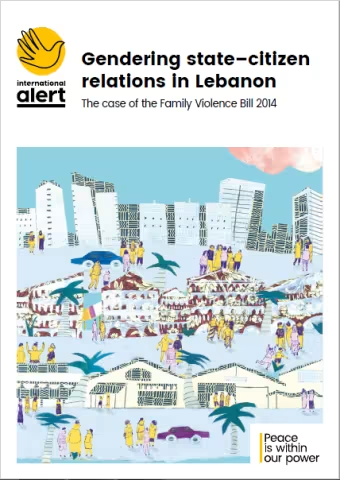
This report examines the nature of interaction and engagement between Lebanese citizens’ collectives and the state on gender-specific matters, through the case study of
This report aims to present a general overview of the current local gender actors and their interventions in Lebanon. It also aims to shed light on the complex relationship between women’s organisations in Lebanon and their donors. In this context, it is important to ask to what extent the funding tends to shape project design at a local level? And moreover, does funding of short-term and service-oriented projects edulcorate the political change that these organisations could bring?
Based on a survey done by Lebanon Support during 2015, it gives an overview of the main gender actors, their...
The concept of resilience offers a framework that facilitates cross-institutional and cross-disciplinary dialogue and pushes us to examine systems that influence complex situations.