The Arab region continues to manage uncertainties on its path towards an inclusive and sustainable growth trajectory: geopolitical tensions persist, and global interest rates have soared.
With globalisation, the mobility of people has grown, and women are essential actors in this migratory phenomenon. This article focuses on the role of women in migration and the role of migration in advancing women’s rights to achieve gender equality.
This report constitutes the final publication of the outcomes of the program "Development in Lebanon: Poverty Eradication, Gender Equity and Youth Participation; the Role of NGOs Civil Society and Other Actors".
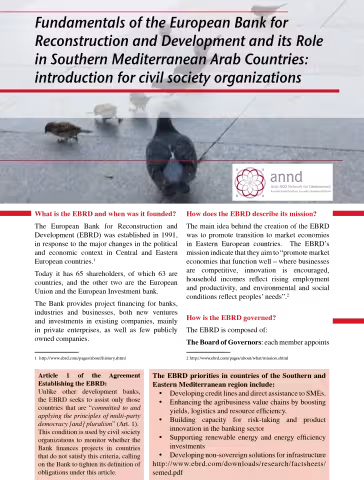
The European Bank for Reconstruction and Development (EBRD) was established in 1991, in response to the major changes in the political and economic context in Central and Eastern European countries.1 Today it has 65 shareholders, of which 63 are countries, and the other two ar
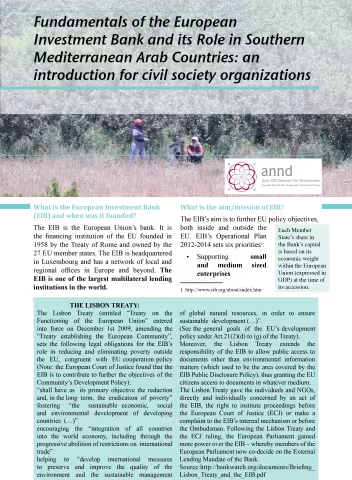
The EIB is the European Union’s bank. It is the financing institution of the EU founded in 1958 by the Treaty of Rome and owned by the 27 EU member states. The EIB is headquartered in Luxembourg and has a network of local and regional offices in Europe and beyond.
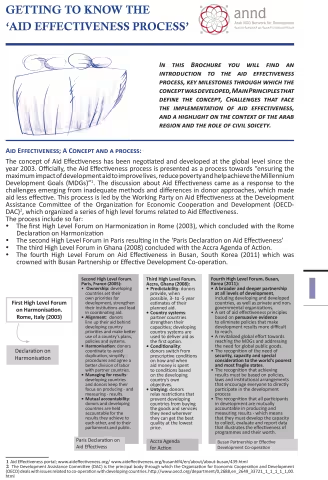
In this Brochure you will find an introduction to the aid effectiveness process, key milestones through which the concept was developed, Main Principles that define the concept, Challenges that face the implementation of aid effectiveness, and a highlight on the context of the
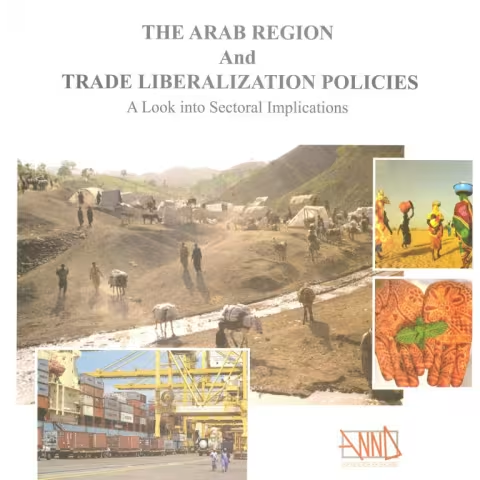
It contains 8 chapters: 1) an introduction to the general debate on trade and development, 2) an overview of the situation In the Arab region, 3) the engagement of Arab countries with the WTO, 4) Arab countries and the Euro-Mediterranean partnership, 5) Arab countries and free
This paper seeks to explain why women remain marginal in the Lebanese economy. It conducts a thorough review of literature to shed light on the economic, social and legal context to identify barriers to their full participation.
A detailed report on ANND’s participation in this forum that covered the issues of neoliberal globalization and human development, women’s rights, geopolitical changes, democracy and public freedoms, cultural dimensions, environment and sustainable development, migration and t