تجاوز إلى المحتوى الرئيسي

موارد

Intervention Sectors
Displaying 1 - 20 of 83
National
Publishing Date
The third toolbox: Institutionalizing Conflict Sensitivity at the Organizational Level aims to ensure that organizations working within the humanitarian and stabilization response in Lebanon can better integrate the concept of conflict sensitivity and its principles at all aspects and levels across an organization’s structure, procedures, and policies.
National
Publishing Date
This package includes 3 maps pertaining to Lebanon's 2009 elections: - "confessional-distrib": showing the confessional geographic distribution of Lebanon's population - "election-results": showing the election results in West Bekaa/Rashaya and Metn areas. - "results&voters": showing the sectarian representation of parliamentary seats across Lebanon, the percentage of voters per electoral district, election results, and deputy representation per number of voters
National
Publishing Date
Lebanon may witness a remarkable rise in the number of women serving in Parliament come May 2018 due to initiatives from women’s groups, “civil society” activists, and the substantial number of female candidates – 113 at the start of the election period. However, as this briefing paper shows, Lebanese women continue to face numerous challenges in entering government. The new electoral law passed in June 2017 does not provide women with equal opportunity to be elected, and it is yet to be seen whether it will increase female representation in Parliament. Nevertheless, the historic number of...
National
Publishing Date

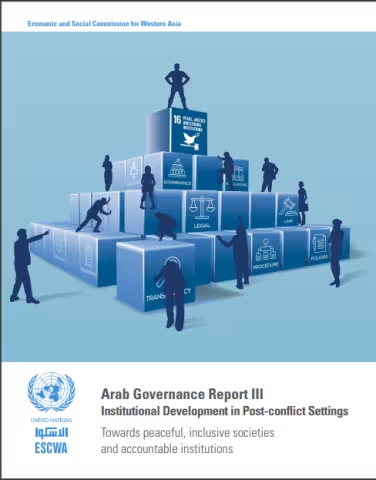
The third edition of the Arab Governance Report introduces post-war best practices from international and regional experiences. It suggests strategies and policies for Libya and Yemen that focus on the immediate aftermath once combat ceases and a future political settlement.

National
Publishing Date
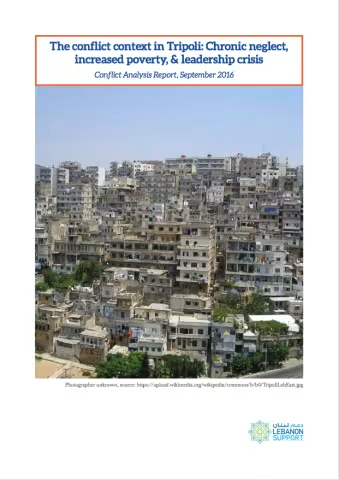
The “Roadmap to Reconciliation in Tripoli,” (RRT) project is a grassroots initiative that aims at launching a transitional justice route through understanding the public perceptions in Tripoli about reconciliation as well as people’s readiness and willingness to engage in a co
National
Publishing Date
This report examines both the historical development and current situation of Syrians working in Lebanon through the analysis of policies established and implemented by the Lebanese government. While the report is not an assessment of these policies, it nevertheless reflects on its impact on Syrians’ working conditions and livelihoods. In this vein, this report notably focuses on emerging dynamics of increased informality, exploitation, and dependence. It is part of a series of reports to be published in 2016, the 1st of which being "Formal Informality, Brokering Mechanisms, and Illegality...
National
Publishing Date
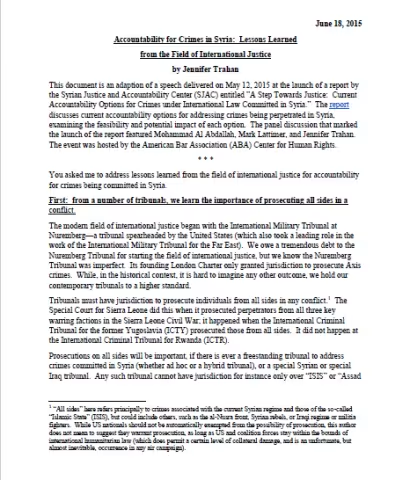
This document is an adaption of a speech delivered on May 12, 2015 at the launch of a report by the Syrian Justice and Accountability Center (SJAC) entitled ”A Step Towards Justice: Current Accountability Options for Crimes under International Law Committed in Syria.” The repo
National
Publishing Date
Bringing together the years of regional and international experience within civil society activities, Besme was settled in Lebanon in September 2014, in order to contribute to the peaceful settlement of regional conflicts in Middle East. Through a route, which is full of difficulties, we managed to leave the year of 2015 behind, with successful and effective projects. We reckon 2015 as a year of investment for Besme. Reinvigorating the individual connections of management team at national, regional and international levels, we assume that a great step forward was taken for future. In the road...
National
Publishing Date
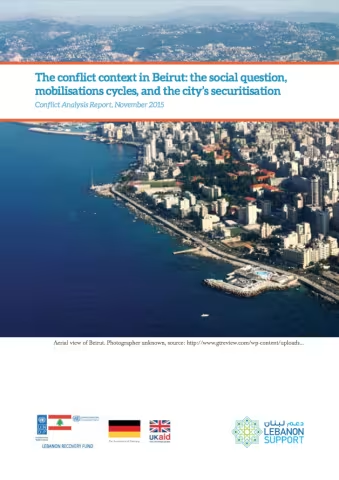
This report provides an analysis of the history and current situation of the conflict context, actors and dynamics in Beirut, Lebanon. The report seeks to shed light on the main actors, topics of contestation, conflict and mobilisation in its historical becoming as well as current expressions. The report includes a special focus on the social question, subsequent political and social mobilisation, gender issues, the securitisation of the city, as well as the interactions between the Lebanese host community and Syrian refugees and their unfolding within the last four years (since 2011).
National
Publishing Date
This study was based on a comprehensive assessment of the vocational needs as well as the labor absorption capacity mainly with business owners in the area of intervention and individual workers and vocational trainings candidates following different assessment and data collection methodologies such as key informant interviews, focus groups, and individual assessments