“More than 60% of Syrian refugees households comprise a person with disabilities and 1/5 Syrian refugees has a disability in Lebanon and Jordan”, shows a large study conducted by Humanity & Inclusion (HI) and iMMAP.
Analyzing the Impact on the Personal and Professional Development
of Young Participants at Erasmus Plus/Youth in Action/Euromed projects through “Chabibeh Sporting Club” From 2008 till 2017
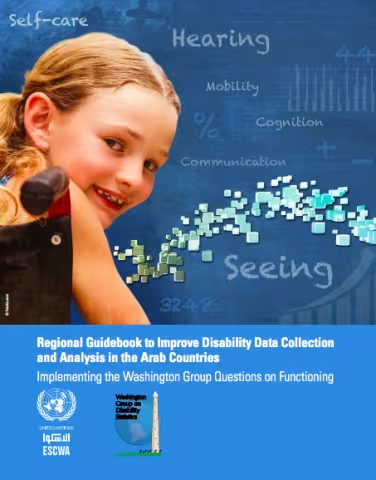
This regional Guidebook explores the different approaches in design, implementation and analysis of disability data collection in the Arab countries, in view of improving the standardization and implementation of the Washington Group Short Set on Functioning and related indica
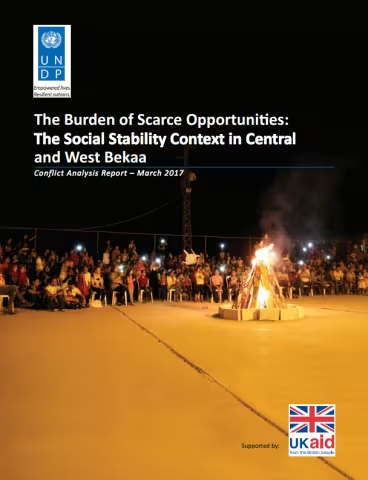
This report introduces the conflict context in the Central Bekaa region. The area is of geostrategic importance as it contains the main border crossing to Syria and the Damascus highway, the international route from Beirut to Damascus.
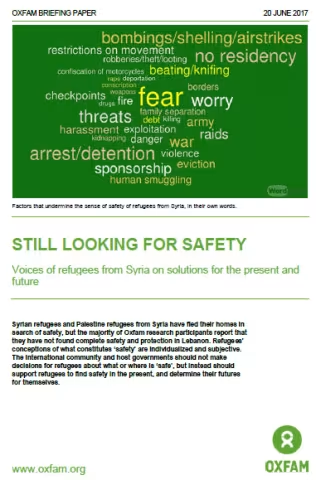
Based on the findings of participatory protection research that Oxfam undertook with refugees in Lebanon between late 2016 and early 2017, this paper explores refugees’ own definitions and conceptions of safety, and highlights refugee perspectives on how the international comm
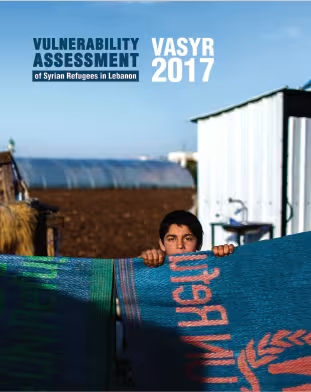
The 2017 Vulnerability Assessment of Syrian Refugees in Lebanon (VASyR) is the fifth annual survey assessing the situation of a representative sample of registered Syrian refugee households to identify situational changes and trends.
This report aims to explore the fragmented organisation of healthcare services in Lebanon, for Syrian refugees. Although it is not an assessment of the Lebanese healthcare system, this report does nevertheless reflect on the challenges and underlying dynamics of the current Lebanese system, which are reproduced in the healthcare provision for Syrian refugees. In this sense, the report highlights the privatised, rather ad hoc, and irregular provision of healthcare in Lebanon, notably for Syrian refugees, which tends to take on a more curative rather than preventive approach, resulting in...
The purpose of this policy brief is to inform policy formulation on local level security provision and refugee protection, and to propose modalities for upgrading the sys- tems of the Lebanese security institutions in a way that strengthens protection of the Lebanese communities and the Syrian refugees they host. Based on eld research conducted between February and May 2016 in three locations across Lebanon, this brief analyses the challenges to protecting local communities and refugees in a hybrid system, in which formal and informal security actors coexist and implement a mix of security...
This report aims to analyse how formal and informal security providers implement their respective social order agendas through a security “assemblage”. It also aims to inform the debate on refugee protection and security provision in urban settings, in the context of Lebanon’s hybrid security system. The accounts collected illustrate how state security institutions tacitly accept – or even rely on – informal security actors, managing at times to achieve their political and strategic goals through decentralised and/or illegal forms of control. In this vein, local municipalities imposed curfews...
Since the uprising in Syria in March 2011, over 4.3 million Syrians have fled to neighboring countries. Over a million have sought refuge in Lebanon, constituting almost a quarter of the Lebanese population and becoming the largest refugee population per capita in the world.
With inequitable health coverage being a longstanding problem in Lebanon, Syrian refugee women’s health, and specifically their sexual and reproductive health, is disproportionately affected. An increase in gender-based violence and early marriage, a lack of access to emergency obstetric care, limited access to...