The third toolbox: Institutionalizing Conflict Sensitivity at the Organizational Level aims to ensure that organizations working within the humanitarian and stabilization response in Lebanon can better integrate the concept of conflict sensitivity and its principles at all aspects and levels across an organization’s structure, procedures, and policies.
The third edition of the Arab Governance Report introduces post-war best practices from international and regional experiences. It suggests strategies and policies for Libya and Yemen that focus on the immediate aftermath once combat ceases and a future political settlement.
More than a decade after the United Nations’ adoption of the Convention on the Elimination of All Forms of Discrimination against Women, which is adopted by many countries including Lebanon, these countries returned in 2015 to commit themselves to achieve gender equality and t
UNFPA on behalf of UNDP and UN Women organized a national workshop on gender-related laws, policies and practices in Lebanon, which was held in Beirut on the 7th and 8th of August, 2018.
This report presents the findings of the labour market study in Bar Elias and the Bekaa, focusing on the labour activities, initiatives, and aspirations of current B&Z beneficiaries and Syrian refugee youth and women heads of household respondents that could potentially be
The Arab region continues to manage uncertainties on its path towards an inclusive and sustainable growth trajectory: geopolitical tensions persist, and global interest rates have soared.
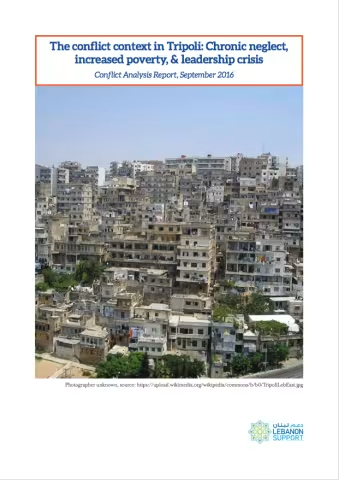
The “Roadmap to Reconciliation in Tripoli,” (RRT) project is a grassroots initiative that aims at launching a transitional justice route through understanding the public perceptions in Tripoli about reconciliation as well as people’s readiness and willingness to engage in a co
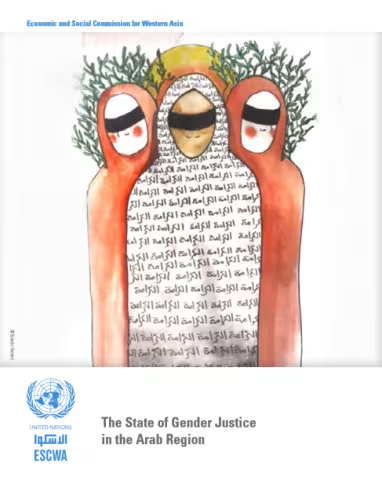
This study maps the current state of gender justice in the Arab region, documenting barriers as well as opportunities. Its primary research aim is to determine how to develop an environment, at the legal, policy, and social levels that is conducive to gender justice.
This report examines both the historical development and current situation of Syrians working in Lebanon through the analysis of policies established and implemented by the Lebanese government. While the report is not an assessment of these policies, it nevertheless reflects on its impact on Syrians’ working conditions and livelihoods. In this vein, this report notably focuses on emerging dynamics of increased informality, exploitation, and dependence.
It is part of a series of reports to be published in 2016, the 1st of which being "Formal Informality, Brokering Mechanisms, and Illegality...
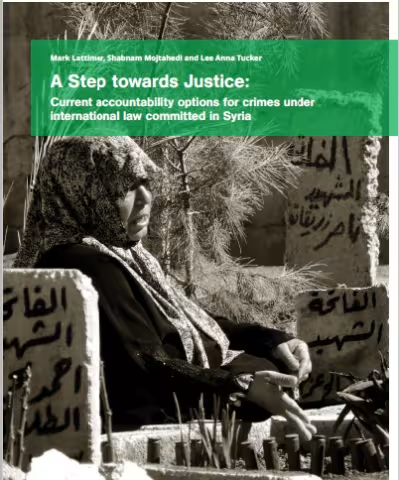
This document is an adaption of a speech delivered on May 12, 2015 at the launch of a report by the Syrian Justice and Accountability Center (SJAC) entitled ”A Step Towards Justice: Current Accountability Options for Crimes under International Law Committed in Syria.” The repo
Bringing together the years of regional and international experience within civil society activities, Besme was settled in Lebanon in September 2014, in order to contribute to the peaceful settlement of regional conflicts in Middle East. Through a route, which is full of difficulties, we managed to leave the year of 2015 behind, with successful and effective projects. We reckon 2015 as a year of investment for Besme. Reinvigorating the individual connections of management team at national, regional and international levels, we assume that a great step forward was taken for future. In the road...
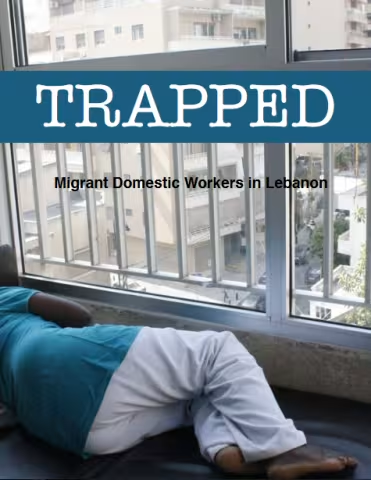
Over 250,000 migrant women are employed by private households in Lebanon to carry out household tasks such as cleaning, cooking, and caring for children and the elderly.
The right to freedom of movement forms one of the cornerstones of the international human rights regime and the Lebanese legal system. It is a right that everyone ought to enjoy regardless of race, national origin, residence status, religion or any other criteria.