This paper is inspired by examples of domestic workers organizing themselves in different parts of the world through social and solidarity economy enterprises and organizations which have become more evident since the advent of the ILO Domestic Workers Convention 2011, (No.189
This paper examines the impact of a rise in the Value Added Tax (VAT) on poverty and inequality in Lebanon. It develops an empirical model based on consumer demand theory and uses only household survey data on expenditures and spatial price indexes.
This brochure highlights UNDP’s contribution in the Early Recovery process of the Palestinian and Lebanese populations who were affected by the Nahr El Bared crisis.
The Israeli July 2006 war exposed the Lebanese population to disastrous conditions. It has profoundly affected residents’ livelihoods through bringing down access to services, infrastructure and natural resources. Responding to these emerging problems poses further challenges for the Lebanese government and society. In this respect, different emergency measures have been undertaken to address the arising needs, starting with assessing physical, economic and social damages.
As a contribution to identifying short and medium term intervention needs, the World Bank initiated undertaking a Post...
This national survey provides a vital statistical database on the demographic and the educational status in Lebanon; the residential fact and the economic activity of the individuals; the health insurance, the migration, the family’s income and the aid received during the war
Most theorists maintain that social exclusion is a process, not only the condition reflecting the outcome of that process. Yet few, if any, people ever reach the ultimate end of the imagined trajectory.
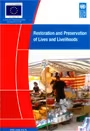
The activities, presented in this brochure, are illustrative of UNDP – European Commission Humanitarian Aid Department (ECHO) funded interventions and support in restoring and preserving livelihoods in the Lebanese most damaged regions.