The toolbox is intended as an open learning resource for youth workers that are engaged in community work with young refugees, asylum seekers and young people with migration background. Specifically: project managers, community leaders, educators, facilitators, social workers, intercultural mediators that are interested to improve their ability in the social inclusion of excluded groups.
The toolbox could also be used in formal settings such as schools, colleges and universities addressing
development challenges as well as for project managers and experts engaged in the design and...
This report aims to provide a contextual understanding of migration governance in the Lebanese context, as well as its implications for refugees and migrants.
Lebanon has had an ambiguous approach to the more than one million Syrians seeking protection in the country since 2011. The country is neither party to the 1951 Convention relating to the Status of Refugees, nor does it have any national legislation dealing with refugees.
In May 2015, the Lebanese authorities instructed UNHCR to temporarily suspend registration of Syrian refugees, including individuals already in the country and new arrivals.
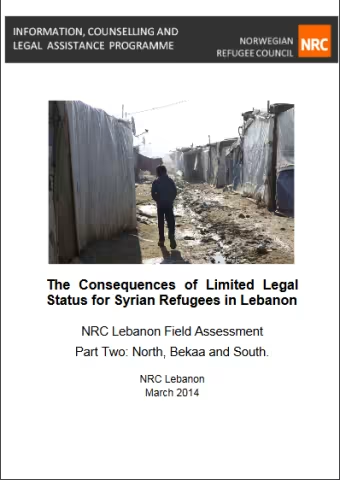
In December 2013, NRC launched a report entitled ‘The Consequences of Limited Legal Status for Syrian Refugees in Lebanon: NRC Field Assessment in Aarsal and Wadi Khaled’ (Part One) based on the findings of an assessment that NRC conducted between
This report places the spotlight on children, hearing from them the biggest challenges they face each day. We visited with 100 Syrian children, aged 7-13 in Central and West Bekaa.
Severe weather struck the country this week, affecting Syrian refugees sheltered in the mountain region of Bekaa. Heavy rains and snowfall have flooded some settlements, and a number of refugee families were forced to seek shelter elsewhere.
UNHCR’s Policy Development and Evaluation Service (PDES) is committed to the systematic examination and assessment of UNHCR policies, programmes, projects and practices.