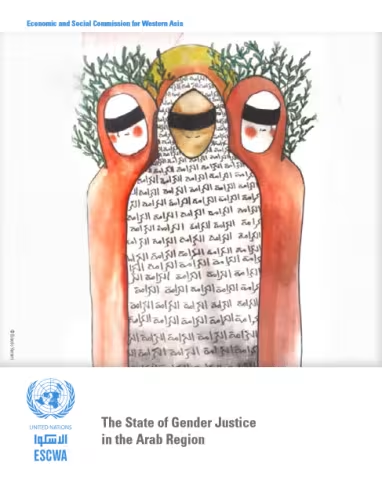
This study maps the current state of gender justice in the Arab region, documenting barriers as well as opportunities. Its primary research aim is to determine how to develop an environment, at the legal, policy, and social levels that is conducive to gender justice.
This paper is inspired by examples of domestic workers organizing themselves in different parts of the world through social and solidarity economy enterprises and organizations which have become more evident since the advent of the ILO Domestic Workers Convention 2011, (No.189
This study aims to shed light on the industry that profits from the recruitment of women from South Asian countries into domestic work employment in the Middle East, with a particular focus on Bangladesh, Jordan and Lebanon.
This report was presented at the International Labour Conference, 99th Session, 2010. It was intended to facilitate the discussion of domestic work at the Conference and consists of ten chapters, each of which covers issues pertaining to the topic of domestic work.
This paper examines the impact of a rise in the Value Added Tax (VAT) on poverty and inequality in Lebanon. It develops an empirical model based on consumer demand theory and uses only household survey data on expenditures and spatial price indexes.
This brochure highlights UNDP’s contribution in the Early Recovery process of the Palestinian and Lebanese populations who were affected by the Nahr El Bared crisis.
Most theorists maintain that social exclusion is a process, not only the condition reflecting the outcome of that process. Yet few, if any, people ever reach the ultimate end of the imagined trajectory.
The activities, presented in this brochure, are illustrative of UNDP – European Commission Humanitarian Aid Department (ECHO) funded interventions and support in restoring and preserving livelihoods in the Lebanese most damaged regions.