Findings in the "Analysis on Stunting Among Syrian Refugee Children" showed that risk factors perceived to be contributing to stunting levels among Syrian refugee children included those at the individual and household level with poor maternal nutrition, household food insecurity and inadequate complementary feeding practices as the factors perceived to be contributing the most to stunting among Syrian children. On the other hand, at the institutional and community level, market food prices, poverty, income, employment and livelihoods were the factors perceived to be contributing the most to...
More than a decade after the United Nations’ adoption of the Convention on the Elimination of All Forms of Discrimination against Women, which is adopted by many countries including Lebanon, these countries returned in 2015 to commit themselves to achieve gender equality and t
UNFPA on behalf of UNDP and UN Women organized a national workshop on gender-related laws, policies and practices in Lebanon, which was held in Beirut on the 7th and 8th of August, 2018.
This Policy Brief is based on research that explored the process of establishing and implementing Law 293, and on a policy dialogue that took place at the Institute on March 8, 2017 t
This is an assessment done in the detention centers and prisons in south Lebanon in coordination with the prisons department in the ministry of interior through which the WASH situation inside these prisons and centers was detected, needs and priorities were defined and possible rehabilitation and enhancement explored.
This document provides elements of discussion and pragmatic solutions to challenges in addressing GBV in the context of resistance. It does not provide clear cut answers to all questions, but intends to bring together evidence from UNRWA and results from other agencies.
This report examines the role of gender in Lebanese security perceptions, Lebanese perceptions of security institutions, as well as gender dynamics within security institut
Violence against women is directly linked to the historic discrimination against them. It is an expression of the gendered imbalance of power that has resulted in a gap intensified by the existing legal, social, and cultural institutions.
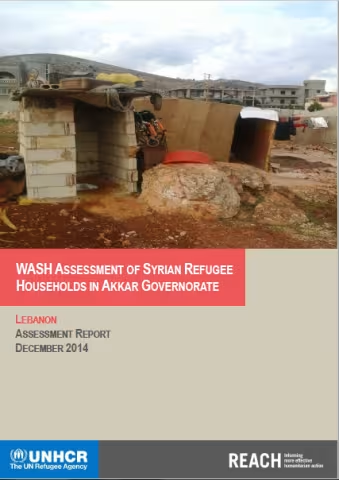
As the Syrian Crisis enters its fourth year, numerous water, sanitation, and hygiene (WASH) needs remain to be filled among Syrian refugees living in Lebanon, who now number more than 1.1 million.
As part of the assessment support mission, capacity assessment requested by the WASH partners to be carried out, the assessment team developed a Capacity Assessment Tool designed to collect information covering aspects, such as, profile, WASH response, WASH activities, transpo
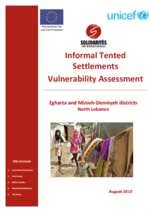
This report is the result of 4 months of field data collection from April to August 2013 carried out in the Informal Tented Settlements (ITS) of the two districts of Zgharta and Minieh-Dennieh by SOLIDARITÉS INTERNATIONAL’s (SI) outreach workers.
The number of Syrian refugees registered in Lebanon has more than quadrupled over the past six months. On January 1, 2013 Lebanon was hosting some 130,000 refugees; today that figure stands at more than 600,000.
This thematic report provides an overview of available lessons identified from assessments undertaken concerning the humanitarian situation in Syria as well as the situation for Syrian refugees in host-countries.
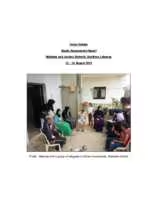
Swiss Solidar undertook a multi-sectoral needs assessment in August 2013 to assess the humanitarian needs of Syrian refugees residing in Nabatieh and Jezzine Districts in Southern Lebanon.1 Prior to undertaking its field assessment, Solidar undertook a detailed documentation r