An overview of the state of Palestinian refugees in Lebanon throughout history, that covers the political make up of the refugee camps, the impact of the July 2006 war on the Palestinian refugees, the refugees' rights and legal status, and the local and international NGOs work
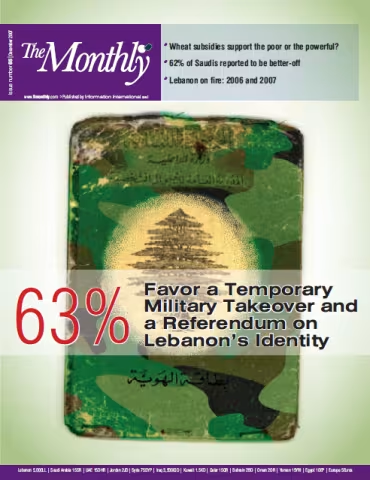
Events and experiences over the past years have confirmed that Lebanon is not a "country" in the legal and political context of the term but an "agreement" between 18 confessions to live on one land and find an appropriate framework (the state) to deal with their differences.
The Lebanese people are divided behind their zu'ama (leaders), who always disagree over national and critical matters in order to protect their status and interests.
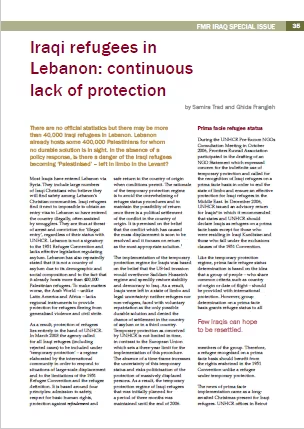
There are no official statistics but there may be more than 40,000 Iraqi refugees in Lebanon. Lebanon already hosts some 400,000 Palestinians for whom no durable solution is in sight.
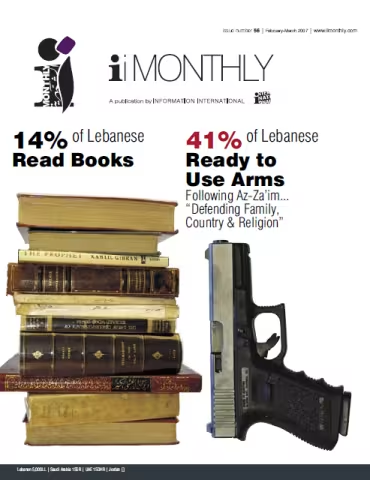
In the previous issue, Information International surveyed the opinion of the Lebanes on various issues, namely their political belonging, their position toward Hizbullah's arms and rearmament of political parties, their most preferred candidates for presidency and premiership,
As a consequence of the armed struggle between the Islamist group Fatah al-Islam and the Lebanese Army in and around the Nahr El-Bared Palestinian refugee camp north of Tripoli the past 3 weeks, the vast majority of its population has fled their homes and is now dispersed to
This report is the result of an assessment undertaken by the Danish Refugee Council (DRC) from March 28. to June 27, 2005 in Lebanon. The assessment was supported financially by the European Commission’s Humanitarian Aid department (ECHO).
A detailed report on ANND’s participation in this forum that covered the issues of neoliberal globalization and human development, women’s rights, geopolitical changes, democracy and public freedoms, cultural dimensions, environment and sustainable development, migration and t
The popularity of the women’s rights cause and its obvious intrinsic merit have unfortunately generated many facile assumptions and much confusion about the conditions of women in the Middle East and the problems they face
The study upon which this article is based analyzes the status of Arab women in general, gender relations in the Middle East, and the situation of Arab women with disabilities, based on available disability statistics from a few selected countries and the author's observations
To help expand the focus of the social protection debate to include the informal sector, particularly women workers, the ILO global programme STEP, "Strategies and Tools against Social Exclusion and Poverty" and the global network called Women in Informal Employment: Globalizi