This report is the result of 4 weeks’ field work from April 22 to May 17 carried out in the two districts of Zgharta and Minieh-Dennieh by SOLIDARITÉS INTERNATIONAL’s (SI) outreach workers.
Since Syria’s Arab Spring events began in March 2011, the Syrian Observatory for Human Rights estimates that the death toll has surpassed 21,000 people, mostly civilians, who have been killed in unrelenting violence in certain areas of the country1.
The human rights situation in the Syrian Arab Republic has deteriorated significantly since November 2011, causing further suffering to the Syrian people. Widespread violence and increasingly aggravated socio-economic conditions have left many communities in a perilous state.
ABAAD-Resource Center for Gender Equality, in partnership with Women's League for International Peace and Freedom (WILPF) and in collaboration with the United Nations Interim Forces (UNFIL) in South Lebanon, organized the National Consultation Meeting on May 10th, 2012 at Holi
The PDM consisted of conducting household surveys with beneficiaries who received Non-Food Items (NFIs in the form of hygiene kits) and food vouchers as part of WVL's Syrian refugee response in the Bekaa.
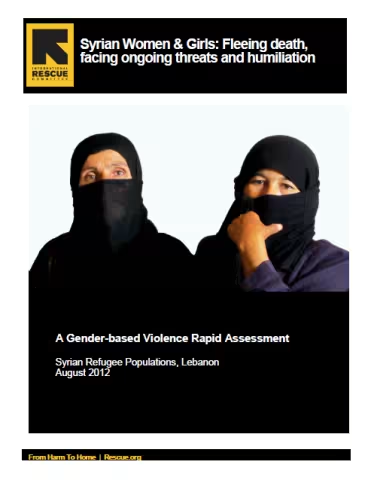
This Gender-based Violence Rapid Assessment conducted by International Rescue Committee in 2012 focuses on risks and violence faced by women and girls among the Syrian refugee population within Lebanon.
Research Paper | October 2011
A Case Study on Lebanon’s National Strategy for Forest Fire Management Elissar Harati and Hana A. El‐Ghali
The case study on Lebanon’s forest fire policy aims to trace the policy-formulation process which led to the National Strategy for Forest Fire Management. The policy represents a successful example of a civil society organization, namely a nongovernmental organization (NGO) specialized in reforestation activities, influencing policy-making through research and advocacy. The mandate of forest fires falls under the jurisdiction of a number of institutions...
Research Paper | October 2011
A Case Study on Lebanon’s National Strategy for Forest Fire Management Elissar Harati and Hana A. El‐Ghali
The case study on Lebanon’s forest fire policy aims to trace the policy-formulation process which led to the National Strategy for Forest Fire Management. The policy represents a successful example of a civil society organization, namely a nongovernmental organization (NGO) specialized in reforestation activities, influencing policy-making through research and advocacy. The mandate of forest fires falls under the jurisdiction of a number of institutions...
هذه الدراسة تم انجازها عام 2010، من قبل عزّة شرارة بيضون، بدعم من منظمتي أوكسفام برطانيا(OXFAM) و كفى عنف و استغلال و بتمويل من UNTRUSTED FUND ضمن إطار مشروع "تطوير مقاربات و استراتيجيات العمل مع الرجال لمناهضة العنف المنزلي في الشرق الاوسط".
This brochure elaborates on the achievements of the UNDP’s 4 portfolios in Lebanon: Democratic Governance, Poverty & Social Development, Environment & Energy, and Crisis Prevention & Recovery.
The starting point for the present Report is that, since the publication of the first volume in the series, the region’s human development fault lines have grown more complex, and in some cases deepened.
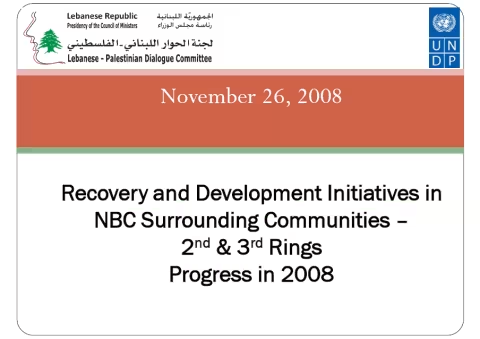
Following the Nahr EL Bared War, LPDC launched in 2008 a workshop mapping the recovery and development initiatives in the camp's area. They followed up in 2009 with another workshop reviewing the development projects that took place in the NBC area.
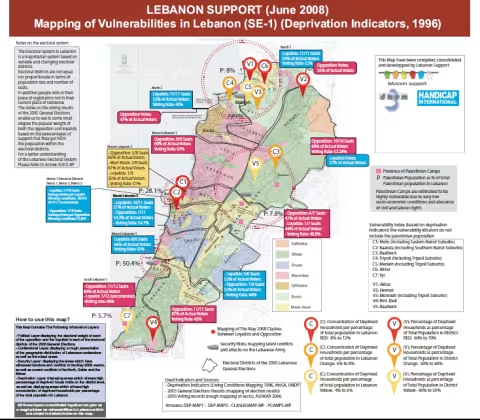
This Map Contains The Following Information Layers: - Political Layer displaying the electoral weight of each of the opposition and the loyalists in each of the electoral districts of the 2005 General Elections - Confessional Layer, displaying a rough presentation of the geogr
Evaluation des besoins en eau de la population de villages affectés par la guerre de Juillet 2006, et rapport des aides et distributions déjà reportées.