This report is this first of a three-part series focusing on the current status and lessons learned relating to transitional justice and policing initiatives in opposition-controlled Syria. • Part I focuses on the effects of the departure of judicial and security elements of the Syrian state has had on conditions on the ground currently and on the nascent justice institutions that have emerged in this void (including levels of institutionalisation, Islamic law, and the legal systems currently being debated and trialed in some areas). • Part II examines the variety of institutions and...
This paper examines the situation of impunity in Lebanon that has persisted since the 1975–1990 war. It highlights the price of the Lebanese authorities’ failure to address the legacy of past conflict.
This study recommends a holistic approach to crafting a comprehensive and victim-centered transitional justice process in Lebanon. An incremental approach to reform would be of value, given the likely challenges to pursuing accountability in the country. Programming must involve state and nonstate actors—political and community leaders, civil society, and the broader public. In addition, human...
This report examines the situation of impunity in Lebanon that has persisted since the 1975-1990 war through the lenses of core elements of transitional justice.
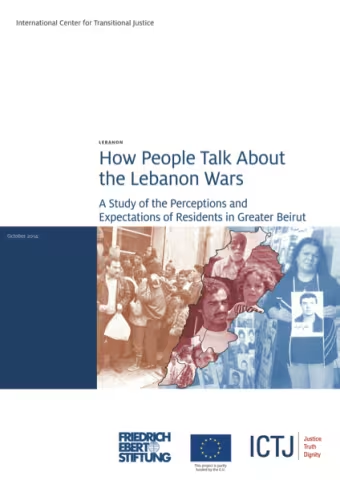
This report presents qualitative data collected by ICTJ on how individuals in Greater Beirut talk about the Lebanon wars and the need for truth, justice, and an end to violence in their country.
This report examines variations in wartime experiences and the attitudes of residents in Greater Beirut regarding measures to confront Lebanon’s legacy of political violence.
This paper discusses the risk of a renewed civil strife in Lebanon as a result of the Syrian Crisis. It argues that the security situation inside Lebanon could deteriorate due to three interrelated spillover effects stemming from Syria’s ongoing civil war.
Since March 2012, several towns and villages in the North, the Bekaa and the South started receiving Lebanese families who fled Syria, against the backdrop of sectarian conflicts. Most of those families left their hometown decades ago and got Syrian citizenship.
This report is the result of 4 months of field data collection from April to August 2013 carried out in the Informal Tented Settlements (ITS) of the two districts of Zgharta and Minieh-Dennieh by SOLIDARITÉS INTERNATIONAL’s (SI) outreach workers.
Swiss Solidar undertook a multi-sectoral needs assessment in August 2013 to assess the humanitarian needs of Syrian refugees residing in Nabatieh and Jezzine Districts in Southern Lebanon.1 Prior to undertaking its field assessment, Solidar undertook a detailed documentation r
Swiss Solidar undertook a multi-sectoral needs assessment in August 2013 to assess the humanitarian needs of Syrian refugees residing in Nabatieh and Jezzine Districts in Southern Lebanon.
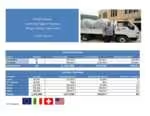
The average number of assisted families during the a/m period is 46% of the overall number of families reportedly arrived to DRC North Lebanon operational area (Akkar region).
The average number of assisted families during the a/m period is 35% of the overall number of families reportedly arrived to DRC Bekaa operational area.