Information and Communication Technology is necessary to help organisations, as well as grassroots collectives to better communicate, plan, organise, implement, monitor, and develop programmes and initiatives.
This guidebook strives to fulfill the preliminary needs of different small to medium CSOs in better using technology in their daily tasks. It targets team members fulfilling different roles in an organisation, and assumes the team has basic digital literacy.
This guidebook covers the use of MS Office, working on the Google Suite, Monitoring & Evaluation using Google Forms or...
This guidebook aims to build the capacities of civil society organisations’ members, prepare them for using organisational management tools, and introduce them to good governance mechanisms.
We Play for Peace is a handbook produced under the project with the same title highlighting activities and tools that can be adopted by trainers, coaches and facilitators with pre-adolescents and children under arts, sports and recreation.
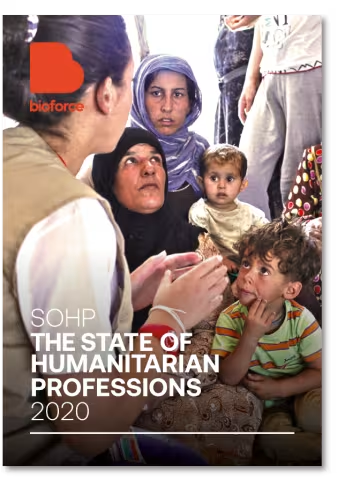
The State of Humanitarian Professions 2020 (SOHP) is the result of a year-long consultation with more than 1,500 humanitarian professionals. For the first time, this study gathers and analyses key figures on 24 humanitarian professions, as well as on recruitment practices and professional development in the sector. In addition, the SOHP study demonstrates the need to coordinate on the challenges of professionalising humanitarian teams, with 19 recommendations to be discovered in the final report.
The toolbox is intended as an open learning resource for youth workers that are engaged in community work with young refugees, asylum seekers and young people with migration background. Specifically: project managers, community leaders, educators, facilitators, social workers, intercultural mediators that are interested to improve their ability in the social inclusion of excluded groups.
The toolbox could also be used in formal settings such as schools, colleges and universities addressing
development challenges as well as for project managers and experts engaged in the design and...
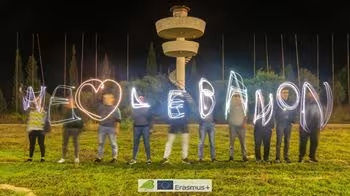
This document is the outcome of a workshop done during the Erasmus Plus training "Influence Youth".
The workshop was about the topic of teamwork, specifically the challenges faced when working with a team of volunteers and how to overcome it.
The participants of the workshop talked about their challenges and possible interventions were shared also by participants based on their experience working in this field.
The document includes the information shared by the participants in this workshop.
This is an assessment done in the detention centers and prisons in south Lebanon in coordination with the prisons department in the ministry of interior through which the WASH situation inside these prisons and centers was detected, needs and priorities were defined and possible rehabilitation and enhancement explored.
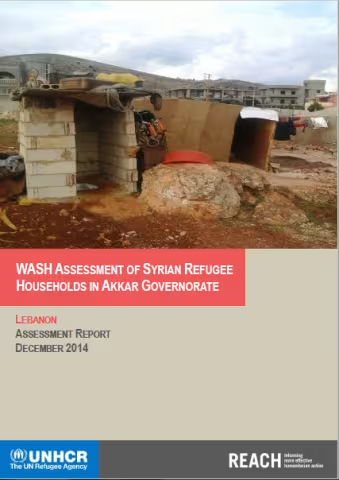
As the Syrian Crisis enters its fourth year, numerous water, sanitation, and hygiene (WASH) needs remain to be filled among Syrian refugees living in Lebanon, who now number more than 1.1 million.
The manual is composed of fun and interactive games for children aged 8 to 12 years old. The games will facilitatethe learning of important concepts and terminology pertaining to Gender Equality. More importantly, during/afterthe games have been played, it allows the trainer the freedom to begin important discussions about the conceptsthat the children learned during the games.
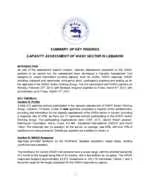
As part of the assessment support mission, capacity assessment requested by the WASH partners to be carried out, the assessment team developed a Capacity Assessment Tool designed to collect information covering aspects, such as, profile, WASH response, WASH activities, transpo
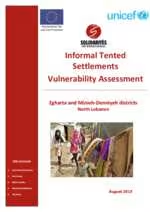
This report is the result of 4 months of field data collection from April to August 2013 carried out in the Informal Tented Settlements (ITS) of the two districts of Zgharta and Minieh-Dennieh by SOLIDARITÉS INTERNATIONAL’s (SI) outreach workers.
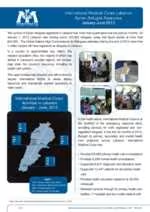
The number of Syrian refugees registered in Lebanon has more than quadrupled over the past six months. On January 1, 2013 Lebanon was hosting some 130,000 refugees; today that figure stands at more than 600,000.
This thematic report provides an overview of available lessons identified from assessments undertaken concerning the humanitarian situation in Syria as well as the situation for Syrian refugees in host-countries.
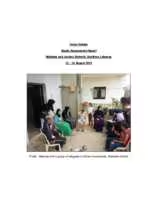
Swiss Solidar undertook a multi-sectoral needs assessment in August 2013 to assess the humanitarian needs of Syrian refugees residing in Nabatieh and Jezzine Districts in Southern Lebanon.1 Prior to undertaking its field assessment, Solidar undertook a detailed documentation r
This resource, published by Oxfam in 2013, aims to present standards that were originally developed for Oxfam staff to ensure a consistent approach to promoting gender equality in humanitarian preparedness and response programming.
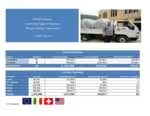
The objective of the project is to improve the housing conditions of the most vulnerable people affected by the Syrian crisis and to reduce their vulnerability to face the winter season.
This report is the result of 4 weeks’ field work from April 22 to May 17 carried out in the two districts of Zgharta and Minieh-Dennieh by SOLIDARITÉS INTERNATIONAL’s (SI) outreach workers.