Since Syria’s Arab Spring events began in March 2011, the Syrian Observatory for Human Rights estimates that the death toll has surpassed 21,000 people, mostly civilians, who have been killed in unrelenting violence in certain areas of the country1.
This book tackles key Issues of concern within the aid discussion. It outlines issues of particular importance for civil society in the Arab region and highlights the difference of prospectives between government representatives and CSOs.
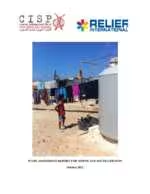
The human rights situation in the Syrian Arab Republic has deteriorated significantly since November 2011, causing further suffering to the Syrian people. Widespread violence and increasingly aggravated socio-economic conditions have left many communities in a perilous state.
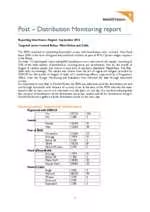
The PDM consisted of conducting household surveys with beneficiaries who received Non-Food Items (NFIs in the form of hygiene kits) and food vouchers as part of WVL's Syrian refugee response in the Bekaa.
The Strategic Planning is based on the findings of fieldwork carried out in several villages in Dinnieh, which aimed at identifying the major characteristics of the region in different fields.
The Manual on the Internal Management of the Non Governmental Organizations (NGOs) in Lebanon aims at providing a practical tool to develop and build the capacities of the NGOs in Lebanon.
This paper seeks to explain why women remain marginal in the Lebanese economy. It conducts a thorough review of literature to shed light on the economic, social and legal context to identify barriers to their full participation.
Following the Nahr EL Bared War, LPDC launched in 2008 a workshop mapping the recovery and development initiatives in the camp's area. They followed up in 2009 with another workshop reviewing the development projects that took place in the NBC area.
Evaluation des besoins en eau de la population de villages affectés par la guerre de Juillet 2006, et rapport des aides et distributions déjà reportées.