Events and experiences over the past years have confirmed that Lebanon is not a "country" in the legal and political context of the term but an "agreement" between 18 confessions to live on one land and find an appropriate framework (the state) to deal with their differences.
The Lebanese people are divided behind their zu'ama (leaders), who always disagree over national and critical matters in order to protect their status and interests.
This report, compiled by Pernilla Ouis and Tove Myhrman, is a comparative situation analysis of honour violence, early marriages and sexual abuse in Lebanon, the Occupied Palestinian Territories and Yemen.
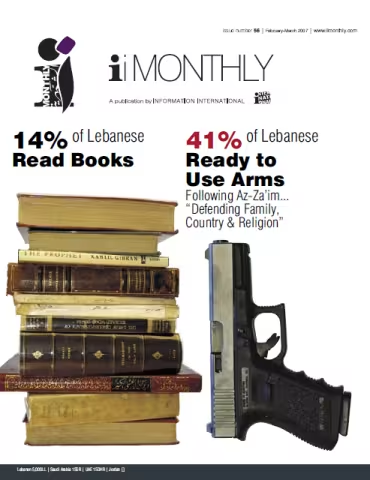
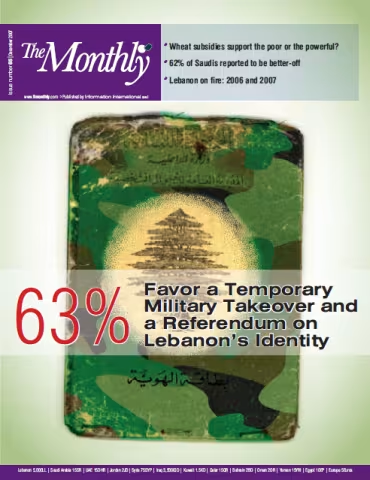
In the previous issue, Information International surveyed the opinion of the Lebanes on various issues, namely their political belonging, their position toward Hizbullah's arms and rearmament of political parties, their most preferred candidates for presidency and premiership,
The impetus for this case study arose in the “Advocacy for Reproductive Health” project, funded by the United Nations Population Fund (UNFPA) and implemented by The Palestinian Initiative for the Promotion of Global Dialogue and Democracy (MIFTAH), a non-governmental organizat
A detailed report on ANND’s participation in this forum that covered the issues of neoliberal globalization and human development, women’s rights, geopolitical changes, democracy and public freedoms, cultural dimensions, environment and sustainable development, migration and t
The popularity of the women’s rights cause and its obvious intrinsic merit have unfortunately generated many facile assumptions and much confusion about the conditions of women in the Middle East and the problems they face
This paper provides a brief overview of what is known about effective strategies for involving men in violence prevention efforts from the perspective of men who are recipients of anti-violence programs as well as from the men who provide them.