This Country Study is based on a full national report that is the first to draw a profile of poverty in Lebanon based on money-metric poverty measurements of household expenditures.
The Israeli July 2006 war exposed the Lebanese population to disastrous conditions. It has profoundly affected residents’ livelihoods through bringing down access to services, infrastructure and natural resources. Responding to these emerging problems poses further challenges for the Lebanese government and society. In this respect, different emergency measures have been undertaken to address the arising needs, starting with assessing physical, economic and social damages.
As a contribution to identifying short and medium term intervention needs, the World Bank initiated undertaking a Post...
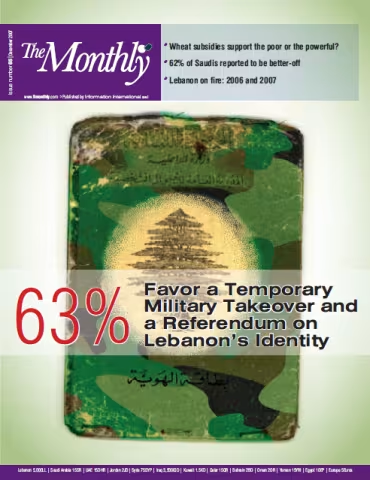
Events and experiences over the past years have confirmed that Lebanon is not a "country" in the legal and political context of the term but an "agreement" between 18 confessions to live on one land and find an appropriate framework (the state) to deal with their differences.
The Lebanese people are divided behind their zu'ama (leaders), who always disagree over national and critical matters in order to protect their status and interests.
تهدف "دراسة الأحوال المعيشية للأسر للعام 2007 " إلى توفير قاعدة غنية من البيانات الإحصائية في المواضيع أدناه، وذلك بهدف التعرّف على الأوضاع المعيشية للأسر في العام 2007 ومدى تأثير عدوان تموز 2006عليها: • الخصائص الاجتماعية للأسر ولأفرادها • الخصائص الديموغرافية والتربوية لأفرا
This report, compiled by Pernilla Ouis and Tove Myhrman, is a comparative situation analysis of honour violence, early marriages and sexual abuse in Lebanon, the Occupied Palestinian Territories and Yemen.
This national survey provides a vital statistical database on the demographic and the educational status in Lebanon; the residential fact and the economic activity of the individuals; the health insurance, the migration, the family’s income and the aid received during the war
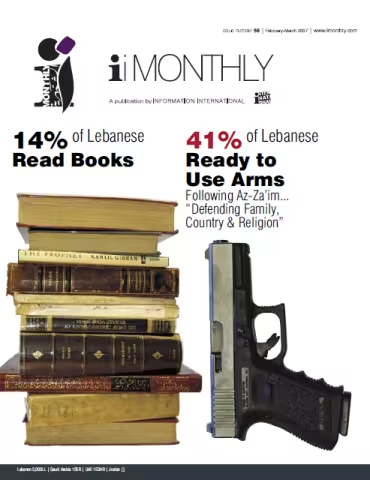
In the previous issue, Information International surveyed the opinion of the Lebanes on various issues, namely their political belonging, their position toward Hizbullah's arms and rearmament of political parties, their most preferred candidates for presidency and premiership,
“Moukhtar” booklet provides guidelines for municipality leaders and mayors, on how to effectively implement practices and procedures that would benefit the local community, whether in regular daily activities or in conflict situations.
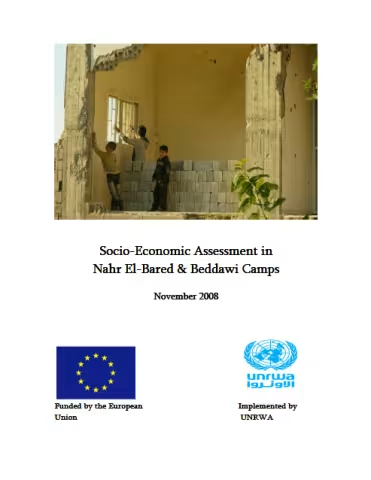
As a consequence of the armed struggle between the Islamist group Fatah al-Islam and the Lebanese Army in and around the Nahr El-Bared Palestinian refugee camp north of Tripoli the past 3 weeks, the vast majority of its population has fled their homes and is now dispersed to
This package contains two documents: - "AidProvidedbyPremiereUrgence_upto22August2006": Summary of the aid provided by Premiere Urgence, Lebanon, up to 22 August 2006 following the July 2006 Israeli war on Lebanon.
Dans le cadre du Projet MEDSTAT Environnement, l’Administration Centrale de la Statistique (ACS) – le point focal des statistiques en général et des statistiques environnementales en particulier – élabore le présent compendium.
A committee constituted of stakeholders in both KRC and EL-NADIM visited some villages in south Lebanon between September 4th & 7th, 2006. This post-war exploration tour extended to Marjeyoun, Tyr & Bint Jbeil.
• 40,000 Benefit from Food & Non-Food Relief Items in Southern Lebanon & Bekaa Valley • Survey on Situation of Migrant Domestic Workers following Voluntary Repatriation of 13,300 Stranded Migrants to Countries of Origin • Support to the Government of Lebanon in Managin
This package includes two documents: - "Islamic_Relief_Sitrep": Islamic Relief's situation report summarizing their relief activities to date and planned actions following the July 2006 Israeli war on Lebanon, prepared by IR's Disaster Preparedness and Response Unit (DPRU).
Since the beginning of the crisis in Lebanon on July 12, 2006, it has been reported as of August 24, 2006 that 1,1841 of people were killed and more than 4,0591 were wounded.
The objectives of this assessment are to identify and prioritize environmental impacts caused by the July 2006 war, to propose measures to alleviate those impacts rated as significant, and to recommend opportunities for greening the recovery, reconstruction, and reform process