تجاوز إلى المحتوى الرئيسي

موارد

Scope
Resource Type
Displaying 161 - 180 of 549
National
Publishing Date
In Lebanon, the question of hosting and ensuring protection for Syrian refugees in light of the government stance against the erection of camps has created many deliberations concerning different proposed and implemented shelter options and solutions. UN-Habitat, in partnership with the American University of Beirut’s (AUB) Issam Fares Institute for Public Policy and International Affairs (IFI), initiated a research study in July 2014 to address solutions for hosting and ensuring protection for refugees specifically on the subject of erecting camps to address the Syrian crisis. The study...
National
Publishing Date
The “Profiling vulnerability of Palestine refugees from Syria living in Lebanon” report is a multi-sectorial analysis of the vulnerability experienced by the Palestine Refugees from Syria [PRS] according to the following sectors: economic; education; food-security; health; protection; non-food items; shelter and water, sanitation and hygiene. It provides information on the living conditions of PRS to inform decision-making on programmatic activities. The survey is based on the VASyR [Vulnerability Assessment of Syrian Refugees in Lebanon] and adapted for UNRWA’s specific context. Data was...
National
Publishing Date
Working Paper Series # 24 | October 2014 Operation Protective Edge & Legal RemediesNoura Erakat, Bianca Isaias, and Salmah Rizvi On 26 August 2014, Israel and Palestinian resistance groups entered into a long-term ceasefire agreement. The terms of the agreement look almost identical to those established in November 2012, including a lack of implementation mechanisms. Indeed, if the parties fail to make these terms more precise and binding, it will be no more than a holding position before Israel’s next assault on the Gaza Strip Its most significant omission is a commitment to lift Israel’s...
National
Publishing Date
Working Paper Series # 24 | October 2014 Operation Protective Edge & Legal RemediesNoura Erakat, Bianca Isaias, and Salmah Rizvi On 26 August 2014, Israel and Palestinian resistance groups entered into a long-term ceasefire agreement. The terms of the agreement look almost identical to those established in November 2012, including a lack of implementation mechanisms. Indeed, if the parties fail to make these terms more precise and binding, it will be no more than a holding position before Israel’s next assault on the Gaza Strip Its most significant omission is a commitment to lift Israel’s...
National
Publishing Date

Working Paper | October 2014
Operation Protective Edge & Legal Remedies by Noura Erakat, Bianca Isaias, and Salmah Rizvi
This briefing paper provides a non-exhaustive survey of the legal fora in which Palestinians have sought, or can seek, legal redress. These include international courts, in particular the International Court of Justice (ICJ), the International Criminal Court (ICC), and special tribunals; national courts under universal jurisdiction as well as the Alien Tort Statute (ATS) in US federal courts; and human rights bodies and mechanisms like the Human Rights Council, and human...

National
Publishing Date
   As the Syrian crisis enters the fourth year, there is a timely need to reflect on the wider implications on Lebanon. The influx of over a million and half Syrian refugees brought a total of 400,000 school age refugees to Lebanon. This dramatic demographic shift posed a formidable challenge to an education system suited to deliver education to a national student population of just over 900,000. To date, the Lebanese Ministry of Education and Higher Education (MEHE) which only host 30% of the student population in Lebanon shouldered the burden of education service delivery with support from...
National
Publishing Date
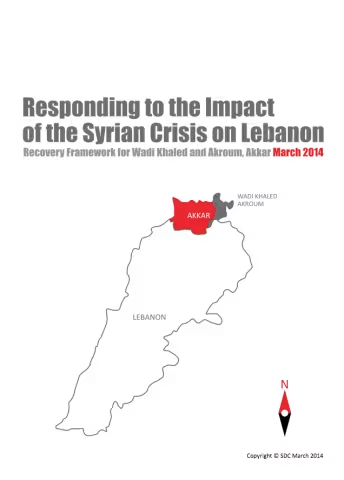
The Swiss Agency for Development and Cooperation (SDC) is pleased to share with you the report:  “Responding to the Impact of the Syrian Crisis on Lebanon: Recovery Framework for Wadi Khaled and Akroum, Akkar”, March 2014. SDC facilitated a process to shed light on the impact of the Syria crisis at the national level but also on the local level. The formulation of a recovery framework for Wadi Khaled and Akroum is a process that can be replicated for other affected regions of Lebanon. The findings and recommendations are based on consultations (between October 2013 and January 2014) with...
National
Publishing Date
This document represents the strategic plan of the Middle East and North Africa Harm Reduction Association,MENAHRA, for the period of July 2014 till December 2019. The development of a revised strategic plan was necessary due to the new challenges faced, and changing contexts in which MENAHRA has been operating in the past few years. Established in 2007 as a network of organisations with a central Secretariat in Beirut and three Knowledge Hubs in Iran, Lebanon and Morocco,MENAHRA has taken on additional roles over the past years, including the management of a large regional HIV grant. The...
National
Publishing Date
This working paper analyzes the susceptibility of agricultural outputs to future climate change in Lebanon, and the extent to which it propagates to the economic system as a whole. A methodological framework in which physical and economic models are integrated for assessing the higher-order economic impacts of projected climate changes is used. The researchers then quantify the broader economic impacts in the country considering not only the temporal dimension but also the regional disaggregation of the results. The results show that there are potential high costs and risks associated with a...
National
Publishing Date
Potential greenhouse gas (GHG) emissions reduction and social welfare gains can be achieved from upgrading the bus service in the Greater Beirut Area through a bundle of realistic bus service improvements in the short term. Such improvements will need to be comprehensive in scope and include both improvements in bus level of service attributes (access/egress time, headway, in-vehicle travel time, and number of transfers) and the provision of amenities, including air-conditioning and Wi-Fi. Moreover, such a service needs to be cheaply priced to achieve reasonably high levels of switching...