This policy brief was developed based on an in-depth report titled “Women’s Political Participation: Exclusion and Reproduction of Social Roles. Case Studies from Lebanon;” in addition to discussions and insights gathered during a consultation workshop held on 8 November 2018, and which marked the participation of women who had taken part of the research, as well as activists, representatives of civil society organisations, and academics.
With globalisation, the mobility of people has grown, and women are essential actors in this migratory phenomenon. This article focuses on the role of women in migration and the role of migration in advancing women’s rights to achieve gender equality.
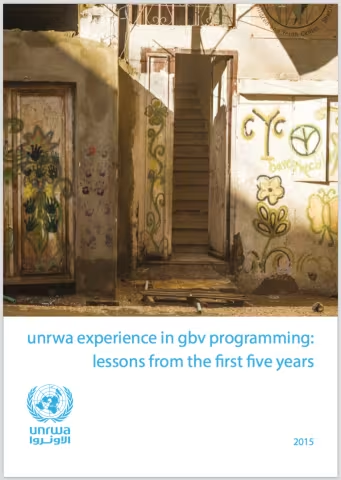
This document provides elements of discussion and pragmatic solutions to challenges in addressing GBV in the context of resistance. It does not provide clear cut answers to all questions, but intends to bring together evidence from UNRWA and results from other agencies.
This paper was prepared by the Economic and Social Commission for Western Asia (ESCWA) as a background paper contributing to the Arab Sustainable Development Report. It focuses on gender equality as a core element to achieve sustainable development.
Violence against women is directly linked to the historic discrimination against them. It is an expression of the gendered imbalance of power that has resulted in a gap intensified by the existing legal, social, and cultural institutions.
This thesis investigates transnational campaigns from the international and state level to consider the existence of transnational activism in Lebanon’s women’s movement.
This document is the outcome of a workshop organised by UNRWA on the 31st of March 2010 on “Community of Practice in Building Referral Systems for Women Victims of Violence”.
This paper seeks to explain why women remain marginal in the Lebanese economy. It conducts a thorough review of literature to shed light on the economic, social and legal context to identify barriers to their full participation.
This essay proposes to re-orient feminist debates on epistemology towards the care-security nexus as a pathway that can plausibly provide an integral understanding of a human-centred and eco-minded security.
This paper explores some faces of globalization by using a gender perspective, in order to consider reproduction (psychological and emotional as well as biological) and the activities and attitudes of care that give moral resources for response to systemic tragedy, not only fo
Using time-diary data from 25 countries, the authors demonstrate that there is a negative relationship between real GDP per capita and the female-male difference in total work time per day -- the sum of work for pay and work at home.
This resourse, assembled by Women for Women's Human Rights (WWHR) - New Ways, is a compilation of texts written by Evelyne Accad, Pinar Ilkkaracan, Nadera Shalhoub-Kevorkian, Dina Siddiqi and Zeina Zaatiri.
This article addresses the public policy concept of gender mainstreaming and the extent of its efficacy since the 1995 Beijing Platform for Action (PfA) and the UN's adoption thereof in 1997.