The United Nations Secretary-General has called for the first ever World Humanitarian Summit: to reaffirm our commitment to humanity and chart a course for change. The Secretary-General’s Agenda for Humanity calls on global leaders to commit to five core responsibilities in the name of our shared humanity:
Global leadership to prevent and end conflict
Uphold the norms that safeguard humanity
Leave no one behind
Change people's lives – from delivering aid to ending need
Invest in humanity
This study was undertaken by the Center for Women (ECW) at the United Nations Economic and Social Commission for Western Asia (ESCWA), in the context of a regional programme to review progress made in the implementation of the Beijing Declaration and Platform of Action in the
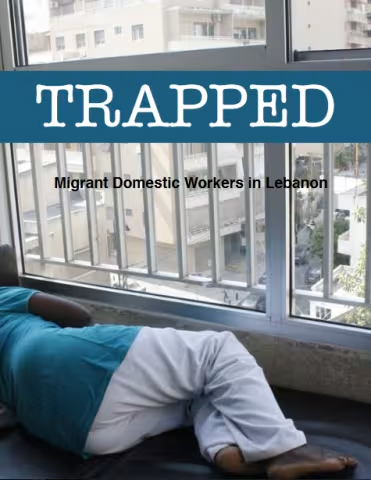
Over 250,000 migrant women are employed by private households in Lebanon to carry out household tasks such as cleaning, cooking, and caring for children and the elderly.
In October 2014, Lebanon’s Council of Ministers adopted a comprehensive policy on Syrian displacement, one explicit goal of which is to decrease the number of Syrians in Lebanon by reducing access to territory and encouraging return to Syria.
This report presents a brief analysis of the social stability context in the Qazas of Nabatieh and Bint Jbeil in the Nabatieh governorate, a sparsely populated religiously and politically homogenous area which hosts a small number of Syrian refugees.
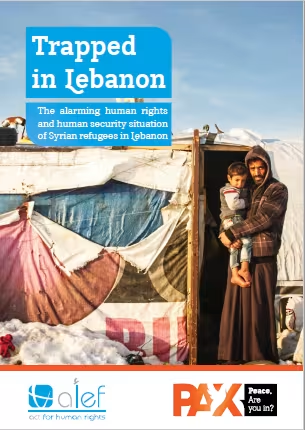
This report analyses the human rights and human security situation of refugees from Syria and their impact on the Lebanese society. Since the beginning of the conflict
The right to freedom of movement forms one of the cornerstones of the international human rights regime and the Lebanese legal system. It is a right that everyone ought to enjoy regardless of race, national origin, residence status, religion or any other criteria.
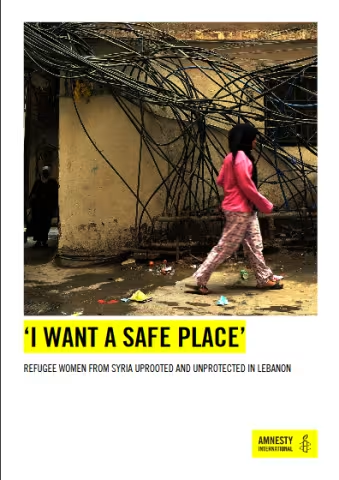
Syrian refugee women and Palestinian refugee women from Syria face risks of serious human rights violations and abuses in Lebanon, including gender-based violence and exploitation. Those who are heads of their households are at particular risk.
This is an analytical report based on data and statistics collected from public schools and aiming at detecting the effect of the Syrian refugees crisis on the public education sector and the priorities and needs for the public schools in the best interest of the Lebanese and refugees students.
This is a survey with Lebanese women 75% and Syrian refugees women 25% aiming at detecting the status of human rights in general and women rights in particular in the local southern community as well as refugees' community. The study also aims at detecting the economical status related to these women and the possibility or the access to jobs or small businesses financing and the level of economical dependency on males which relates positively or negatively on their knowledge of rights and consequently access to it.
Digital Citizen is a biweekly review of news, policy, and research on human rights and technology in the Arab World.
It is a collaborative reporting effort by Global Voices Advocacy, Access, EFF, and Social Media Exchange.
Get the latest edition of Digital Citizen on the web.
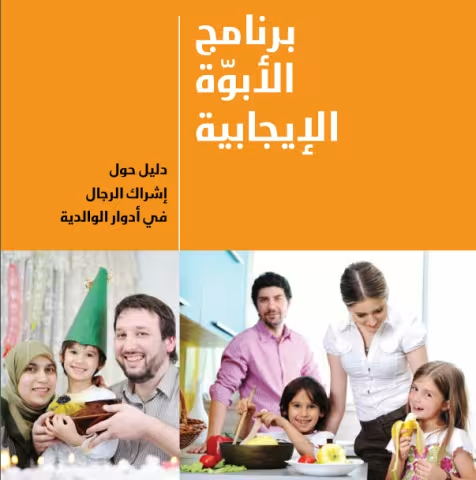
The adapted version of the Global "Program P" manual provides concrete strategies and activities to engage men in active positive fatherhood, from their partner’s pregnancies through their children’s early years. It identifies best practices on engaging men in maternal and child health, care-giving, and preventing violence against women and children on basis of equality and non-violence.
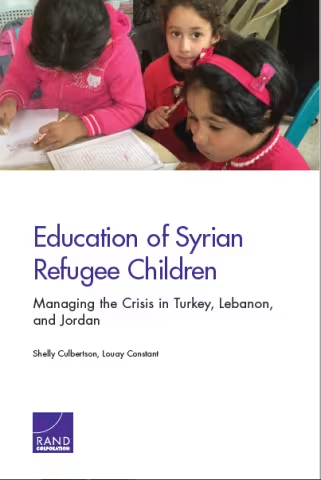
This scoping study is intended to contribute to the ongoing policy discussions among governments, donors, and United Nations agencies about the education of Syrian refugees in Lebanon, Turkey, and Jordan (the three countries with the largest populations of Syrian refugees),
This study aims to shed light on the industry that profits from the recruitment of women from South Asian countries into domestic work employment in the Middle East, with a particular focus on Bangladesh, Jordan and Lebanon.
In May 2015, the Lebanese authorities instructed UNHCR to temporarily suspend registration of Syrian refugees, including individuals already in the country and new arrivals.
This document provides elements of discussion and pragmatic solutions to challenges in addressing GBV in the context of resistance. It does not provide clear cut answers to all questions, but intends to bring together evidence from UNRWA and results from other agencies.