This report was presented at the International Labour Conference, 99th Session, 2010. It was intended to facilitate the discussion of domestic work at the Conference and consists of ten chapters, each of which covers issues pertaining to the topic of domestic work.
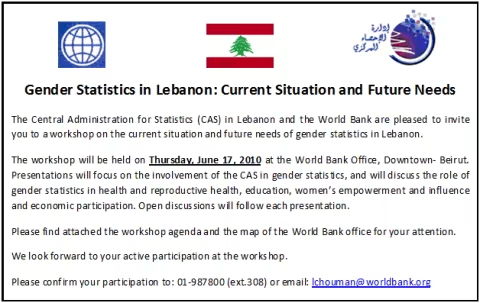
The Central Administration of Statistics (CAS) and the World Bank organized a workshop entitled "Gender Statistics in Lebanon: Current Situation and Future Needs," which took place on June 17, 2010.
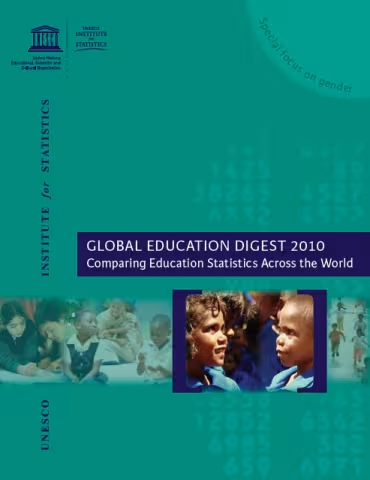
This edition of the Global Education Digest (GED) explores the changing patterns in gender and schooling throughout the formal education system – from primary to tertiary education levels.
The report assesses the progress made in the achievement of the Millennium Development Goals (MDGs) based on new national data which was formulated after the first MDGR that was published in 2003.
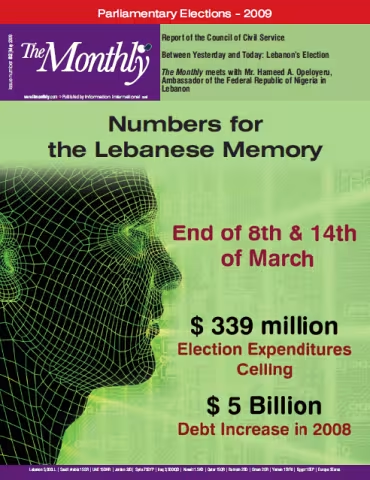
Parliamentary elections of 2009 and the year 2008 in review. The evenings of tuesday and Wednesday, April 7/8 marked the last day to register as a candidate for the Lebanese Parliamentary Elections scheduled on Sunday June 7, 2009.
Review of marginalisation of people with disabilities in Lebanon, Syria and Jordan. Using a social exclusion conceptual framework, this paper identifies several causes of marginalization of people with disabilities in the context of the MENA region.
This paper examines the impact of a rise in the Value Added Tax (VAT) on poverty and inequality in Lebanon. It develops an empirical model based on consumer demand theory and uses only household survey data on expenditures and spatial price indexes.
The aim of the “Socio-Economic Assessment in Nahr el-Bared surrounding areas” report is to provide an assessment of the pre and post conflict conditions of households located in the vicinity of Nahr el Bared camp for a variety of livelihood aspects including: housing, health,
This brochure highlights UNDP’s contribution in the Early Recovery process of the Palestinian and Lebanese populations who were affected by the Nahr El Bared crisis.
The Israeli July 2006 war exposed the Lebanese population to disastrous conditions. It has profoundly affected residents’ livelihoods through bringing down access to services, infrastructure and natural resources. Responding to these emerging problems poses further challenges for the Lebanese government and society. In this respect, different emergency measures have been undertaken to address the arising needs, starting with assessing physical, economic and social damages.
As a contribution to identifying short and medium term intervention needs, the World Bank initiated undertaking a Post...
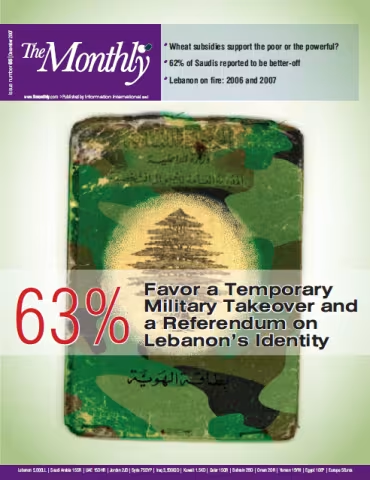
The Lebanese people are divided behind their zu'ama (leaders), who always disagree over national and critical matters in order to protect their status and interests.
This national survey provides a vital statistical database on the demographic and the educational status in Lebanon; the residential fact and the economic activity of the individuals; the health insurance, the migration, the family’s income and the aid received during the war
Most theorists maintain that social exclusion is a process, not only the condition reflecting the outcome of that process. Yet few, if any, people ever reach the ultimate end of the imagined trajectory.
As a consequence of the armed struggle between the Islamist group Fatah al-Islam and the Lebanese Army in and around the Nahr El-Bared Palestinian refugee camp north of Tripoli the past 3 weeks, the vast majority of its population has fled their homes and is now dispersed to
تشارك بما تقوم به حاليا بعض الجهات (جمعيات، تجمعات، أفراد...) في مجال التدخل التربوي (دعم اجتماعي نفسي للشباب والأطفال، نشاطات متنوعة مع الشباب والأطفال...) في الضاحية والبقاع والجنوب واحتمالات تدخل اليونسكو
In 2002 the Lebanese Physically Handicapped Union (LPHU) conducted a study of 200 graduates of institutions for disabled people, to find out if institutions help disabled people enjoy their rights in the areas of education and employment, as set out in Lebanon’s laws on disabi
The activities, presented in this brochure, are illustrative of UNDP – European Commission Humanitarian Aid Department (ECHO) funded interventions and support in restoring and preserving livelihoods in the Lebanese most damaged regions.