تجاوز إلى المحتوى الرئيسي

موارد

Theme
Displaying 41 - 60 of 79
National
Publishing Date
The purpose of the needs assessment conducted in the Bekaa area is to identify the needs of Syrian refugees (SR), in terms of food, non food items (NFIs), shelter, water and education.
National
Publishing Date
The Palestinian Student Guide in the Lebanese Educational Institutions is considered as an important tool that answers the needs of the Palestinian students related to the education system in Lebanon.
National
Publishing Date
This report summarises the findings of the recent Rapid Needs Assessment at Amel Association International’s Burj el Barajneh (Baajour) community centre, which took place in late March 2013.
National
Publishing Date
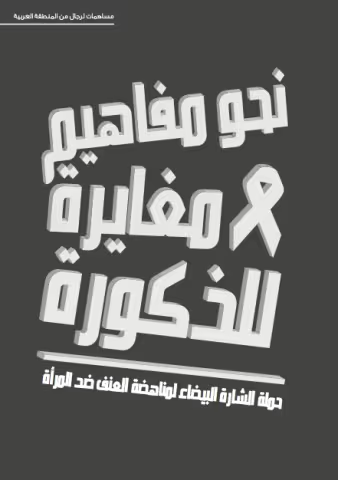
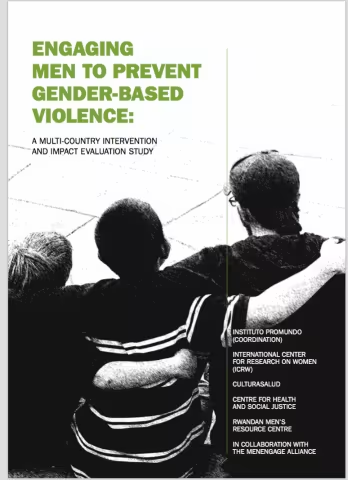
In cooperation with Oxfam GB, and with the support of the European Union, Kafa - Enough Violence and Exploitation works since 2009 on developing strategies and interventions with men and boys to end gender-based violence through the white ribbon campaign. On the occasion of the 16 days of activism to end violence against women Kafa considers that men should be involved in limiting and ending gender based violence, as standing against patriarchal society will also reflect positively on men and society in general.  The patriarchal society, which puts men and women in predefined solid identities...
National
Publishing Date

Working Paper | November 2012
The Role of Research Centers in Jordanian  Political Decision-Making | 1989-2010 by Walid Abdel Hay
It is difficult to assess the role of research centers in any country without understanding the overall environment in which they operate. The activities of these centers are intertwined with the movement of society in its various aspects, with the government in its various decisions, and with organized social forces in a civil society (parties and others). These activities are also not separate from the implications of their regional and international environments...

National
Publishing Date

2012 ورقة عمل |  تشرين الأول
​دور مراكز الأبحاث في صناعة القرار السياسات الأردني  | 1989-2010 من إعداد وليد عبد الحي
من الصعب الحكم على دور مراكز الدراسات في أية دولة دون إدراك البيئة العامة التي تعمل فيها هذه المراكز،إذ تتشابك نشاطات هذه المراكز مع حركة المجتمع في مختلف جوانبها، ومع الحكومة في مختلف قراراتها، ومع القوى الإجتماعية المنظمة في مجتمع مدني من أحزاب وغيرها، كما أنها غير منفصلة عن انعكاسات بيئتها الإقليمية والدولية 

National
Publishing Date

Study | December 2011
Restoring Dignity: The Raison D’etre of the Youth Movements in the Arab Citizen Revolt? by Rima Afifi, Ziyad Mahfoud, Rami Khouri, Sara Bittar, and Ahmad Younis
Dignity (in Arabic: Al Karama) is a slogan that has been chanted regularly during the Arab Citizen Revolt1 and a concept that continues to be a central theme as events unfold. In this paper, we explore the concept of dignity, identify a conceptual framework for thinking about dignity, and connect dignity to youth and the current situation. We then use data from the Gallup World Poll of Arab youth to assess the fit...

National
Publishing Date
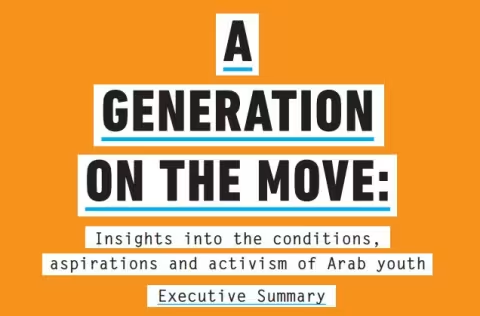
IFI Executive Summary | November 2011 A Generation on the Move: Insights into the Conditions, Aspirations, and Activism of Arab Youth Rami G. Khouri, Shahida Azfar, Charles Harb, Nasser Yassin, Moussa Shteiwi, Yazan Doughan, Abla Rouag-Djenidi, Dina Shehata, Barbara Ibrahim, Gregory Gause, Christine Asaad, Muneira Hoballah, Jad Melki, Mark Levine, Waad Ibrahim, Rodda Leage, Ivana Chalmers, Karen Abi Saab, Sarah Tabbara, Joe Khalil, Zina Sawaf, Carine Allaf, Diane Singerman, Nicola Bull, Shereen El Feki, Lucas Nielsen, Ayman Zohry, Mohammad Younis, Ahmed Younis, Leah Pybus, Tim Jacoby, Eileen...
National
Publishing Date
IFI Working Paper Series #4 | July 2010 Media Habits of MENA Youth:  A Three-Country SurveyJad Melki This pilot study surveyed 2,744 university and high school students in Jordan, Lebanon, and the United Arab Emirates. It asked about their media consumption and production habits, and about their attitudes towards certain media. Among the significant findings, the survey found the participants highly adept at using new media. They spent considerable time consuming new and traditional media, but much less time producing media content. For instance, the vast majority of participants indicated...