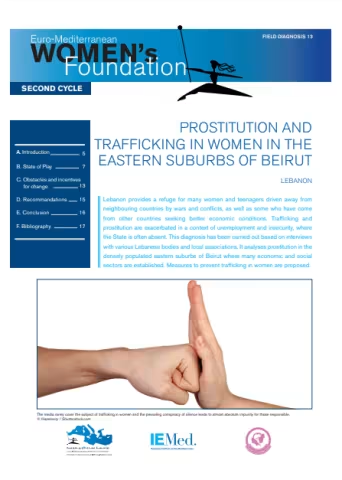
Lebanon provides a refuge for many women and teenagers driven away from neighbouring countries by wars and conflicts, as well as some who have come from other countries seeking better economic conditions.
The Governance and Community Action Programme (GCAP) aims to empower vulnerable municipalities and communities to mitigate conflict caused by resource tensions exacerbated by the Syrian refugee crisis.
This report presents issues within tertiary education for young Syrian refugees in Lebanon. It is part of a broader regional study commissioned by UNESCO.
This policy brief outlines options for strengthening rule of law in Lebanon to improve access to justice for both Lebanese citizens and Syrian refugees.
Refugee protection is inherently political. While international law and values inevitably influence governments’ decisions about how to respond to refugees, so too do power and interests.
This report presents findings from a survey conducted from 3-11 July, 2017 with three distinct refugee groups in Lebanon: Syrian refugees; Palestine refugees from Syria; and Palestine refugees from Lebanon.
The conflict in Syria continues to drive the largest refugee crisis in the world. Over 5.3 million Syrians are registered as refugees in neighbouring countries as of 1 December 2017.
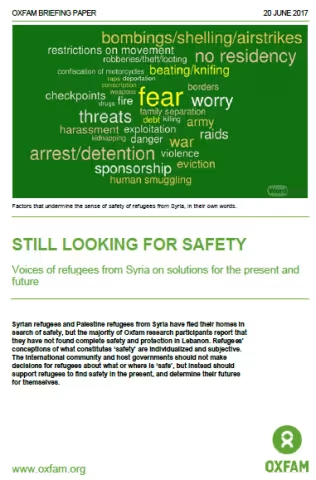
Based on the findings of participatory protection research that Oxfam undertook with refugees in Lebanon between late 2016 and early 2017, this paper explores refugees’ own definitions and conceptions of safety, and highlights refugee perspectives on how the international comm
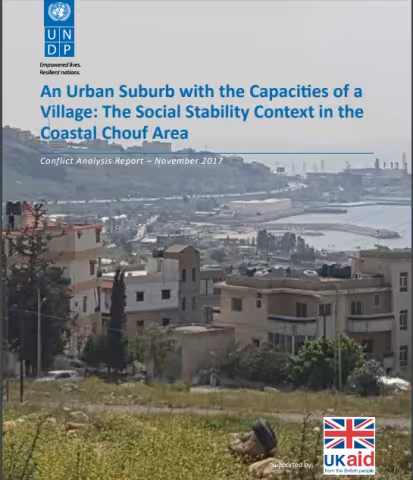
This report introduces the conflict context in the coastal Chouf area, a semi-urban area connecting the capital Beirut to Sidon in the south, the country’s third largest city.
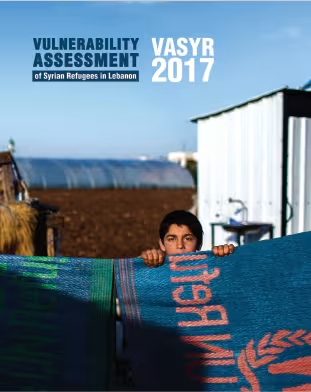
The 2017 Vulnerability Assessment of Syrian Refugees in Lebanon (VASyR) is the fifth annual survey assessing the situation of a representative sample of registered Syrian refugee households to identify situational changes and trends.
This policy brief analyses the socio-political implications of the so-called October policies, and suggests legislative, political, and practical measures to improve the situation of Syrian refugees in Lebanon. It also aims to inform policy formulation regarding Syrian refugees from a human rights-based perspective, while discussing modalities for enhanced programming at the civil society level.
This policy brief is the fourth publication of a research project investigating the social effects of political and legal measures on Syrian refugees’ daily lives. The brief is based on a consultative...
This report aims to explore the fragmented organisation of healthcare services in Lebanon, for Syrian refugees. Although it is not an assessment of the Lebanese healthcare system, this report does nevertheless reflect on the challenges and underlying dynamics of the current Lebanese system, which are reproduced in the healthcare provision for Syrian refugees. In this sense, the report highlights the privatised, rather ad hoc, and irregular provision of healthcare in Lebanon, notably for Syrian refugees, which tends to take on a more curative rather than preventive approach, resulting in...
The present report draws attention on the vulnerable situation of victims of torture from Syria currently residing in Lebanon, especially in the light of the tightening of the Lebanese residency laws, whereby there seems to be a severe risk that torture victims will be exposed to torture once again.
Based on 100 testimonies from victims of torture, the report presents the practices of torture in Syria and in Lebanon towards refugees from Syria, along with the consequences on vulnerable individuals.
دف التّقرير جذب الإنتباه إلى هشاشة وضع ضحايا التعذيب من سوريا المقيمين حاليًا في لبنان، خاصةً على ضوء تعديل قانون الإقامة بحيث أصبح أكثر قسوةً، والذي أدّى إلىإحتمال عالي الخطورة تعرّض ضحايا التّعذيب إلى التّعذيب مرّةً أخرى.
هذا التّقرير يقدّم وسائل التّعذيب الممارسة في سوريا وفي لبنان تجاه اللّاجئين السّوريّين، بالإضافة إلى التّداعيات المسبَّبة تجاه الأشخاص ذوي الوضع الهشّ بالأساس، إستنادًا إلى شهادة 100 ضحية تعذيب.
This report examines both the historical development and current situation of Syrians working in Lebanon through the analysis of policies established and implemented by the Lebanese government. While the report is not an assessment of these policies, it nevertheless reflects on its impact on Syrians’ working conditions and livelihoods. In this vein, this report notably focuses on emerging dynamics of increased informality, exploitation, and dependence.
It is part of a series of reports to be published in 2016, the 1st of which being "Formal Informality, Brokering Mechanisms, and Illegality...
This report seeks to provide an overview of Lebanon’s current policy towards Syrian refugees, and to explore the new rules and regulations issued by General Security regarding the entry, residency, and departure of Syrian nationals. It also analyses the challenges pertaining to the current policy and its impact on the daily lives of Syrian refugees, with a special focus on their emerging illegality, their struggle for decent livelihood and working conditions, and increased informality and insecurity.
It is the first of a series of reports to be published in 2016, the 2nd report of the series...
The purpose of this policy brief is to inform policy formulation on local level security provision and refugee protection, and to propose modalities for upgrading the sys- tems of the Lebanese security institutions in a way that strengthens protection of the Lebanese communities and the Syrian refugees they host. Based on eld research conducted between February and May 2016 in three locations across Lebanon, this brief analyses the challenges to protecting local communities and refugees in a hybrid system, in which formal and informal security actors coexist and implement a mix of security...