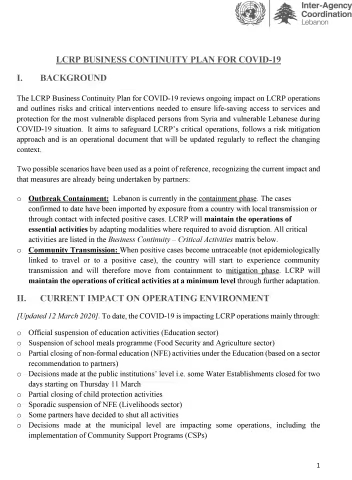
The LCRP Business Continuity Plan for COVID-19 reviews ongoing impact on LCRP operations and outlines risks and critical interventions needed to ensure life-saving access to services and protection for the most vulnerable displaced persons from Syria and vulnerable Lebanese during COVID-19 situation.
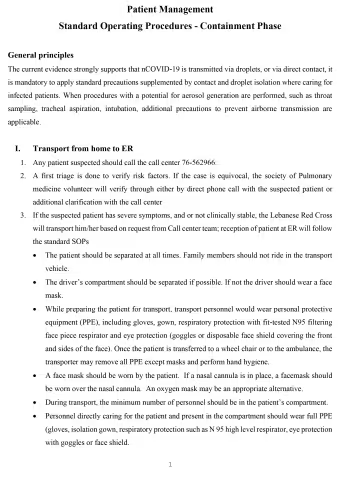
The current evidence strongly supports that nCOVID-19 is transmitted via droplets, or via direct contact, it
is mandatory to apply standard precautions supplemented by contact and droplet isolation where caring for
infected patients.
This document provides an update that aims to provide an operational snapshot for NGOs in a rapidly changing context. This also provides some suggestions around national level response planning from a field perspective.
“More than 60% of Syrian refugees households comprise a person with disabilities and 1/5 Syrian refugees has a disability in Lebanon and Jordan”, shows a large study conducted by Humanity & Inclusion (HI) and iMMAP.
Analyzing the Impact on the Personal and Professional Development
of Young Participants at Erasmus Plus/Youth in Action/Euromed projects through “Chabibeh Sporting Club” From 2008 till 2017
This report aims to explore the fragmented organisation of healthcare services in Lebanon, for Syrian refugees. Although it is not an assessment of the Lebanese healthcare system, this report does nevertheless reflect on the challenges and underlying dynamics of the current Lebanese system, which are reproduced in the healthcare provision for Syrian refugees. In this sense, the report highlights the privatised, rather ad hoc, and irregular provision of healthcare in Lebanon, notably for Syrian refugees, which tends to take on a more curative rather than preventive approach, resulting in...
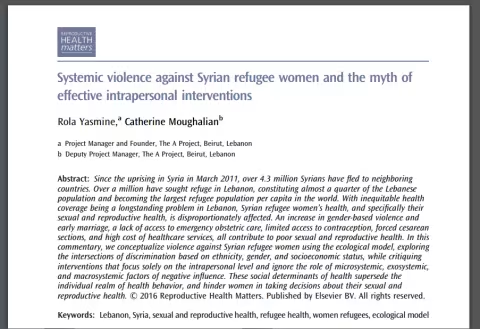
Since the uprising in Syria in March 2011, over 4.3 million Syrians have fled to neighboring countries. Over a million have sought refuge in Lebanon, constituting almost a quarter of the Lebanese population and becoming the largest refugee population per capita in the world.
With inequitable health coverage being a longstanding problem in Lebanon, Syrian refugee women’s health, and specifically their sexual and reproductive health, is disproportionately affected. An increase in gender-based violence and early marriage, a lack of access to emergency obstetric care, limited access to...
Twenty-five years after the end of the Lebanese Civil War, the families of the missing and forcibly disappeared in Lebanon are still waiting for answers about the fate of their loved ones. A new report by the International Center for Transitional Justice says the country seems to be ready to address this issue through an independent national commission and lays out the features of a successful future commission.
The 38-page study, “The Missing in Lebanon: Inputs on the Establishment of the Independent National Commission for the Missing and Forcibly Disappeared in Lebanon,” includes expert...