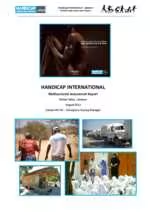
The purpose of the needs assessment conducted in the Bekaa area is to identify the needs of Syrian refugees (SR), in terms of food, non food items (NFIs), shelter, water and education.
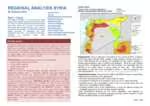
This Regional Analysis of the Syria Conflict (RAS) seeks to bring together information from all sources in the region and provide holistic analysis of the overall Syria crisis.
Disability & Vulnerability Focal Point (DVFP) have been developed based on the observation that one of the greatest difficulties following a crisis is not only to identify and to access to vulnerable people including people with disabilities, but also to accompany them wit
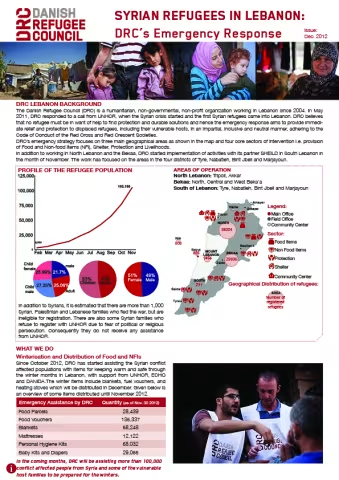
DRC LEBANON BACKGROUNDThe Danish Refugee Council (DRC) is a humanitarian, non-governmental, non-profit organization working in Lebanon since 2004. In May 2011, DRC responded to a call from UNHCR, when the Syrian crisis started and the first Syrian refugees came into Lebanon. DRC believes that no refugee must be in want of help to find protection and durable solutions and hence the emergency response aims to provide immediate relief and protection to displaced refugees, including their vulnerable hosts, in an impartial, inclusive and neutral manner, adhering to the Code of Conduct of the Red...
This study, supported by UNFPA, assessed the reproductive health and gender-based violence among displaced Syrian women in Lebanon between July and September 2012.
The human rights situation in the Syrian Arab Republic has deteriorated significantly since November 2011, causing further suffering to the Syrian people. Widespread violence and increasingly aggravated socio-economic conditions have left many communities in a perilous state.
Over 57,000 displaced Syrians are receiving protection and assistance in Lebanon through the efforts of the Government of Lebanon and UN and NGO partners.
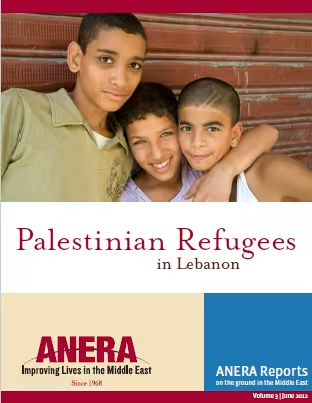
The list of challenges Palestinian refugee families living in Lebanon face is long and overwhelming. They live in overcrowded camps and have to deal with discrimination, isolation and social exclusion.
Oxfam GB commissioned the pilot study discussed in this report in order to understand further the context that shapes men’s gender roles and affects their behaviours, practices, and attitudes towards gender equality, with an explicit focus on VAW.
This report was presented at the International Labour Conference, 99th Session, 2010. It was intended to facilitate the discussion of domestic work at the Conference and consists of ten chapters, each of which covers issues pertaining to the topic of domestic work.
The report assesses the progress made in the achievement of the Millennium Development Goals (MDGs) based on new national data which was formulated after the first MDGR that was published in 2003.
This paper examines the impact of a rise in the Value Added Tax (VAT) on poverty and inequality in Lebanon. It develops an empirical model based on consumer demand theory and uses only household survey data on expenditures and spatial price indexes.
This brochure highlights UNDP’s contribution in the Early Recovery process of the Palestinian and Lebanese populations who were affected by the Nahr El Bared crisis.
The Israeli July 2006 war exposed the Lebanese population to disastrous conditions. It has profoundly affected residents’ livelihoods through bringing down access to services, infrastructure and natural resources. Responding to these emerging problems poses further challenges for the Lebanese government and society. In this respect, different emergency measures have been undertaken to address the arising needs, starting with assessing physical, economic and social damages.
As a contribution to identifying short and medium term intervention needs, the World Bank initiated undertaking a Post...
This national survey provides a vital statistical database on the demographic and the educational status in Lebanon; the residential fact and the economic activity of the individuals; the health insurance, the migration, the family’s income and the aid received during the war