The United Nations Secretary-General has called for the first ever World Humanitarian Summit: to reaffirm our commitment to humanity and chart a course for change. The Secretary-General’s Agenda for Humanity calls on global leaders to commit to five core responsibilities in the name of our shared humanity:
Global leadership to prevent and end conflict
Uphold the norms that safeguard humanity
Leave no one behind
Change people's lives – from delivering aid to ending need
Invest in humanity
This report aims to present a general overview of the current local gender actors and their interventions in Lebanon. It also aims to shed light on the complex relationship between women’s organisations in Lebanon and their donors. In this context, it is important to ask to what extent the funding tends to shape project design at a local level? And moreover, does funding of short-term and service-oriented projects edulcorate the political change that these organisations could bring?
Based on a survey done by Lebanon Support during 2015, it gives an overview of the main gender actors, their...
يسعى هذا التقرير إلى تقديم لمحة عامة عن الجهات الفاعلة الحالية في مجال قضايا الجندر وتدخلاتها في لبنان. كما يسعى إلى تسليط الضوء على العلاقة المعقدة بين المنظمات التي تعنى بشؤون المرأة في لبنان والجهات الممِّولة لها. ومن الأهمية بمكان في هذا الإطار الإجابة على الأسئلة التالية: إلى أي مدى تساهم توجهات التمويل في تحديد ملامح تصميم المشاريع على المستوى المحلي؟ وهل أن المشاريع القصيرة الأمد والمتحورة حول توفير الخدمات تساهم في تنقية التغيير الإجتماعي الذي يمكن لهذه المنظمات إحداثه؟
أتاحت لنا البيانات التي تم جمعها من خلال مسح قام به مركز دعم لبنان في ٢٠١٥ إمكانية بلورة لمحة عامة عن...
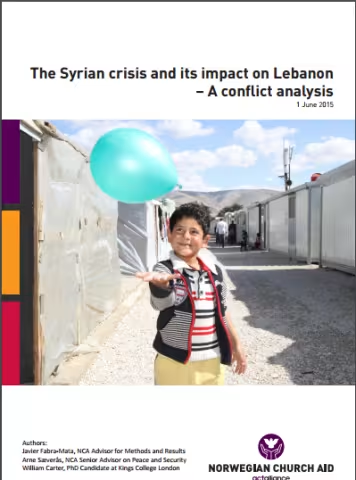
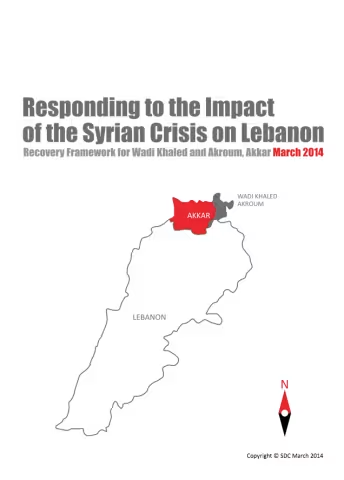
The present report analyses the impact of the Syrian conflict and refugee crisis on Lebanon and Lebanese host communities. This brief analysis presents the main conflict issues and trends, and the network of interaction between local and national level conflict dynamics.
The Swiss Agency for Development and Cooperation (SDC) is pleased to share with you the report:
“Responding to the Impact of the Syrian Crisis on Lebanon: Recovery Framework for Wadi Khaled and Akroum, Akkar”, March 2014.
SDC facilitated a process to shed light on the impact of the Syria crisis at the national level but also on the local level. The formulation of a recovery framework for Wadi Khaled and Akroum is a process that can be replicated for other affected regions of Lebanon.
The findings and recommendations are based on consultations (between October 2013 and January 2014) with...
The mission there is to provide helps to handicapped persons at home
Materials or accommodation specifies the helps
Materials are wheel chair, prosthesis, medicines
The accommodation is defined under the parent’s responsibility
The private sector has long been a major contributor to humanitarian action. At the community level, businesses frequently use their materials and resources to aid people affected by crises. As local markets recover and supply chains are repaired, crisis-affected people are once again able to access basic goods and, in some cases, resume livelihoods. Large national, regional and multinational firms are also closely involved in supporting humanitarian objectives, whether indirectly, by resuming operations in crisis affected areas, or directly, by providing cash and in kind donations of goods or...
The humanitarian aid system is growing and expanding, and so surely its capacity to meet these challenges should also be growing.
Yet despite the enormous resources, in the more complex, less high-profile and difficult contexts, MSF teams in the field have seen that humanitarian responses to displacement emergencies have not occurred in a timely and effective way. This is especially the case in conflict areas.
These observations have prompted MSF to conduct this review, to better understand how the humanitarian system is responding to acute displacement emergencies. The review is based on...
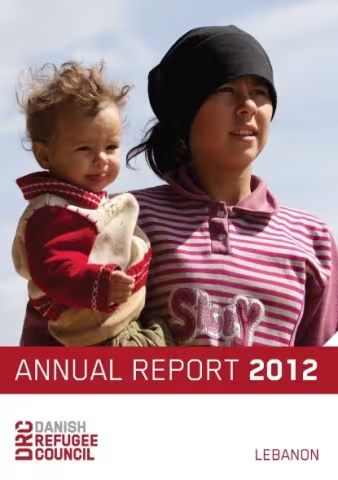
DRC in Lebanon
The Danish Refugee Council has been operating in Lebanon since September 2004.The focus of the organization has shifted over time as the country’s needs changed.
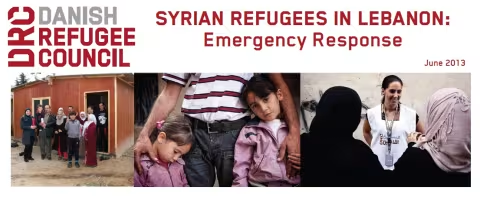
DRC’s main focus in Lebanon in 2013 has been on providing emergency assistance to refugees from Syria, and on developing the capacities of hosting communities across Lebanon. The emergency response program focuses on four sectors of intervention: Protection, Direct Assistance, Shelter/Community Center Management, and Community Development.
In parallel, the organization’s Development Programme works with Migrant...
This paper highlights the specificity of the refugee crisis in the unstable Lebanese landscape and calls for the reconfiguring of current relief mechanisms by enabling decentrali
DRC in Lebanon
The Danish Refugee Council began operating in Lebanon in 2004. Since then, the organization
has partnered with local and international NGOs to implement different programs that followed the
country’s needs. Today, DRC’s main focus is on assisting those affected by the Syrian crisis, including
refugees and members of the hosting communities. DRC also provides assistance to Palestinian
refugees, migrant domestic workers and women at risk.
DRC currently addresses the needs of four displaced population groups, as well as the affected
Lebanese communities:
-Syrian refugees feeling...
The Syrian crisis continues to provoke an ever increasing displacement across the border into Lebanon. According to the UNHCR, more than 569,000 Syrian refugees are now receiving protection and assistance from the Lebanese government, the UN and NGO’s. With no end to the crisis in sight, the number of Syrian refugees entering Lebanon is expected to rise to one million by the end of the year, posing a significant challenge to hosting communities around Lebanon. DRC and its partners continue to provide essential services to meet the needs of refugees and locals.
DRC’s emergency strategy focuses...
This report summarises the findings of Amel Association International’s latest Rapid Needs Assessment that was conducted from its Haret Hreik community centre in May 2013. It is hoped that the reader will benefit both from the summary of the target population’s needs and the analysis of how Amel Association International can best replicate such assessments in the future.
This report summarises the findings of the recent Rapid Needs Assessment at Amel Association International’s Burj el Barajneh (Baajour) community centre, which took place in late March 2013. It is hoped that the reader will benefit both from the summary of the target population’s needs and the analysis of how Amel Association International can best replicate such assessments in the future.
Sommaire :
Avant‐propos
I) Organigramme d’Adyan
II) Les réalisations par département
A) CCSD
B) SEC‐D
C) Média
D) Solidarité
III) Le Réseau des Volontaires
IV) Les Rencontres internationales
V) L’équipe administrative
VI) Budget et Résultat
VII) Faites un don
VIII) Adresse
IX) Web, 15
Table of content:
Forward
I) Adyan organizational chart
II) Key achievements by department
A) CCSD
B) SEC-D
C) Media D
D) Solidarity D
III) Volunteerism at Adyan
IV) Intercultural and International Meetings
V) Office and admin team
VI) Budget and Balance
VII) Support us
VIII) Address
IX) Web
The continuing unrest in Syria is resulting in a growing influx of Syrian refugees to Lebanon. The United Nations High Commissioner for Refugees has registered over 57,000 Syrian refugees in Lebanon (September 7, 2012) while many refugees are awaiting registration.