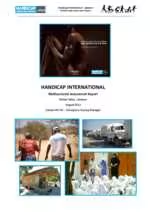
Severe weather struck the country this week, affecting Syrian refugees sheltered in the mountain region of Bekaa. Heavy rains and snowfall have flooded some settlements, and a number of refugee families were forced to seek shelter elsewhere.
The general objective of the project is to contribute to mitigate the impact of the Syrian Crisis on the most vulnerable persons and their families - including Syrian injured refugees and other vulnerable groups - by responding to their basic and specific needs.
UNHCR’s Policy Development and Evaluation Service (PDES) is committed to the systematic examination and assessment of UNHCR policies, programmes, projects and practices.
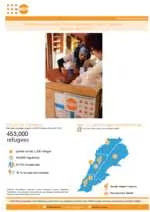
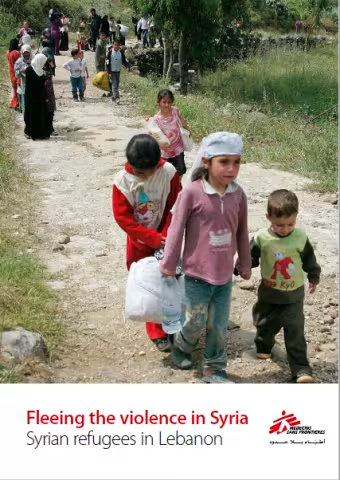
Over 57,000 displaced Syrians are receiving protection and assistance in Lebanon through the efforts of the Government of Lebanon and UN and NGO partners.
Research and Policy Memo #10 | May 2011
Climate Change and Health Research in the Eastern Mediterranean Region (EMR)Rima R. Habib
Climate change is likely to aggravate the burden of disease in the Arab region currently suffering from political instability, natural disasters and humanitarian crises. The prevailing arid environment and the reliance on rain-fed food production exacerbate the situation. Therefore, governments and key stakeholders are encouraged to make further outlays to counteract new and increasing challenges to population health.
The brief of this qualitative exploratory study was to conduct targeted interviews with female employers of migrant domestic workers, psychiatrists, lawyers and institutional stakeholders in Lebanon.
This report will provide a description of the assessment conducted by IMC’s Mental Health and Psychosocial team in the region of Wadi Khaled following the displacement of Syrians into the northern villages between the Lebanese-Syrian borders as a result of the internal conflic
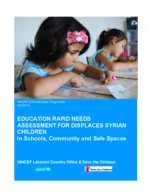
UNHCR, coordinating the operations in the North along side with the HRC (High Relief Commission) and DRC as its main implementing partner, requested from DRC to conduct a first rapid assessment in the Bekaa with the following objectives: a) To identify existing areas of displa
Working Paper Series #3 | July 2010
Describing the Lebanese Youth: A National and Psycho-Social SurveyCharles Harb
The present research investigates socio-demographic, socio-cultural and social-psychological profiles of a representative sample of Lebanese youth. The study thus provides a first assessment of youth in Lebanon, with a clear hope to replicate this research in other parts of the Arab world. This report does not aim to provide a comprehensive model testing between levels of analyses, but rather focuses on a more descriptive profiling of such variables in a way that may be useful to...
IFI Research and Policy Memo #1 | April 2010
The Transnational Tobacco Industry Effectively Hampers Tobacco Control Policy-Making in LebanonRima Nakkash
Lebanon is still considered one of the weakest countries in the region with regards to regulating tobacco use, despite having ratified the World Health Organisation’s Framework convention on Tobacco Control in 2005. Lebanon has failed numerous attempts to introduce a national tobacco control policy, including banning smoking in closed public areas, banning advertising and sponsorship, and placing large pictorial health warnings on tobacco...
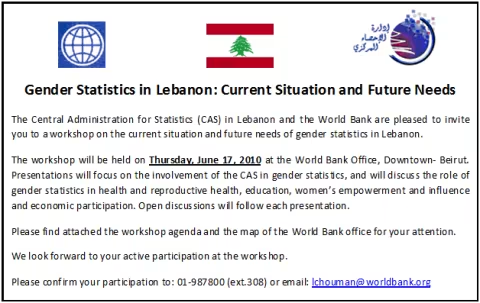
The Central Administration of Statistics (CAS) and the World Bank organized a workshop entitled "Gender Statistics in Lebanon: Current Situation and Future Needs," which took place on June 17, 2010.
Information on the health service in Lebanon including availability of access and availability of drugs and treatment. Information on treatment of mental health issues such as anxiety, depression, post traumatic syndrome, including psychiatric treatment.
في 21 كانون الثاني/يناير 2009 اعتمد المجلس التنفيذي لمنظمة الصحة العالمية القرار م ت124 ق 4 الذي طلب إلى المديرة العامة لمنظمة الصحة العالمية أن توفد بعثة صحية متخصصة إلى غزة للوقوف على الاحتياجات الصحية و الإنسانية العاجلة بعد 22 يوماً من العمليات العسكرية الإسرائلية التي بدأ