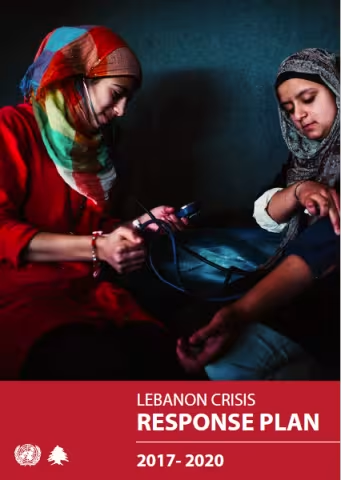
This document provides an update that aims to provide an operational snapshot for NGOs in a rapidly changing context. This also provides some suggestions around national level response planning from a field perspective.
“More than 60% of Syrian refugees households comprise a person with disabilities and 1/5 Syrian refugees has a disability in Lebanon and Jordan”, shows a large study conducted by Humanity & Inclusion (HI) and iMMAP.
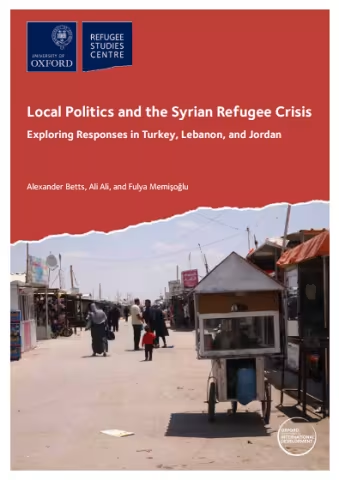
Refugee protection is inherently political. While international law and values inevitably influence governments’ decisions about how to respond to refugees, so too do power and interests.
This policy brief analyses the socio-political implications of the so-called October policies, and suggests legislative, political, and practical measures to improve the situation of Syrian refugees in Lebanon. It also aims to inform policy formulation regarding Syrian refugees from a human rights-based perspective, while discussing modalities for enhanced programming at the civil society level.
This policy brief is the fourth publication of a research project investigating the social effects of political and legal measures on Syrian refugees’ daily lives. The brief is based on a consultative...
This report aims to explore the fragmented organisation of healthcare services in Lebanon, for Syrian refugees. Although it is not an assessment of the Lebanese healthcare system, this report does nevertheless reflect on the challenges and underlying dynamics of the current Lebanese system, which are reproduced in the healthcare provision for Syrian refugees. In this sense, the report highlights the privatised, rather ad hoc, and irregular provision of healthcare in Lebanon, notably for Syrian refugees, which tends to take on a more curative rather than preventive approach, resulting in...
Since the uprising in Syria in March 2011, over 4.3 million Syrians have fled to neighboring countries. Over a million have sought refuge in Lebanon, constituting almost a quarter of the Lebanese population and becoming the largest refugee population per capita in the world.
With inequitable health coverage being a longstanding problem in Lebanon, Syrian refugee women’s health, and specifically their sexual and reproductive health, is disproportionately affected. An increase in gender-based violence and early marriage, a lack of access to emergency obstetric care, limited access to...
This document is an adaption of a speech delivered on May 12, 2015 at the launch of a report by the Syrian Justice and Accountability Center (SJAC) entitled ”A Step Towards Justice: Current Accountability Options for Crimes under International Law Committed in Syria.” The repo
This cross sectional survey was conducted among Syrian refugees living in Lebanon, to monitor access to and utilization of key health services. Refugees in Lebanon are predominantly living in urban areas and informal settlements and there are no refugee camps.