تجاوز إلى المحتوى الرئيسي

موارد

Theme
Displaying 1 - 20 of 64
National
Publishing Date
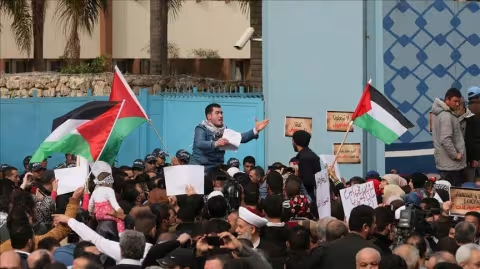
ككل عام تطلق المؤسسة الفلسطينية لحقوق الانسان (شاهد) تقريرها السنوي للعام 2023 حول واقع اللاجئين الفلسطينيين في لبنان، تطرح فيه الأرقام والوقائع الموثقة وتضعها بين يدي صانع القرار المحلي والدولي. هذا التقرير هو خلاصة للجهود البحثية والمتابعات الميدانية لفريق عمل مؤسسة (شاهد) خلال عام كامل.
International
Publishing Date
The State of Humanitarian Professions 2020 (SOHP) is the result of a year-long consultation with more than 1,500 humanitarian professionals. For the first time, this study gathers and analyses key figures on 24 humanitarian professions, as well as on recruitment practices and professional development in the sector. In addition, the SOHP study demonstrates the need to coordinate on the challenges of professionalising humanitarian teams, with 19 recommendations to be discovered in the final report.
National
Publishing Date
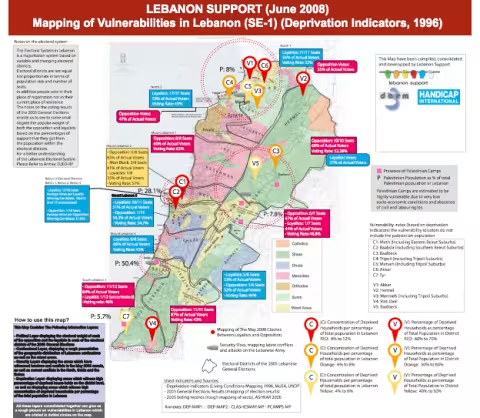
This package includes 3 maps pertaining to Lebanon's 2009 elections: - "confessional-distrib": showing the confessional geographic distribution of Lebanon's population - "election-results": showing the election results in West Bekaa/Rashaya and Metn areas. - "results&voters": showing the sectarian representation of parliamentary seats across Lebanon, the percentage of voters per electoral district, election results, and deputy representation per number of voters
National
Publishing Date
Lebanon may witness a remarkable rise in the number of women serving in Parliament come May 2018 due to initiatives from women’s groups, “civil society” activists, and the substantial number of female candidates – 113 at the start of the election period. However, as this briefing paper shows, Lebanese women continue to face numerous challenges in entering government. The new electoral law passed in June 2017 does not provide women with equal opportunity to be elected, and it is yet to be seen whether it will increase female representation in Parliament. Nevertheless, the historic number of...
National
Publishing Date

IFI Background Paper | November 2011
The Future Today: Youth and Adolescents of the Middle East and North Africa
 Situation Analysis on Adolescents and Youth in MENA by Suad Joseph
Calls for attention to children and youth are usually couched in future thinking: The children and youth of today will be the bulk of the population tomorrow, so we need to pay attention to them today. In much of the Middle East and North Africa, the reality is reversed. Children and youth are the bulk of today’s population. In all the MENA countries, those under 29 constitute a minimum of one half and up to two...


National
Publishing Date
The purpose of this policy brief is to inform policy formulation on local level security provision and refugee protection, and to propose modalities for upgrading the sys- tems of the Lebanese security institutions in a way that strengthens protection of the Lebanese communities and the Syrian refugees they host. Based on eld research conducted between February and May 2016 in three locations across Lebanon, this brief analyses the challenges to protecting local communities and refugees in a hybrid system, in which formal and informal security actors coexist and implement a mix of security...
National
Publishing Date
This report aims to analyse how formal and informal security providers implement their respective social order agendas through a security “assemblage”. It also aims to inform the debate on refugee protection and security provision in urban settings, in the context of Lebanon’s hybrid security system. The accounts collected illustrate how state security institutions tacitly accept – or even rely on – informal security actors, managing at times to achieve their political and strategic goals through decentralised and/or illegal forms of control. In this vein, local municipalities imposed curfews...
National
Publishing Date
The influence of terrorist groups operating on the Lebanese-Syrian border, Hezbollah’s involvement in Syria, and the increasing sense of humiliation and powerlessness amongst Sunnis since Hezbollah’s takeover of west Beirut in 2008 is breeding concern about the radicalization