تجاوز إلى المحتوى الرئيسي

موارد

Theme
Displaying 61 - 80 of 117
National
Publishing Date
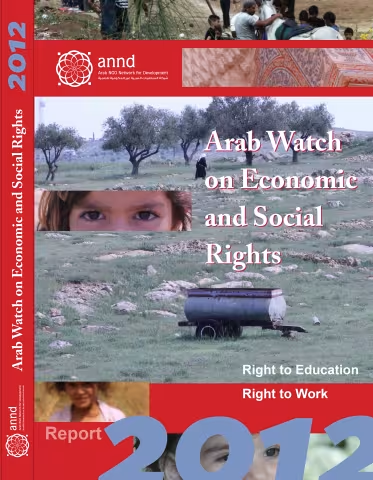
This report was prepared by ANND in cooperation with its member from 10 Arab countries. It is considered a result of the new direction that was followed after the revolution outbreak in the region. It is the first report of the Arab Watch for social and economic rights.
National
Publishing Date

UN-Related Publication | January 2013
Benghazi so Far: A View from Inside the United Nations Support Mission in Libya (UNSMIL) by Georges Nasr
I joined the UN Support Mission in Libya, known by its acronym UNSMIL, in early 2012 as Head of Office in Benghazi. Established by Security Council resolution 2009, the Mission’s mandate is to support Libya’s democratic transition by facilitating political dialogue and delivering targeted technical support in the areas of electoral assistance, constitution drafting, human rights, transitional justice and public security. UNSMIL also has a mandate to...

National
Publishing Date
This resource, published by Oxfam in 2013, aims to present standards that were originally developed for Oxfam staff to ensure a consistent approach to promoting gender equality in humanitarian preparedness and response programming.
National
Publishing Date

Lecture | December 2012
International Intervention in Lebanon and Beyond by Maureen Ali
As part of its United Nations and the Arab World Program, the Issam Fares Institute for Public Policy and International Affairs initiated a series of panels and lectures entitled, “International Intervention in Lebanon and Beyond.” The series analyzes the role played by international institutions in conflict and post-conflict zones in the region and seeks to contextualize military, civilian and humanitarian stands that are often interlinked or sometimes so blurred as to obscure the reality on the ground...

National
Publishing Date

Working Paper | December 2012
Production of Norms and Securitization in Development Policies: From Human Security to Security Sector Reform by Penelope Larzilliere 
Several regional products have been very successful as region-based products, such as Saudi Dates, Jordanian Thyme, Syrian Barazi, Egyptian Foul Mdamas, and Lebanese Chick Pea paste (Homos Tahini). These trends of regionbased, Geographic indicator (GI) and governmental labeled products are considered to be an added value to agroindustrial sector, and are highly efficient tactics to increase small and medium-sized enterprises (SME’s...

National
Publishing Date

Interview | October 2012
Insight into the UN in Libya
Dr. Tarek Mitri, Senior Fellow at the Issam Fares Institute for Public Policy and International Affairs (IFI), on October 15th 2012, began his appointment as the Special Representative for the Secretary-General at the United Nations, and Head of the United Nations Support Mission in Libya (UNSMIL). Dr. Mitri will be spending the year in this capacity, working closely with the Libyan government and civil society, aiding the process of institution building and security stabilization, as well as work with international actors playing a role in...

National
Publishing Date

Working Paper | August 2012
 The Politics of International Justice  – US Policy and the Legitimacy of the Special Tribunal for Lebanon by John Cerone
Assessing the state of US policy toward international criminal courts is a complex, if not impossible, undertaking. Indeed, there is no coherent U.S. policy on international criminal courts generally. This is attributable on the one hand to the multifaceted nature of international criminal courts, and on the other to the fact that U.S. policy is an amalgamation of diverse views reduced in some cases to written form, which is itself subject to...

National
Publishing Date
Summary Booklet | June 2012 Arab Uprisings Symposium Summary Critically Assessing the Changing Landscape of Power and Players IFI by Maureen Ali This symposium is part of the AUB-wide Arab Uprisings Research Initiative, which was launched and is supported by the Office of the Provost and managed by the Issam Fares Institute for Public Policy and International Affairs. AUB has invited over twenty scholars from the Arab world and abroad to this Symposium to discuss critical themes that have emerged to date, and to help shape our future research agenda. The symposium will highlight shifting power...
National
Publishing Date

Working Paper | May 2012
Women’s Citizenship Rights in Lebanon by Maya W. Mansour and Sarah G. Abou Aad
This paper tackles citizenship rights of Lebanese women married to foreigners, from an international human rights perspective at first, as consecrated over and over by multiple conventions and treaties; to move afterwards to a more practical approach in exposing the provisions of the Lebanese Constitution, the nationality law and regulations, while pointing out the consequences and challenges in addition to the movements of the civil society facing such trials. The analysis used in...

National
Publishing Date
   This study targeted the prisons in South Lebanon within the provinces of Tyre (Tyre prison) and Nabatiye (Nabatiye and Tebnin prisons). Its human and material limits were wide as it included most of the inmates in the three prisons and their families- whether living in or outside the south (Beirut, Baalabek, and Zahle) and remaining Lebanese regions. The main target was to detect and acquire knowledge about the social, educational, medical and economic needs of these families, to follow them up, and shed light on them through a program on which all public and private community stakeholders...
National
Publishing Date

Tobacco Control Research #2 | March 2012
A Smoke Free Campus: Lessons Learned from AUB by the AUB Tobacco Control Research Group (AUB-TCRG)
Following the adoption of a No Smoking Policy (NSP) by the American University of Beirut (AUB), the vast majority (90%) of undergraduate and graduate students surveyed, and over a third (36%)of them who smoked were satisfied with the new policy; with a full compliance (respecting the designated smoking areas) rate of 73% among the smokers surveyed. In addition, 1 in 6 smokers reported receiving a warning ticket when smoking in nondesignated areas. And, 20%...

National
Publishing Date

Policy Series: Tobacco Control Research #1 | March 2012
The Transnational Tobacco Industry Effectively Hampers Tobacco Control Policy-Making in Lebanon by the AUB Tobacco Control Research Group (AUB-TCRG)
Lebanon is still considered one of the weakest countries in the region with regards to regulating tobacco use, despite having ratified the World Health Organisation’s Framework convention on Tobacco Control in 2005. Lebanon has failed numerous attempts to introduce a national tobacco control policy, including banning smoking in closed public areas, banning advertising and sponsorship, and...

National
Publishing Date

Working Paper Series #7 | February 2012
The Dynamics of Policy Innovation and Diffusion in the Gulf Cooperation Council:  A Case Study of Three Specialized Cities by Hiba Khodr
This study examines a recent phenomenon in the Gulf Cooperation Council (GCC) referred to as Specialized Cities (SC). A Specialized City is a “city in-the-city” that has the main purpose of implementing innovations in selected policy areas, in addition to being a new town. This paper goes beyond describing the spread of SC in the Arab Gulf region to answer to a broader question: what motivates a GCC country to adopt...

National
Publishing Date
Link to orginial post: http://www.helem.net/node/188 Written by: Doctor Wahid Al Farchichi: Law Professor at the Tunisian University, Professor Nizar Saghiyeh: Lawyer and Independant Law Researcher Contents: The law and homosexuality A survey and an analytical study of the legislation of most Arab countries  Part one: The discrepancies in the Arab legislations in the criminalization of the homosexual act Part two: The disparities of the sanctions for the homosexual acts in the Arab legislations  Conclusion Law and homosexuality: any ways for reconciliation?  List of references Homosexuals in...
National
Publishing Date
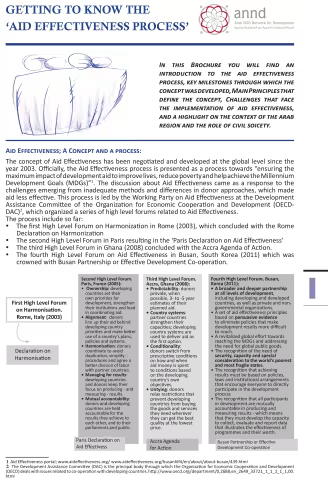
In this Brochure you will find an introduction to the aid effectiveness process, key milestones through which the concept was developed, Main Principles that define the concept, Challenges that face the implementation of aid effectiveness, and a highlight on the context of the