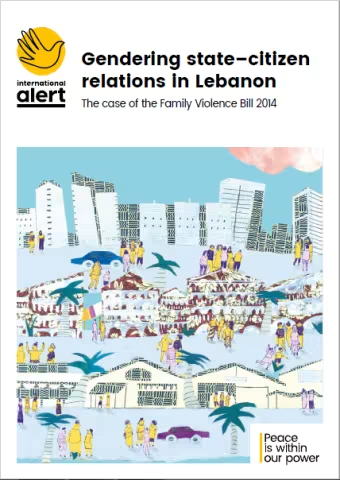
This report examines the nature of interaction and engagement between Lebanese citizens’ collectives and the state on gender-specific matters, through the case study of
The present guide proposes to reconcile the gender-related targets in the Sustainable Development Goals with the objectives of the Beijing Platform according to various sub-topics. It is organized in two sections.
This report aims to present a general overview of the current local gender actors and their interventions in Lebanon. It also aims to shed light on the complex relationship between women’s organisations in Lebanon and their donors. In this context, it is important to ask to what extent the funding tends to shape project design at a local level? And moreover, does funding of short-term and service-oriented projects edulcorate the political change that these organisations could bring?
Based on a survey done by Lebanon Support during 2015, it gives an overview of the main gender actors, their...
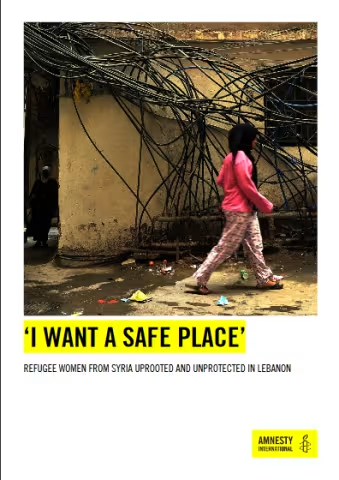
Syrian refugee women and Palestinian refugee women from Syria face risks of serious human rights violations and abuses in Lebanon, including gender-based violence and exploitation. Those who are heads of their households are at particular risk.
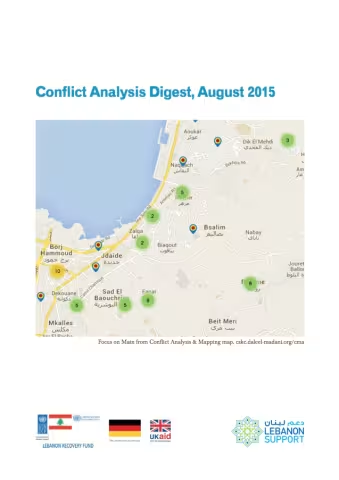
This Conflict Analysis Digest is composed of:
I. Current conflict trends
1- Overview of mapped conflict incidents in Lebanon, with the villages where most incidents are mapped for each classification. (Between 1 July 2014 and 28 June 2015) 2- Mapped air strikes/ armed conflicts and violations classified as Syrian Border Conflicts. (Between 1 July 2014 and 28 June 2015) 3- Overview of mapped conflict incidents in the Matn.
II. Brief thematic report Politics of security, discourses of fear and economic fatigue: the conflict dynamics in al-Matn
Abstract: This short report provides an...
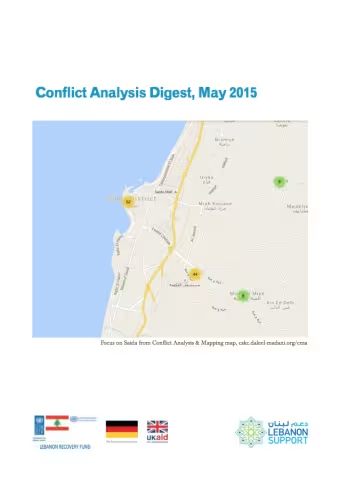
This Conflict Analysis Digest is composed of:
I.Current conflict trends - p.5
II.Brief thematic report - p.11 Spatial Fragmentation and rise in poverty: the conflict context in Saida
Abstract: This short report provides a contextual and analytical summary of the conflict in the region of Saida, south of Lebanon, with a focus on spatial struggles and poverty growth. It describes the main conflict actors and how they have historically contributed to the shaping of conflictual dynamics in Saida from the fifties until today. Findings highlight that while most observers and media attention are...
The conflict in Syria is forging new forms of territorial control, and a political economy that is not unlike the patronage system that was previously fostered by the ruling Ba’ath party.
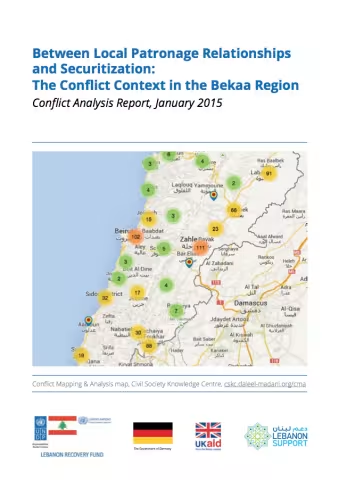
This report provides an analytical summary of the conflict context in the Bekaa region of Lebanon, with a focus on the relationships between the Syrian de facto refugees and the Lebanese host communities in the Baalbeck-Hermel area. It is based on a socio-political qualitative assessment and a conflict analysis that are primarily based on experiences and perspectives of key informants,2 as well as Lebanese and Syrian residents of the Bekaa. Unless otherwise noted, information in this report is based on these interviews. The report is intended as a quick reading of the field at a set point in...
The objective of the Civil Society Review is to bring civil society practitioners, experts, activists, and researchers together to develop knowledge, as well as to innovate new tools and practices so as to strengthen Lebanon’s civil society and its voice. The Civil Society Review produces evidence-based research and analysis and disseminates findings and recommendations to promote civic engagement, shape policies, and stimulate debate within civil society spheres in Lebanon.
Norwegian Church Aid (NCA) with its partner International Orthodox Christian Charities (IOCC) has been providing assistance to Syrian refugees in Lebanon and host communities since January 2014.
This document provides elements of discussion and pragmatic solutions to challenges in addressing GBV in the context of resistance. It does not provide clear cut answers to all questions, but intends to bring together evidence from UNRWA and results from other agencies.