Research and Policy Memo #4 | May 2009
Water Mismanagement Responsible for High Levels of Saline and Chloride in Greater Beirut GroundwaterMark Saadeh
Intrusion in the coastal aquifers of Greater Beirut has largely been a direct consequence of decades of water mismanagement – exacerbated by a civil war lasting more than fifteen years, according to Dr Mark Saadeh, consultant to the Litani River Authority. Concurrent urban growth and repeated natural drought conditions have also amplified this phenomenon.
Dr. Saadeh presented two lectures at AUB, as part of the Research and Policy Forum on...
Research and Policy Memo #3 | February 2009
Multi-Faceted Mitigation Can Reduce Risk of Complete Collapse of Arab World’s Water, Food, and Land SystemsGeorge J. Nasr
Shifts in trade and transport patterns due to global warming may cut off Arab countries from food and water, affecting them more than developed countries. This is only one of many urgent implications of climate change on food, water, and land in the Arab world - as outlined by George Nasr during a lecture at the American University of Beirut.
“Cross-border mobilization and immediate investment in research and development would...
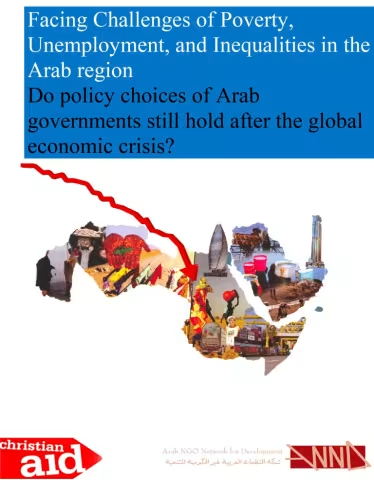
This paper was produced by ANND and Christian Aid and contains five main sections: “Executive Summary: a crisis of multiple dimensions; the threat of explosive vulnerabilities and increasing insecurities”, “Vulnerability to poverty: the key challenges faced by the Arab region”
IFI Research and Policy Memo #2 | January 2009
Governments Should Practice 'Water Demand Management' to Rescue Region's Water ResourcesHamed Assaf
Surging populations and increasing living standards in the Middle East are exacerbating the region’s water problem as countries begin to expect more of scarce and poorly managed water, warned Dr. Hamed Assaf, a professor of water resources engineering at the American University of Beirut. High water demand, negligence of water quality, and over-pumping are more serious threats to the region’s water supply than are the potential impacts of climate...
Following the Nahr EL Bared War, LPDC launched in 2008 a workshop mapping the recovery and development initiatives in the camp's area. They followed up in 2009 with another workshop reviewing the development projects that took place in the NBC area.
2009 مذكرات للباحثين وصناع القرار #2 | كانون الثاني
على الحكومات أن تمارس "إدارة الطلب على المياه" كي تنقذ الموارد المائية للمنطقة من التغير المناخيحامد عساف
حذر البروفيسور حامد عساف من تفاقم مشكلة المياه في الشرق الاوسط يوماً بعد يوم، في ظل الزيادات السكانية وازدياد المتطلبات والمستوى المعيشي، مما يعني أنه على دول المنطقة توقع المزيد من الشح وتبعات سوء الإدارة في مواردها المائيةّ
وجاء كلام عساف، الدكتور برتبة بروفيسور في هندسة الموارد المائية في الجامعة الاميركية في بيروت، خلال محاضرته التي نظمها معهد عصام فارس للسياسات العامة والشؤون الدولية
The fourth National Human Development Report, “Toward a Citizen’s State”, addresses citizenship in Lebanon through three principle perspectives: citizenship and sectarian state, socio-economic citizenship and citizenship and culture and education.
This paper examines the impact of a rise in the Value Added Tax (VAT) on poverty and inequality in Lebanon. It develops an empirical model based on consumer demand theory and uses only household survey data on expenditures and spatial price indexes.
The aim of the “Socio-Economic Assessment in Nahr el-Bared surrounding areas” report is to provide an assessment of the pre and post conflict conditions of households located in the vicinity of Nahr el Bared camp for a variety of livelihood aspects including: housing, health,
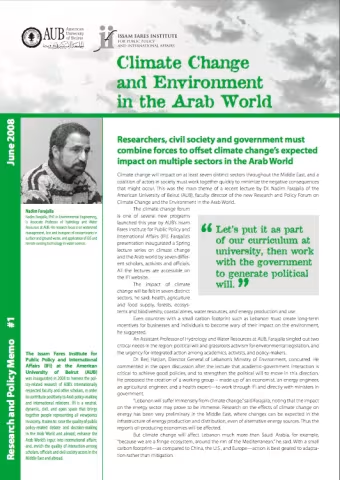
Research and Policy Memo by Nadim Farajalla, PhD in Environmental Engineering, who is an Associate Professor of Hydrology and Water Resources at AUB. The policy adresses climate change and environment in the Arab world, where Dr. Nadim Farajalla talked about in his lecture.
Climate change will impact on at least seven distinct sectors throughout the Middle East, and a coalition of actors in society must work together quickly to minimize the negative consequences that might occur.
Research and Policy Memo #1 | June 2008
Researchers, Civil Society and Government Must Combine Forces to Offset Climate Change’s Expected Impact on Multiple Sectors in the Arab World Nadim Farajalla
Climate change will impact on at least seven distinct sectors throughout the Middle East, and a coalition of actors in society must work together quickly to minimize the negative consequences that might occur. This was the main theme of a recent lecture by Dr. Nadim Farajalla of the American University of Beirut (AUB), faculty director of the new Research and Policy Forum on Climate Change and the...
This brochure highlights UNDP’s contribution in the Early Recovery process of the Palestinian and Lebanese populations who were affected by the Nahr El Bared crisis.
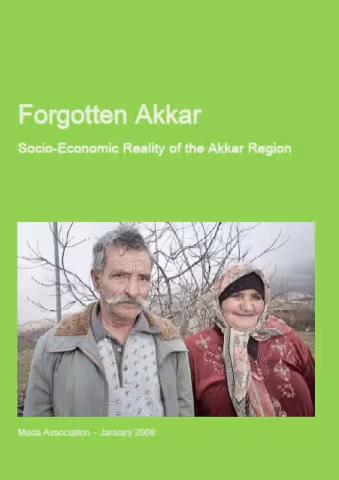
This study focuses on presenting the socio-economic reality of Akkar. It begins with a situational analysis, including an assessment measuring the impact of the July 2006 and Nahr al-Bared wars on the livelihoods of the people of Akkar.
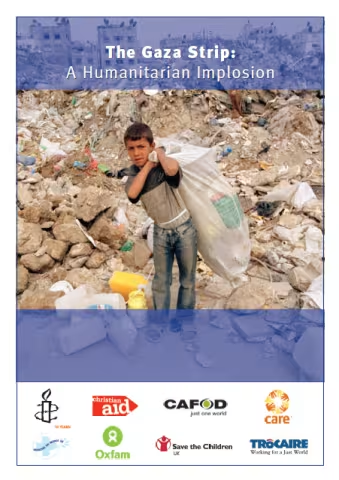
The situation for 1.5 million Palestinians in the Gaza Strip is worse now than it has ever been since the start of the Israeli military occupation in 1967.
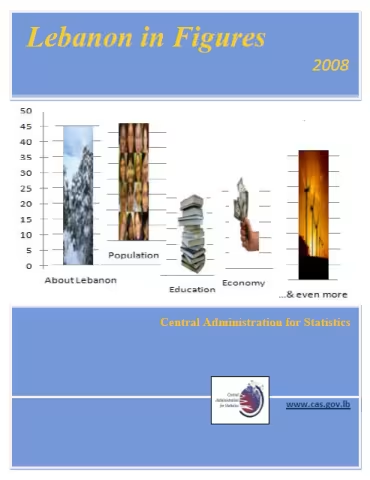
Lebanon in Figures 2008 gathers number of social and economic indicators: About Lebanon, Population, Education, Employment, Tourism, Consumer Price Index, National Accounts...
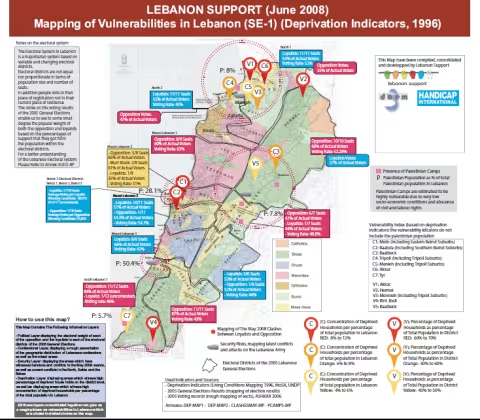
This Map Contains The Following Information Layers: - Political Layer displaying the electoral weight of each of the opposition and the loyalists in each of the electoral districts of the 2005 General Elections - Confessional Layer, displaying a rough presentation of the geogr
This Country Study is based on a full national report that is the first to draw a profile of poverty in Lebanon based on money-metric poverty measurements of household expenditures.