تجاوز إلى المحتوى الرئيسي

موارد

Theme
Displaying 41 - 60 of 102
National
Publishing Date
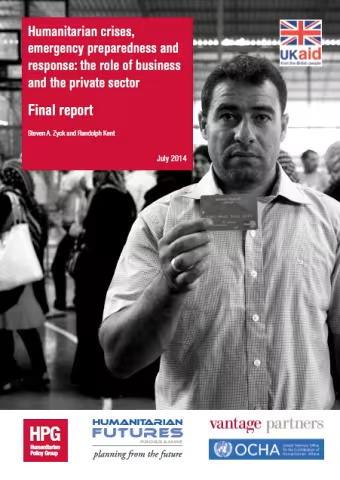
The private sector has long been a major contributor to humanitarian action. At the community level, businesses frequently use their materials and resources to aid people affected by crises. As local markets recover and supply chains are repaired, crisis-affected people are once again able to access basic goods and, in some cases, resume livelihoods. Large national, regional and multinational firms are also closely involved in supporting humanitarian objectives, whether indirectly, by resuming operations in crisis affected areas, or directly, by providing cash and in kind donations of goods or...
National
Publishing Date
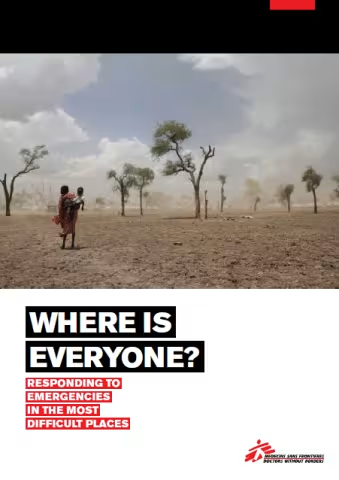
The humanitarian aid system is growing and expanding, and so surely its capacity to meet these challenges should also be growing. Yet despite the enormous resources, in the more complex, less high-profile and difficult contexts, MSF teams in the field have seen that humanitarian responses to displacement emergencies have not occurred in a timely and effective way. This is especially the case in conflict areas. These observations have prompted MSF to conduct this review, to better understand how the humanitarian system is responding to acute displacement emergencies. The review is based on...
National
Publishing Date

Research Report | July 2014
History of Climate Change Negotiations and the Arab Countries The Case of Egypt by Ibrahim Abdel Gelil
Even though Egypt’s share of Global Greenhouse Gases (GHGs) emissions is less than 1 %, Egypt has proved to be one of the most vulnerable countries to the potential risks of climate change. The most vulnerable sectors include coastal zones, water resources, and agriculture. Estimates show that a Sea Level Rise would lead to the permanent submersion of large areas of cropland in the Nile Delta, and accelerate the trend of desertification that is worsening the...

National
Publishing Date

Working Paper | June 2014
Climate Change in Lebanon: Higher-order Regional Impacts from Agriculture by Nadim Farajalla, Eduardo A. Haddad, Marina Camargo, Ricardo Lopes, and Flavio Vieira
This working paper analyzes the susceptibility of agricultural outputs to future climate change in Lebanon, and the extent to which it propagates to the economic system as a whole. A methodological framework in which physical and economic models are integrated for assessing the higher-order economic impacts of projected climate changes is used. The researchers then quantify the broader economic impacts in the...

National
Publishing Date

Research Report | April 2014
Impact of Population Growth and Climate Change on Water Scarcity, Agricultural Output and Food Security
This research project brought together several teams from across multiple countries to conduct a review and analysis on a wide range of complex, interconnected topics. Any one of these issues (e.g. climate change, population dynamics, food security and water security) can allow for vast and deep exploration. Seeking to integrate the concepts into unified analysis that is comprehensive and coherent is both exceptionally challenging and incredibly necessary. By...

National
Publishing Date

Research Report | April 2014
Impact of Population Growth and Climate Change on Water Scarcity, Agricultural Output and Food Security
This research project brought together several teams from across multiple countries to conduct a review and analysis on a wide range of complex, interconnected topics. Any one of these issues (e.g. climate change, population dynamics, food security and water security) can allow for vast and deep exploration. Seeking to integrate the concepts into unified analysis that is comprehensive and coherent is both exceptionally challenging and incredibly necessary. By...

National
Publishing Date

Working Paper | September 2013
Policy-making in Lebanon: Potential Offshore Oil and Gas Discoveries by Jeremy Arbid
This report follows the conclusion of the thesis research entitled “Policy-making in Lebanon: Potential Offshore Oil and Gas Discoveries” carried out with support from the Issam Fares Institute for Public Policy and International Affairs, United Nations in the Arab World Program at the American University of Beirut. The research aimed to clarify the inner workings of the policy-making process in Lebanon. Using the multiple streams framework of John Kingdon (2003), the research...

National
Publishing Date

Research Study | January 2013
Effect of Distributed Electric Power Generation on Household Exposure to Airborne Carcinogens in Beirut by Alan Shihadeh, Marc Al Helou, Najat Saliba, Sara Jaber, Nader Alaeddine, Elias Ibrahim,
Zahra Salahieh, Maher Chiit
Due to inadequate power production capacity, EDL has in recent years instituted a rotating power outage regimen in Lebanon. People and businesses have turned to privately-owned diesel generator sets for power during outages. Because these generators are located in dense urban areas, their emissions may significantly increase inhalation exposure...

National
Publishing Date
This thematic report provides an overview of available lessons identified from assessments undertaken concerning the humanitarian situation in Syria as well as the situation for Syrian refugees in host-countries.
National
Publishing Date

Working Paper | December 2012
The Efficiency of Food Labeling as a Rural Development Policy: The Case of Olive Oil in Lebanon by Jad Chaaban
Several regional products have been very successful as region-based products, such as Saudi Dates, Jordanian Thyme, Syrian Barazi, Egyptian Foul Mdamas, and Lebanese Chick Pea paste (Homos Tahini). These trends of regionbased, Geographic indicator (GI) and governmental labeled products are considered to be an added value to agroindustrial sector, and are highly efficient tactics to increase small and medium-sized enterprises (SME’s) revenues. However...

National
Publishing Date
Research and Policy Memo #6 | May 2011 2010 Report of the Arab Forum for Environment and Development on WaterDr Berj Hatjian gives a course at AUB titled, "Environmental Policy Practice in Lebanon". Seven of his students attended the Arab Forum of Environment and Development (AFED) conference and wrote this policy memo. The Arab Forum of Environment and Development (AFED) revealed poor water management across the Arab world, including, but not limited to; a lack of fresh water resources within the Arab world; 13 of the Arab countries are currently some of the world’s most water-scarce...
National
Publishing Date
مذكرات للباحثين وصناع القرار #9 | أيار 2011 سياسات الطاقة المتجددة في دول الخليج: دراسة حالة  “مدينة مصدر” الخالية من الكربون في ابو ظبيدانيال رايش تعتمد دول الخليج اعتماداً كبيراً على تصدير النفط والغاز الطبيعي لانتاج الدخل لميزانياتها الوطنية, فضلا عن المحافظة على إمدادات الطاقة الرخيصة للاستخدام المحلي. ولكن مؤخراً، بدأ بعض القادة في الخليج يبحثون بعيداً عن الوقود الاحفوري التقليدي وبدأوا بالاهتمام بإمكانيات الطاقة المتجددة
National
Publishing Date
 مذكرات للباحثين وصناع القرار #7 | أيار 2011 إعادة تدوير الكتلة الحيوية الزراعية لإنتاج الغاز الحيوي:  دراسة الجدوى الاقتصادية في المناطق الريفية في لبنانمحمد الابيض عصام بشور علي شلق و روزين حبشي  في دراسة جدوى أجرتها كلية الزراعة والعلوم الغذائية في الجامعة الاميركية في بيروت و مولها معهد عصام فارس، تبين أن الكتلة الحيوية، وهي ثالث أكبر مورد للطاقة الاولية في العالم بعد الفحم والنفط لديها القدرة على أن تكون بديلا جزئياً عن الوقود الاحفوري    
National
Publishing Date
مذكرات للباحثين وصناع القرار #10 | أيار 2011  (EMR) البحوث المتعلقة بالصحة وتغير المناخ في إقليم الشرق المتوسطريما ر. حبيب من المرجح أن يؤدي تغير المناخ إلى تفاقم عبء المرض في المنطقة العربية التي تعاني حالياً من عدم الاستقرار السياسي والكوارث الطبيعية والازمات الانسانية. كما أن البيئة القاحلة السائدة والاعتماد على الزراعة البعلية في الانتاج الغذائي يفاقمان الوضع. ولذلك، على الحكومات وأصحاب المصلحة الرئيسيني تخصيص المزيد من الاموال من أجل التصدي للتحديات الجديدة والمتزايدة التي تواجه صحة السكان