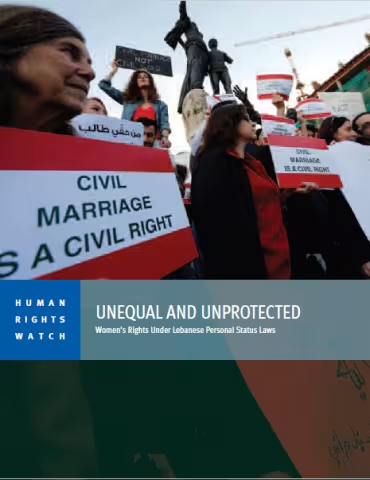
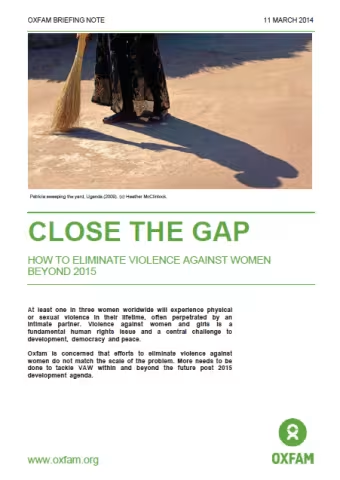
More than a decade after the United Nations’ adoption of the Convention on the Elimination of All Forms of Discrimination against Women, which is adopted by many countries including Lebanon, these countries returned in 2015 to commit themselves to achieve gender equality and t
This report aims to provide a contextual understanding of migration governance in the Lebanese context, as well as its implications for refugees and migrants.
UNFPA on behalf of UNDP and UN Women organized a national workshop on gender-related laws, policies and practices in Lebanon, which was held in Beirut on the 7th and 8th of August, 2018.
The July war 2006, lasted 34 days, and led to the displacement of 915,762 (almost 25% of the Lebanese population) persons, relocating into public and private schools all over the country. With the coming into force of the cease fire in August 14th 2006, there was a rapid return of the displaced to the south.
“الجهل بالقانون لا يُنهض عُذراً لأحد”
يشير هذا المبدأ الجوهري في الممارسة المواطنية إلى ضرورة توعية المواطنين على قوانينهم وأهميتها وسبل التمتع بما توفره من حماية لهم ولحقوقهم. والمعرفة بالقانون تستدعي أيضا معرفة بالنظام المخوّل بتطبيقه وتنفيذه.
التوعية القانونية عملية معقدة وواسعة وتتطلب تفاعل العديد من المؤسسات الوطنية كالمدرسة والجامعة ووسائل الإعلام ومنظمات المجتمع المدني… ولا نكشف سرّاً إذ نقول إن هذه التوعية لا تمارَس إلا بحدّها الأدنى في بلادنا، في حين يُمارس التعسف في تطبيق القانون، بل ويُنتهك القانون طولاً وعرضاً، بدون ضابط أو قيد.
يحاول هذا الكتاب أن يساهم في عملية التوعية هذه،...
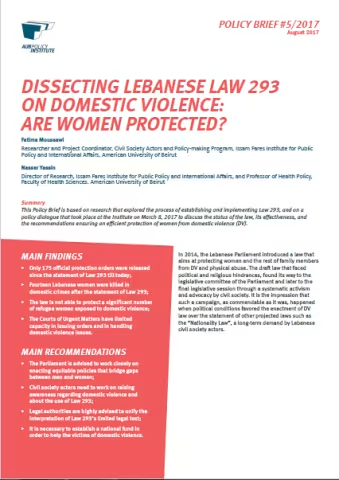
This Policy Brief is based on research that explored the process of establishing and implementing Law 293, and on a policy dialogue that took place at the Institute on March 8, 2017 t
The conflict in Syria continues to drive the largest refugee crisis in the world. Over 5.3 million Syrians are registered as refugees in neighbouring countries as of 1 December 2017.
The United Nations Secretary-General has called for the first ever World Humanitarian Summit: to reaffirm our commitment to humanity and chart a course for change. The Secretary-General’s Agenda for Humanity calls on global leaders to commit to five core responsibilities in the name of our shared humanity:
Global leadership to prevent and end conflict
Uphold the norms that safeguard humanity
Leave no one behind
Change people's lives – from delivering aid to ending need
Invest in humanity
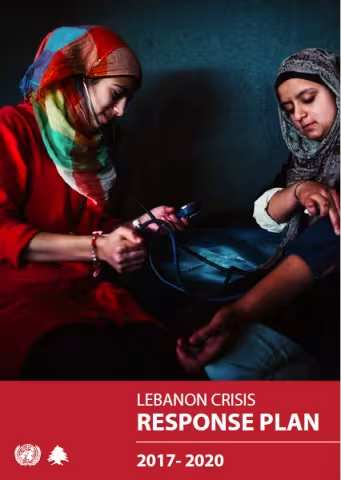
Lebanon has had an ambiguous approach to the more than one million Syrians seeking protection in the country since 2011. The country is neither party to the 1951 Convention relating to the Status of Refugees, nor does it have any national legislation dealing with refugees.
In May 2015, the Lebanese authorities instructed UNHCR to temporarily suspend registration of Syrian refugees, including individuals already in the country and new arrivals.
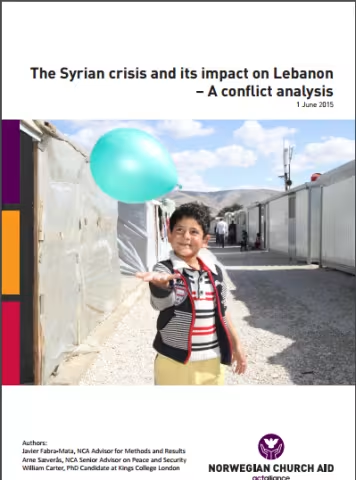
The present report analyses the impact of the Syrian conflict and refugee crisis on Lebanon and Lebanese host communities. This brief analysis presents the main conflict issues and trends, and the network of interaction between local and national level conflict dynamics.
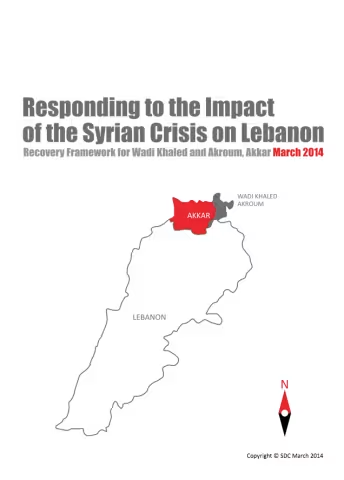
The Swiss Agency for Development and Cooperation (SDC) is pleased to share with you the report:
“Responding to the Impact of the Syrian Crisis on Lebanon: Recovery Framework for Wadi Khaled and Akroum, Akkar”, March 2014.
SDC facilitated a process to shed light on the impact of the Syria crisis at the national level but also on the local level. The formulation of a recovery framework for Wadi Khaled and Akroum is a process that can be replicated for other affected regions of Lebanon.
The findings and recommendations are based on consultations (between October 2013 and January 2014) with...
The private sector has long been a major contributor to humanitarian action. At the community level, businesses frequently use their materials and resources to aid people affected by crises. As local markets recover and supply chains are repaired, crisis-affected people are once again able to access basic goods and, in some cases, resume livelihoods. Large national, regional and multinational firms are also closely involved in supporting humanitarian objectives, whether indirectly, by resuming operations in crisis affected areas, or directly, by providing cash and in kind donations of goods or...
The humanitarian aid system is growing and expanding, and so surely its capacity to meet these challenges should also be growing.
Yet despite the enormous resources, in the more complex, less high-profile and difficult contexts, MSF teams in the field have seen that humanitarian responses to displacement emergencies have not occurred in a timely and effective way. This is especially the case in conflict areas.
These observations have prompted MSF to conduct this review, to better understand how the humanitarian system is responding to acute displacement emergencies. The review is based on...
This report is this first of a three-part series focusing on the current status and lessons learned relating to transitional justice and policing initiatives in opposition-controlled Syria. • Part I focuses on the effects of the departure of judicial and security elements of the Syrian state has had on conditions on the ground currently and on the nascent justice institutions that have emerged in this void (including levels of institutionalisation, Islamic law, and the legal systems currently being debated and trialed in some areas). • Part II examines the variety of institutions and...
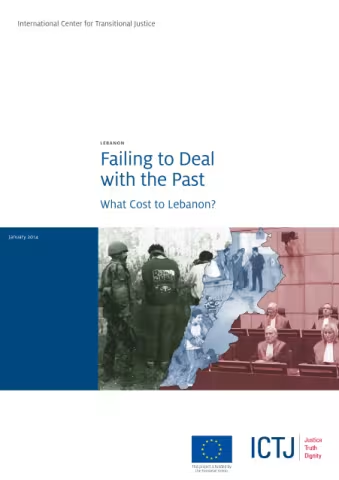
This paper examines the situation of impunity in Lebanon that has persisted since the 1975–1990 war. It highlights the price of the Lebanese authorities’ failure to address the legacy of past conflict.
This study recommends a holistic approach to crafting a comprehensive and victim-centered transitional justice process in Lebanon. An incremental approach to reform would be of value, given the likely challenges to pursuing accountability in the country. Programming must involve state and nonstate actors—political and community leaders, civil society, and the broader public. In addition, human...
Global civil society alliance, CIVICUS, has released a revised version of what is probably the world’s most comprehensive compilation of commitments made by governments on civil society rights.
Originally released in 2008, and now fully updated, the compendium consolidates various international standards and commitments made by governments at the regional and global levels to protect civil society and ensure participation in public processes.
In addition to collating relevant portions of major UN documents, the compendium also includes commitments made by regional bodies such as the Arab...