Global civil society alliance, CIVICUS, has released a revised version of what is probably the world’s most comprehensive compilation of commitments made by governments on civil society rights.
Originally released in 2008, and now fully updated, the compendium consolidates various international standards and commitments made by governments at the regional and global levels to protect civil society and ensure participation in public processes.
In addition to collating relevant portions of major UN documents, the compendium also includes commitments made by regional bodies such as the Arab...
In December 2013, NRC launched a report entitled ‘The Consequences of Limited Legal Status for Syrian Refugees in Lebanon: NRC Field Assessment in Aarsal and Wadi Khaled’ (Part One) based on the findings of an assessment that NRC conducted between
Briefing papers on the preservation of cultural heritageInstitutions and individuals from the Middle East and North Africa experience many shortcomings in legislation, policies and current practices impeding the sustainable preservation of cultural heritage. In order to obtain a systematic overview and a sound basis for engaging in lobby and advocacy work for improved governance of the cultural sector, the Modern Heritage Observatory contracted local lawyers and researchers to analyze and assess current regulations, policies and practices concerning the preservation of cultural heritage in...
The continuing unrest in Syria is resulting in a growing influx of Syrian refugees to Lebanon. The United Nations High Commissioner for Refugees has registered over 57,000 Syrian refugees in Lebanon (September 7, 2012) while many refugees are awaiting registration.
Briefing papers on the preservation of cultural heritage Institutions and individuals from the Middle East and North Africa experience many shortcomings in legislation, policies and current practices impeding the sustainable preservation of cultural heritage.
Since March 2012, several towns and villages in the North, the Bekaa and the South started receiving Lebanese families who fled Syria, against the backdrop of sectarian conflicts. Most of those families left their hometown decades ago and got Syrian citizenship.
This report is the result of 4 months of field data collection from April to August 2013 carried out in the Informal Tented Settlements (ITS) of the two districts of Zgharta and Minieh-Dennieh by SOLIDARITÉS INTERNATIONAL’s (SI) outreach workers.
The purpose of the needs assessment conducted in the Bekaa area is to identify the needs of Syrian refugees (SR), in terms of food, non food items (NFIs), shelter, water and education.
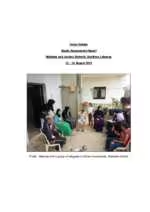
Swiss Solidar undertook a multi-sectoral needs assessment in August 2013 to assess the humanitarian needs of Syrian refugees residing in Nabatieh and Jezzine Districts in Southern Lebanon.1 Prior to undertaking its field assessment, Solidar undertook a detailed documentation r
Swiss Solidar undertook a multi-sectoral needs assessment in August 2013 to assess the humanitarian needs of Syrian refugees residing in Nabatieh and Jezzine Districts in Southern Lebanon.
The average number of assisted families during the a/m period is 46% of the overall number of families reportedly arrived to DRC North Lebanon operational area (Akkar region).
The average number of assisted families during the a/m period is 35% of the overall number of families reportedly arrived to DRC Bekaa operational area.
The “Review of the Public Procurement Legal Framework in Lebanon” introduces the Sustainable Public Procurement (SPP) in Lebanon and elaborates on the legal of the country’s procurement and sustainability laws that may offer a legal possibility for the adoption of SPP principl
Severe weather struck the country this week, affecting Syrian refugees sheltered in the mountain region of Bekaa. Heavy rains and snowfall have flooded some settlements, and a number of refugee families were forced to seek shelter elsewhere.
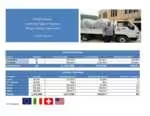
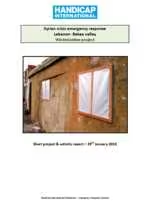
The objective of the project is to improve the housing conditions of the most vulnerable people affected by the Syrian crisis and to reduce their vulnerability to face the winter season.