28 refugee households were surveyed, which represented a total of 501 refugees, 48% male and 52% female, which is approximately 11% of the Syrian refugee population in North Bekaa.
Over 57,000 displaced Syrians are receiving protection and assistance in Lebanon through the efforts of the Government of Lebanon and UN and NGO partners.
This report will provide a description of the assessment conducted by IMC’s Mental Health and Psychosocial team in the region of Wadi Khaled following the displacement of Syrians into the northern villages between the Lebanese-Syrian borders as a result of the internal conflic
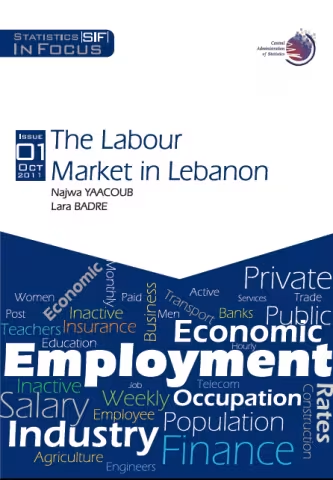
This issue of SIF looks briefly at the labour market key indicators and figures available from a number of surveys conducted by the Central Administration of Statistics (CAS) in Lebanon in recent years.
On December 9, 2009, a Lebanese criminal court sentenced a Lebanese woman to 15 days in jail for repeatedly beating Jonalin Malibago, her Filipina maid, three years earlier. Lebanese newspapers hailed the case a landmark victory for the country’s estimated 200,000 migrant domestic workers (MDWs), many of whom report abuse at the hands of their employers. The case illustrated the positive role that the judiciary can play in protecting MDWs, even though the sentence was lenient given the violation. But it also raised at least one significant question: was the Malibago verdict a rare instance of...
This brochure elaborates on the achievements of the UNDP’s 4 portfolios in Lebanon: Democratic Governance, Poverty & Social Development, Environment & Energy, and Crisis Prevention & Recovery.
On December 9, 2009, a Lebanese criminal court sentenced a Lebanese woman to 15 days in jail for repeatedly beating Jonalin Malibago, her Filipina maid, three years earlier.
This paper was produced by ANND and Christian Aid and contains five main sections: “Executive Summary: a crisis of multiple dimensions; the threat of explosive vulnerabilities and increasing insecurities”, “Vulnerability to poverty: the key challenges faced by the Arab region”
The fourth National Human Development Report, “Toward a Citizen’s State”, addresses citizenship in Lebanon through three principle perspectives: citizenship and sectarian state, socio-economic citizenship and citizenship and culture and education.
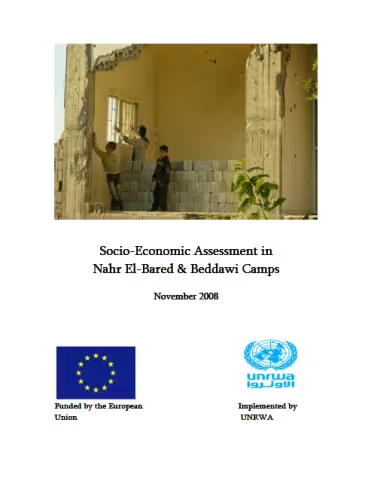
The aim of the “Socio-Economic Assessment in Nahr el-Bared surrounding areas” report is to provide an assessment of the pre and post conflict conditions of households located in the vicinity of Nahr el Bared camp for a variety of livelihood aspects including: housing, health,
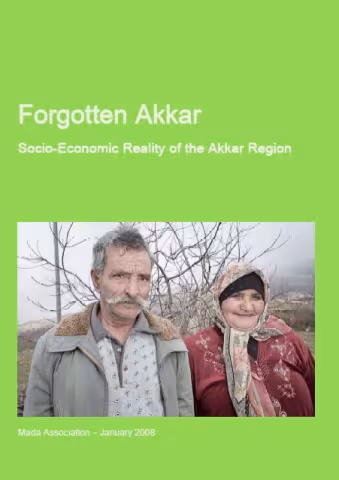
This study focuses on presenting the socio-economic reality of Akkar. It begins with a situational analysis, including an assessment measuring the impact of the July 2006 and Nahr al-Bared wars on the livelihoods of the people of Akkar.
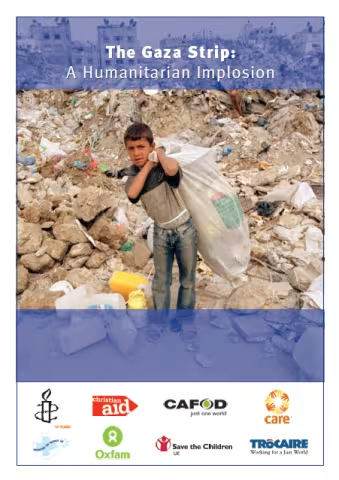
The situation for 1.5 million Palestinians in the Gaza Strip is worse now than it has ever been since the start of the Israeli military occupation in 1967.
Lebanon in Figures 2008 gathers number of social and economic indicators: About Lebanon, Population, Education, Employment, Tourism, Consumer Price Index, National Accounts...
The Israeli July 2006 war exposed the Lebanese population to disastrous conditions. It has profoundly affected residents’ livelihoods through bringing down access to services, infrastructure and natural resources. Responding to these emerging problems poses further challenges for the Lebanese government and society. In this respect, different emergency measures have been undertaken to address the arising needs, starting with assessing physical, economic and social damages.
As a contribution to identifying short and medium term intervention needs, the World Bank initiated undertaking a Post...
تهدف "دراسة الأحوال المعيشية للأسر للعام 2007 " إلى توفير قاعدة غنية من البيانات الإحصائية في المواضيع أدناه، وذلك بهدف التعرّف على الأوضاع المعيشية للأسر في العام 2007 ومدى تأثير عدوان تموز 2006عليها: • الخصائص الاجتماعية للأسر ولأفرادها • الخصائص الديموغرافية والتربوية لأفرا
This national survey provides a vital statistical database on the demographic and the educational status in Lebanon; the residential fact and the economic activity of the individuals; the health insurance, the migration, the family’s income and the aid received during the war