The three CS Guidance notes cover 3 essential areas; Getting started with CS in Lebanon; CS in Project Design Cycle; and CS Procurement, Recruitment, and accountability.
دليل.فيلم هو مصدر مفتوح من تصميم بيروت دي سي وشركائها، يهدف إلى مساعدة صنّاع الأفلام العرب على إنتاج أفلام تصل إلى الجماهير على امتداد المدن العربية والعالم وتكون مراعية لمعايير الحفاظ على البيئة
daleel.film is the guide of guides: an open resource made by Beirut DC and partners to help Arab filmmakers make great socially and environmentally engaged films that reach audiences in every Arab city and the world
إنّ فهم الموارد المالية الخاصّة بمنظمات المجتمع المدني هو أمر أساسي لضمان اتخاذ قرارات صائبة في أنشطة منظمتكم وضمان توافق عملياتكم وآلياتكم المالية مع الخطوط التوجيهية والمبادئ المالية والمحاسبية، كما يمكن في نهاية المطاف أن يوفر لكم الدعم في ضمان استدامة منظمتكم بصورة عامّة.
يشكّل هذا الدليل عن الادارة المالية أداةً أساسية لمساعدة المحاسبين والمدراء الماليين في اتخاذ قرارات مدروسة في ما يخصّ إدارة منظمات المجتمع المدني.
Understanding your Civil Society Organisation’s finances is essential to guarantee proper decision-making in your organisation’s activities and to ensure that your financial operations and processes are in line with the financial and accounting guidelines and principles. It can also ultimately support the sustainability of your organisation as a whole.
This Financial Management Guide is a basic tool to assist accountants and financial managers with making well-in- formed decisions regarding CSO management.
يقدّم هذا الدليل أدوات تسهّل عملية صياغة مقترحات المشاريع والحصول على التمويل، من خلال توضيح ما يتم الاستناد إليه في أغلب المنظمات المانحة، مع الأخذ في الاعتبار الفوارق البسيطة بين مانح وآخر. يتألف هذا الدليل من قسمين لكلٍ منهما أهميته الخاصة. في القسم الأول، يتم التركيز على مفهوم المنح المالية، وكيفية تحديد حاجتنا للتمويل، وكيفية اختيار الشريك الممول لهذا المشروع أو ذاك، وكيفية استهداف الشريك وإقناعه بالفكرة المطروحة. أما القسم الثاني، فيستعرض المراحل الضرورية لبناء مقترح مشروع متكامل، والمحاور الأساسية التي يجب العمل عليها وآلية صياغة الأفكار والأهداف والنتائج المتوقعة، وصولاً إلى صياغة...
This guide provides you with the tools needed to facilitate the proposal writing process and securing funds, by explaining the criteria upon which most donors base their decisions to provide funding, while taking into account the subtle differences between one donor and another. In the first section, we focus on defining the concept of funding grants, in addition to how to identify our funding needs, how to select funding partners for a said project, and how to target partners and persuade them of the proposed idea. In the second section, we present the phases needed to formulate a...
The State of Humanitarian Professions 2020 (SOHP) is the result of a year-long consultation with more than 1,500 humanitarian professionals. For the first time, this study gathers and analyses key figures on 24 humanitarian professions, as well as on recruitment practices and professional development in the sector. In addition, the SOHP study demonstrates the need to coordinate on the challenges of professionalising humanitarian teams, with 19 recommendations to be discovered in the final report.
This report presents findings from a survey conducted from 3-11 July, 2017 with three distinct refugee groups in Lebanon: Syrian refugees; Palestine refugees from Syria; and Palestine refugees from Lebanon.
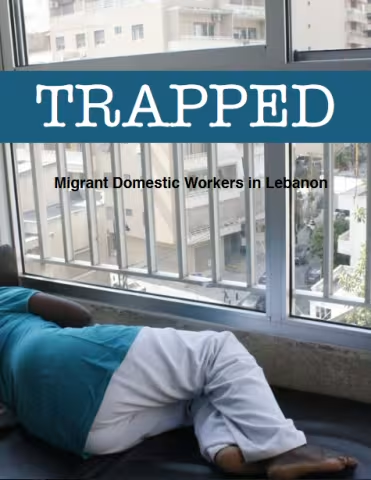
Over 250,000 migrant women are employed by private households in Lebanon to carry out household tasks such as cleaning, cooking, and caring for children and the elderly.
This working paper seeks to document and analyse collaboration mechanisms between local authorities and humanitarian actors in addressing the Syrian refugee crisis in urban and peri-urban settings in Lebanon.
Since the Syrian conflict began in 2011, 11 million people have been internally displaced or have fled to neighboring states. This has put an incredible strain on the hosting societies, particularly in Lebanon,Jordan, Iraq and Turkey.
The right to freedom of movement forms one of the cornerstones of the international human rights regime and the Lebanese legal system. It is a right that everyone ought to enjoy regardless of race, national origin, residence status, religion or any other criteria.
This paper is inspired by examples of domestic workers organizing themselves in different parts of the world through social and solidarity economy enterprises and organizations which have become more evident since the advent of the ILO Domestic Workers Convention 2011, (No.189
This study aims to shed light on the industry that profits from the recruitment of women from South Asian countries into domestic work employment in the Middle East, with a particular focus on Bangladesh, Jordan and Lebanon.
The private sector has long been a major contributor to humanitarian action. At the community level, businesses frequently use their materials and resources to aid people affected by crises. As local markets recover and supply chains are repaired, crisis-affected people are once again able to access basic goods and, in some cases, resume livelihoods. Large national, regional and multinational firms are also closely involved in supporting humanitarian objectives, whether indirectly, by resuming operations in crisis affected areas, or directly, by providing cash and in kind donations of goods or...
The humanitarian aid system is growing and expanding, and so surely its capacity to meet these challenges should also be growing.
Yet despite the enormous resources, in the more complex, less high-profile and difficult contexts, MSF teams in the field have seen that humanitarian responses to displacement emergencies have not occurred in a timely and effective way. This is especially the case in conflict areas.
These observations have prompted MSF to conduct this review, to better understand how the humanitarian system is responding to acute displacement emergencies. The review is based on...
In most Arab countries, family matters including Domestic Violence continue to be handled by religious courts as civil legislation does not criminalise acts of violence within the family.